Showing posts with label Feels good. Show all posts

31 Dec 2013

Building stone walls and paving

There is for me something deeply satisfying in the work involved in building stone walls, stone paths and paved areas. Such work, which can be physically demanding on account of the weight and abrasive nature of the items as well as the repetition of tasks, combines the physical and the useful with the aesthetic, like indeed many forms of craftsmanship. I have, in the past, practiced the trade of carpenter/cabinet-maker and I would say the same of that too. I don't think of the end products of either of these crafts as works of art. They are made by hands and tools and the human mind, but, above all, they are functional. Art is, by definition, useless, and so is perhaps essential in other ways.


The photographs in this article show some of the stone work I currently have in progress in Gascony. All of it uses local materials, much found, some purchased. Very little mortar (lime and sand, with an occasional dab of white cement) has beeen used, except for some of the bottom and top layers, and the angle stones. As the walls have been back-filled with rubble and small stones for extra drainage, and then with earth, this dry stone technique should enable surplus water to find its way out without creating undue pressure. At least that is what I hope! 


work in progress: the second layer terrace is under way in this photo, but is now more or less finished, as below, taken from the mid-level and with plantings in progress


the second-level terrace, now finished apart from the topping stones, still to be cut and laid.

I cannot pretend to be an expert in building rough stone walls, and I make many mistakes for sure, but I do apply myself when I work at this and try to do a good job. So far, the ones I have built seem to be holding up alright, but time will tell I suppose. We are definitely not in the pyramid league here! This project revolves around a two layer stone terrace with a mostly stone (I will be replacing the non-stone parts with stone steps) stairway leading up 17 steps and linking the top level to the bottom via an intermediary terrace which I have also paved. Since these pictures were taken, I have started to extend the bottom layer to the left of the staircase. The system will be similar on each side, with some changes in levels to adapt to the ground.


As well as some of the steps (temporary), the pathway that leads from the house to this staircase is made of river-bed pebbles that come from the Garonne river, nearby (see first photograph below), which are also used, alternately with irregular off-cut slabs salvaged from a local stone-cutter's yard, to pave the middle terrace part (bottom two photographs below).


Plantings are under way on the top terrace, and also in beds set into the middle level. At the bottom level lies a wide, sloping and grassed field with a lake at the bottom of it, about 100 metres from the bottom wall and, in between, some fruit trees that I have planted and which will probably be increasing in numbers.

This article also shows, below, some photographs of stone paving in other places that I have seen and thought to photograph. These will probably provide inspiration for future work.


Stone floor paving inside a chateau currently being restored: Château de Fargues, in Sauternes, near Bordeaux. An example of how to do it!


pebble stone paving in Granada, Spain


At the end of last-summer's work sessions, I cremated my favourite espadrilles which had been worn out by so much unsuitably hard effort. At other times I try to wear more suitable footgear for this work. 


14 Jan 2013

Make love not war, and eat together: Bonobos show the way

Bonobo monkeys, or pan paniscus to give them the species its latin name, share with their larger cousins, the common chimpanzee, a considerable majority of their genes with us humans. In fact these two species are our closest remaining relatives on this planet. The behaviour patterns of the bonobo in its natural environment in the Congo basin have several interesting aspects, the best known of which being their almost constant fornication with almost any partner available. And, as a probable result, far lower levels of agressivity than the larger common chimpanzee, and an apparent absence of jealousy since partners, for both sexes, are multiple. It is clearly a case of "make love not war" with the bonobo. It is also said that bonobos tend to be matriarchal in their organisation and that the females use sexuality to control males. Humans do this too, in some cases!


But this rampant albeit rapid sexuality is not the only endearing aspect of the bonobos' behaviour. They are also capable of concern for each other, apart from those seen as potential sexual partners, and also prefer to share food rather than eat alone. The experiment conducted below shows this latter, perhaps more surprising aspect of their social conduct. Hitherto, many thought that only humans had this preference for sharing their food with others, even unknown strangers, to eating alone.


29 Nov 2012

Go to Lubljana!

I recently spent a couple of days in the capital of Slovenia, Lubljana, whilst attending a wine fair there (about which I will have more to say in another article). First visits to a country or city are often, but not always, the most impressive, as one is, literally, at one's most impressionable, acting like a sponge to all that is new, strange and beautiful around one. All that it ugly too, for that matter. As I said, a sponge...

This article will take the form of a commented snapshot album of small (or larger) things seen. I did not systematically take photographs of everything I enjoyed here, as there was so much and I really prefer just soaking it it, at least the first time around. Suffice it to say that I loved this old city, at least the central part, blissfully car-free and which I visited extensively by foot. I would highly recommend a stay in Lubljana to anyone. The people are very friendly and helpful, the hotels good and reasonably priced, the food and the wines too....what more could you want? I even found an Irish bar that shows rugby games and has 83 beers on offer! A slice of paradise, I tell you!


The dragon is the emblem of Lubljana. This is one of the many turn-of-the-20th century sculptures to be found in Lubljana, and it is one of four of these beasties that guard one of the bridges that span the Ljubljanica River. The bridge is called, not too surprisingly, the Dragon Bridge, and it leads to the splendid market were you can see scenes like the two below, buy great fresh goods, or eat and drink in surrounding cafés. It was designed by the Croatian architect Jurij Zainovich (the bridge I mean).


Lubljana, at least the old town, seemed to me to be happily low profile and discreet, and most of the streets are gloriously free of those dreadfully ubiquitous "big brand" shops (mostly cloths) that totally pollute almost all of the world's cities these days, making you wonder just where you are at times. On the contrary, the streets I walked were full of shops selling odd antiques, books, locally made stuff of all kinds, good food, and cafés and restaurants of all descriptions (and I didn't see a single Chinese restaurant!). Add to this the fact that it's architecture is quite fascinating, occasionally off-key with great colours on some of the facades, and full of sometimes quirky details and a true sense of craftsmanship. I found some similarities in feel to Prague, with perhaps a more "southern" touch.


The lamp post above, like several others and the famous triple bridge (see first photo below), was designed by the local architect Joz Plecnik. As you can see, Lubljana also looks great at night, with some very subtle lighting making the buildings look sharp and intricate, yet very different one from another. 


Presumably some of the strange objects that I saw in the street were due to the pre-Christmas decorations, like this giant teepee-like construction (above) that went the height of a two-story house and stood on the fork between three streets near my hotel. And decorations of various descriptions seem to be into hanging objects, like this collection of shoes supended between two buildings.


Or this one...


There are many more padlocks on either side of this bridge, left apparently by lovers who have sealed a pact, presumably throwing away the key to their hearts into the river below (youth is so rash...but then are they all youths?).

There is also evidence in the streets of contemporary art and contemprary philosophy colluding. What is the world coming to?


And if you want a reasonably priced hotel recommendation for Lubljana, here it is. 

http://www.adorahotel.si/

My room was very comfortable, practically designed, simple, light, impeccably clean and inexpensive. And the staff were particularly helpful and friendly. What more could you want?

Get going!


4 Nov 2012

Simple pleasures in food

I enjoy food, and by that I mean good quality food, made with decent ingredients which are well-prepared. And not too much of it at one time. But, despite the fact that my work is concerned with the workings of taste and particularly its applications to wine, I am definitely not what is known as a "foodie", that is to say someone totally obsessed with whatever goes into his mouth. I don't care a lot for fancy restaurants, for example. I prefer to eat in places that make me feel at ease. They must serve decent food for sure, but the atmosphere of these places, and the friendliness of the service is at least as important than what is in my plate. I happen to know a few famous chefs and appreciate very much, on occasion, eating their cuisine. But I would never make a thing of going to such places regularly, even if I had the means to do so. For instance, I simply cannot imagine booking ahead seats in a fashionable restaurant. If they can't take me when I show up or call that same morning (rare event) then I will just go someplace else or stay at home. So you can be sure that you will never find me standing in a queue (real or virtual) for any restaurant, unless of course I am truly starving. The rest is pure snobbery.


oeuf à la coque on the floor of my kitchen in Gascony


When one feels the need to get back to basics, like when strong feelings flow around you, during seasonal changes, when life is hard, intense, stressful, beautiful or otherwise powerful, the simplest foods are often the best. This morning, for me, it was a boiled egg.

Living in France and spending more than half my time speaking the French language, I am often struck by differences in the senses behind expressions or words that describe the same object, event or process between English and French. I have occasionally, on this blog, underlined the impoverishement of sense that prevails in the translations of film or book titles from English to French. But, in this instance, the impoverishement would seem to run in the other linguistic direction. The French term for "boiled egg" is "oeuf à la coque". This means "egg in its shell", and I like this far better than "boiled egg". Not sure why, but I do. The very definition provided in the inevitably useful Wikipedia is quite enough to put one off the English version, far too basic and flavourless in its expression.

"Boiled eggs are eggs (typically chicken eggs) cooked by immersion in boiling water with their shells unbroken. 
(Eggs cooked in water without their shells are known as poached eggs, while eggs cooked below the boiling temperature, either with or without the shell, are known as coddled eggs.) Hard-boiled eggs are either boiled long enough for the egg white and then theegg yolk to solidify, or they are left in hot water to cool down, which will gradually solidify them, while a soft-boiled egg yolk, and sometimes even the white, remains at least partially liquid."


 the same egg on the table, to show that we can be sophisticated down in the country!

There is something quintessential, amost primitive, about the egg in its shell. It doesn't matter whether it comes from the chicken or another bird. Just the size (and the flavour, to some extent) varies. The shape is strong yet refined with its variable taper on each end. I have heard that the strength of an egg-shell lies way beyond it thickness, signifying perfect design and strength/weight ratio.

A friend once told me that French table protocole stipulated that there were 7 forbidden practices to be avoided at all costs in refined society, when confronted with an "oeuf à la coque".

1). Do not place the egg sharp side down in the egg cup.
2). Never cut off the top of an oeuf à la coque with a knife. One can bash it with a spoon or cut it off with a spoon.
3). Never use a silver spoon to eat one (for the very good reason of undesirable chemical reactions affecting flavour).
4). Do not dip slices of bread or toast into the egg once opened.

This is the point at which I part company with these rules of good behaviour, so I will spare you the others, especially as I cannot remember them anyway! As you will notice from my photographs, I was not about to not obey rule 4 anyway. On the contrary, dipping a slice of fresh and firm bread (or toast) with its crunchy crust into a soft-boiled egg is one of the morning's great pleasures. Eminently sensual, of course. Rules 1, 2 and 3 are just plain common sense. 


10 Oct 2012

Bags for travel

I seem to about the only person travelling these days who actually carries their bags, rather then wheeling them around like trolleys. Am I plain stupid or am I the only one still to have arms? I know that airport corridors are getting longer and longer these days, but is it really necessary for small carry-on bags to be kitted out with wheels like they were the back end of a semi-trailor?

Anyway, this little bit of a rant in the way of an introduction was actually kicked off by a charming young lady from Bulgaria who gazed in admiration at my bag while we were standing one behind another in an airport check-in line recently. She said how much she liked it, and then mentioned some major international baggage brand (can't remember which one) and I said no, this bag is made by a craftsman called Alan Mackenzie who works out of the Isle of Arran in Scotland (I actually shun major brands for their banalisation of everything they touch, added to severe overpricing to cover their advertising expenditure).

This is not some form of reverse snobbery on my part. The bags (I have a large one and a small one) were a gift from my mother, who is a good supporter of fine craftsmen, and I use them a lot since they are practical, strong and simple. They are of the Gladstone bag type, being made of canvas with leather reiniforcements in all the right places. They have lasted very well, apart from the linings which tend to tear away from the main body.

Here is a picture of the two of them, taken, at my feet, in another airport queue recently:


The small one is known as an "overnight" size, and the big one a "weekend" size. I guess it depends how light you travel. I use the small one for a weekend and the big one for a week's journey, unless I have to carry a camera and a portable computer as well as personal stuff. They are nice and flexible too and are really easy to spot on any baggage delivery system (the big one I tend to check in as I hate people cluttering up planes with huge suitcases) since nobody has anything resembling them. But just don't expect them to come with any wheels. They will save your arms a session at the gym instead! You may get a shoulder strap which can be unbuckled when needed, as on my smaller on the right. I lost the other strap.

If you want more information on these bags, here is an official picture and a link to Mackenzie's web site. They make them in leather also, but I go for these, and they are cheaper as well.


http://www.mackenzieleather.co.uk/gladstones/canvasgladstone.htm

7 Oct 2012

The joys of flying

I really like looking at the ground from the air. At the time you may read this (if you read it on October 7th), I will be in the air again, moving west over the Atlantic from Paris to New York and then on to Philadelphia do do a job. These pictures were taken on another flight, earlier this summer, in Europe. They were taken with my telephone and are nothing special but I find the shapes, colours and textures, as well as the gradually shifting distances as one takes off or approaches landing, very interesting and plan to do a series of paintings using them some time in the not-too-distant future. I guess they will need to be quite big paintings. We live and we hope...


And then we're on the ground....


28 Jun 2012

My 15th bike is a KTM Duke 690

Ok, so I've been going on about this for a while, but I have now finally sold my former, fully-repaired and now in very good condition Ducati Multistrada 1000s, and have bought the latest KTM Duke 690, about which I spoke a while ago here .


This latest version of the KTM Duke purports to be the most powerful road-going single-cylinder bike ever produced.They have also civilized the thing a bit, which is fine with me as I am not a stuntman.

Now a single cylinder machine obviously has its limits, one of which has to be high-speed cruising, so I anticipate using it mainly on small roads, which is fine by me as I am not a great fan of riding on motorways: it's just too boring. I am going to Lyon tomorrow to collect it and ride it back to Paris and I am very excited about it! The twisties in the Beaujolais/Burgundy area should be just right for running it in properly. A new bike is always quite an event, and you just don't get tired of such things. It feels like, well, some other very good events. Maybe I would get blasé if I was rich and could buy all kinds of bikes. But I am not, so the event stands out for me.

I suppose this slight tension and excitement has something to do with the fact that I bought the machine over a month ago and have been waiting ever since to find the time from a current heavy load of work to make the 2 hour train journey and probably most of a day's ride back (the machine is running in, remember, and there are suitable stops to be made at the odd winery on the way back).

I like the idea (and the feel, when I tried the bike a few months ago) of lightness on a bike. This is getting harder and harder to find with the growing size and sophistication of modern motorbikes. Now this thing weighs about 150 kilograms dry and maybe 165 wet. And it has 70 bhp down below. Should make for a lot of fun.

Watch this space shortly for a first test report.....

31 Jan 2012

Bach with gym

What do you do while in the gym? That is apart for the more or less strenuous efforts you are making to try and keep your body in shape. I mean gym is really boring, isn't it? And who wants to listen to the mindless pseudo disco crap that some places pump at you whether you want it or not?

So I go the the gym most days with a set of headphones and an i-pod and listen to radio  programmes or, mostly, to music. These are moments in the week when I can catch up with these pleasures, and doing so while pulling on ropes, pulleys, bars and weights makes me feel that I am using that time even better.

There are days when it is jazz, others when it is blues, others when I need a shot of rock to get me moving, days when I need the sound of a female voice, and so on. I had not, until recently tried classical music very much. But, the other day, I happened to press the button on a Glenn Gould recording of Bach's Toccatas and the English Suite number 4. And I now think I have found the perfect match for gym!

There is something about Bach's solo intrumental music, and its variations around themes, which makes it just right for the repetitious movements that one does on those machines in the gym. There is a relentlessness, a to and fro, a light and dark, a circling around the core of the effort that just makes it work. And the music is also incredibly solitary, just like you there trying to force your body to do stuff that it doesn't really want to, but somehow finding joy in the release once it gets into the stride. The effort of getting into Bach is very similar. The music, as played on the piano by Gould, is at first austere, then  it gradually opens up infinite horizons and feelings. The same goes for your gym sessions, I am sure. Repetition is all, but every detail makes a difference.

If you cannot stand gym, try it with some Bach. if you cannot stand Bach (hard to believe but possible), try him with some gym. If that doesn't work, try something else. Meanwhile here is a gift...


1 Jan 2012

Happy New Year to all

I'm not a great fan of fixed-date celebrations, but it does seem like a good moment to wish all of you readers, and especially the brave and happy few who have dared to become members of this blog, a very happy year in 2012.

I started this activity late in October 2010 and, since then, over 185,000 pages of this blog have been visited. I had no idea, when starting, that it would lead to this, or indeed what I was doing. Still not too sure on the latter score! 

I think I made the right decision to entitle the blog "More than just wine", seeing as how not a single wine topic has made it into the top 10 of the most visited pages! In this hit parade, a couple of articles on cricket come first (thank you India!), followed by articles on painting, travel, motorcycles, music and people. And, thanks to cricket, the country that has chalked up the greatest number of visits is India, ahead of the USA, the UK, France, Canada, Germany, Australia, Italy, Spain and the Netherlands.

I have not done a New Year card this year but here is the one from the rugby team (Stade Français Paris) whose varied fortunes I follow and sometimes relate. No, they're not very conventional, which is why I like them.


I'm off into another wine area (The Rhône Valley) for a week's work of tasting wines and talking to wine producers, so I may not have time to post much over the next few days. I will leave you an article in waiting perhaps.

Take care, drink well and selectively, and enjoy everything that is enjoyable

18 Oct 2011

Happy birthday blog

I am not a great one for birthdays myself, and anyway this blog was actually started on October 6th 2010, but I forgot to do this article then as I was too busy.
In just over a year's existence, I have posted 235 articles and 150,000 pages have been visited. How much has been read, I cannot tell. Neither can I tell how many people have just taken a quick look or stayed for a longer while, or been encouraged to return and/or read other things than whatever first attracted their curiosity.
The highest number of visitors so far has been from India (thanks to cricket), followed by the USA, France and the UK. People from many other countries also regularly visit.
For all these visitors, very few leave comments and only 25 of you have become members so far. Maybe I should think about this, but then again, I am doing this blog for fun, so maybe it is not so important.
If one looks at the most popular posts, below is the hit parade, with cricket (in connection with India) clearly leading the field for the moment. After that there is a good diversity of themes involved: painting, travel, bikes, music etc. As no single article about wine appears in the top 20 most popular subjects, I have to conclude that my title for this blog, More then just wine, is a suitable one!
14 avr. 2011, 2 commentaires
40 275 Pages seen
4 avr. 2011, 4 commentaires   
12 406 Pages vues
7 janv. 2011, 2 commentaires
5 795 Pages vues
4 déc. 2010                             
3 865 Pages vues
11 janv. 2011, 7 commentaires
3 754 Pages vues
6 avr. 2011, 2 commentaires    
3 441 Pages vues
12 juil. 2011, 7 commentaires  
3 366 Pages vues
22 juil. 2011, 2 commentaires   
2 711 Pages vues
12 févr. 2011, 8 commentaires  
1 977 Pages vues
16 févr. 2011, 7 commentaires
1 888 Pages

17 Sept 2011

Building stone walls

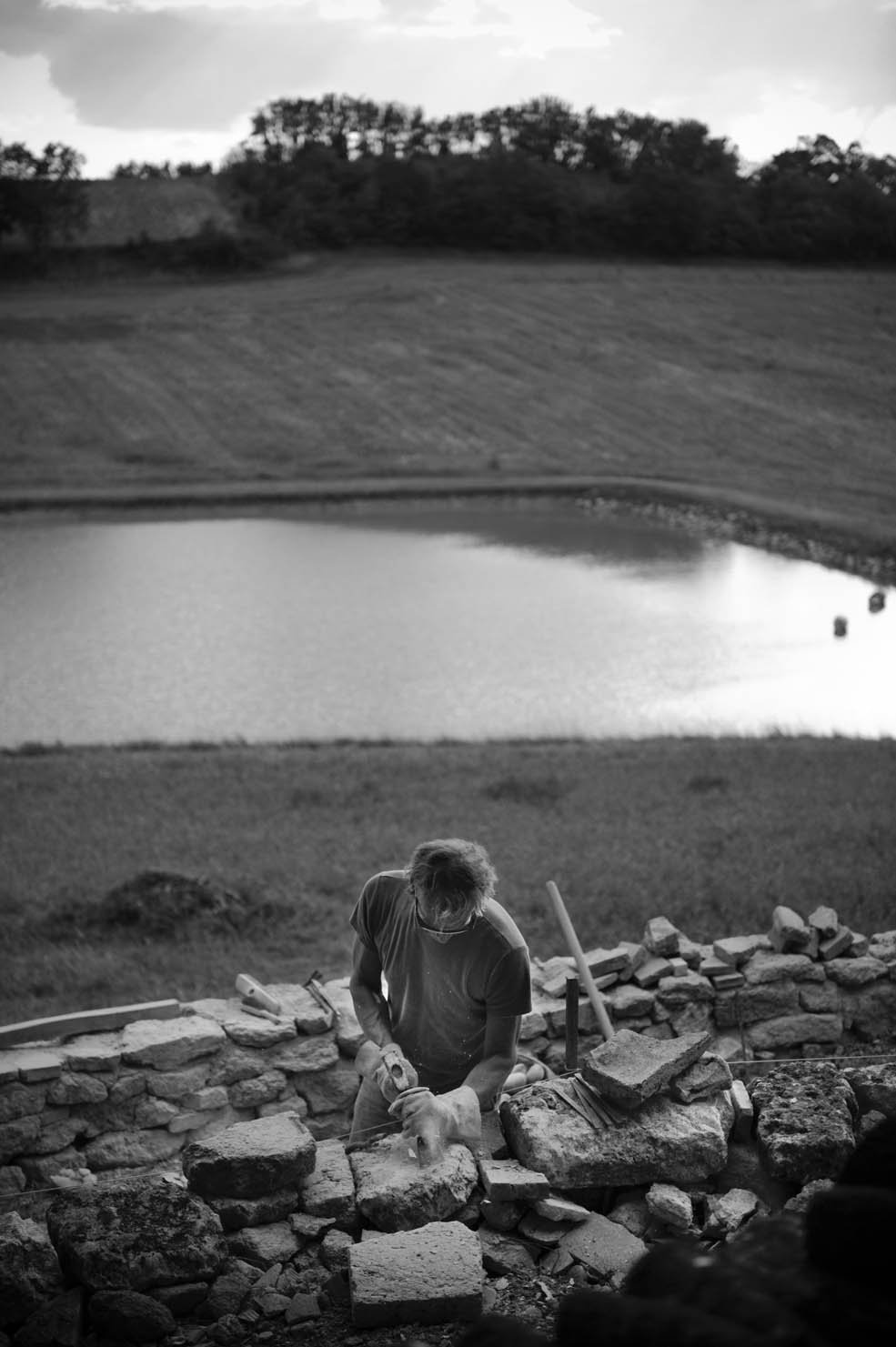
Building stone walls is an age-old practice. Until the use of concrete took over, stone cutting and building was so important to all forms of construction in France that the trade which had the largest number of workers was that of stone-masonry. Building stone walls happens to be one of my activities during the summer holidays. I do other building work of course, but this endeavour, largely considered by members of my family as futile, since these are outside walls which serve no obviously useful purpose apart from creating prospects of their being able, in a year or two, to sit on the terraces thereby created and watch the sun go down, is perhaps my favourite of all, along with woodwork. This article includes some pictures that attempt to show a current job in progress. The best of them (the one below and the black and white shot) were taken by a friend of mine, Christophe Goussard, who is a professional photographer (www.goussard.net).


One of the main difficulties in stone-wall building can be finding the raw material. Stones vary enourmously on their colour, texture and density, but they are always bulky and heavy. Transport is therefore usually the major cost involved and so you need to find them as close as possible to where you are building, and then find a way of carrying them. I use trailors behind cars, tractors or trucks, when I can borrow the latter two. It is best to have one that tips it's load, otherwise you almost double the work involved. In an ideal situation you would have machines to load and unload, but I don't. It is also important to unload the pile as close as possible to where you are going to be building, without that pile getting in the way. In other words, a bit of planning will make the job easier.


So far I have not had to buy any stone. There was some on the site to start with, and I have transported three other loads of about 5 tons each so far in order to build the two levels of the current project, which is not yet completed. So thanks also to generous donors who had some surplus. You need a hell of a lot of the stuff, and it should have variable sizes. Big ones that you need to have help to move (I also use a makeshift tripod and chain-hoist, as well as crowbars and planks) since they can weigh up to 200 kilos and maybe more, medium sized ones of between 20 and 50 kilos, and lots of smaller stuff to block and fill the nooks and crannies and create some variation. They should all have at least one face that is fairly flat, and a base that will lie reasonably well on the layer below. You can of course cut and chip them into shape with an electric stone cutter, or hammer and stone chisel. I use both (see top picture for handwork in process) and you need to do quite a bit of this to get good seating for each stone, especially if you are not using any mortar.


On this project, where the walls are essentially in-filled at the back with rubble and earth, I have dry-built everything, with the exception of the angles and the capping layer. In other words little or no mortar is used. In this case I have taken care to have large and long stones at the base when starting, and also to put in a longer stone every so often to help anchor things. The in-fill also contains a lot of small, stone, broken tiles etcetera immediately behind the wall, as well as the odd drainage pipe, to ensure that water-logged earth will not build up too much pressure in the future.


The house and its out-buildings are built into a slope, so the walls will create terraces that will later be partly paved and partly planted. This is why in the above shot you cannot see the uppper wall, set back from the lower level and less high. A staircase is under construction (see below), leading up through the walls to the house, alongside the barn that serves as a wood-shelter for the moment. I build it as the walls move along and up, thereby creating filling material to go behind the walls and create the terraces. The bottom wall, which is about 6 ft high, has a concrete foundation, whereas the smaller and lighter upper terrace wall (that is the one I am working on in the first picture), and which is about half as high, is built directly onto the compacted earth.


As you can see from the picture to the right, finding some good corner stones enabled me to build the entrance to the stairway. The wall section to the right of the stairway is finshed, whereas the part to the left will be continued on for a further 10 yards or so.

Below the walls and at the bottom of the slope is an artificial lake. Good for reflecting sunsets and to give birds and deer a drink. I hope to finish this project next summer. Wish I could work on it full-time, but I guess the break will give my hands time to heal!