Showing posts with label wine vin and vino. Show all posts

5 Dec 2013

Dominio IV, an exemplary small Oregon winery

During the summer of 2012 I was spending a couple of weeks on holiday along the north-western coastal and forest areas of the USA. I had more or less resolved not to visit any wineries, and therefore that I would probably not be talking much about the wines of Northern California and Oregon on this blog, although I did relate some of my travel experiences. And I pretty much kept to this resolve, at least until now, some 15 months later. In a general sense these things just creep up on you and move you to investigate something and get back into what is, after all, as much a passion as it is a job for me. Then, sometimes also, they linger in your mind for quite a while until you finally decide to do something about what you have experienced. Like a dream that you cannot quite decypher the next day but which hangs around in your head like late morning mist in a valley. So here it is...


Sculpture of a horse (life-size), made of driftwood and seen in the Portland Art Museum. It is made with driftwood. I forget to note the artist's name. When travelling up the western coast, I noticed how much driftwood littered most of the beaches and wondered what I could do with it. Now I have some ideas!


I had not visited Oregon before, so was naturally curious at some point to try a few local wines. Production of wine in this state (which is surprisingly only the 4th largest producer amongst the states of the USofA) began quite recently, in the late 1960's or early 1970's. Since then the learning curve has been pretty steep, at least if the winery that I visited during my trip is anything to go by. Some of the wines that I tried during this 2 week journey, by the glass, in restaurants and wine bars here, were indifferent, but the majority were good to very good, and one, tasted one evening, just sung out to me. I was staying in the small town of McMinnville, south of Portland, and which seems to have the making of being the wine capital of the Willamette Valley. This long valley, bordered by hills, is Oregon's principal wine region and is home to the majority of plantings of its star grape variety, Pinot Noir. 


The Oregon Hotel is the old hotel (they say "historic" locally, but then, in the western US, anything over 50 years old is considered to be historical) of this town and is part of the impressive empire of the McMenamin brothers, who are brewers, wine producers, hoteliers and restaurateurs, their empire spreading through the states of Oregon and Washington. Their hotels are fun, volontarily off-beat, and full of mainly 1970's musical nostalgia and loads of historical references to the past lives of their buildings that have been quite creatively restored. But their restaurants make the bad mistake of serving only their beers, which are good enough, and only (at least by the glass) their own wines, which are quite underwhelming. So we ate out that night, and luckily so! There was not a lot of choice in McMinnville, so I was happy to find a decent selection of wines (of Italian and Oregon origin) by the glass in Nick's Italian Café, right by the hotel. Michael, the helpful and knowledgeable wine waiter there, poured me three Oregon Pinot Noirs, and the second one just hit the spot for me. It was soft at first, then firming up on the palate, with lovely fruit and balance. It had that velvety texture of the finest Pinots and tasted better at each sip. I loved it from the start and it kept growing on me as I gradually emptied the glass, checking it against the other two which were very decent wines. The producer was intriguingly called Dominio IV and this particular Pinot, one of a range, was poetically named "Rain on Leaves". As I was later to discover, the wine-maker and co-owner, Patrick Reuter, is also a poet. It was from the 2007 vintage, which, according to waiter, sorted out the men from the boys in terms of local wine production. So I asked about this producer and it turned out that the winery was in town and I was able, then and there, to make an appointement to meet Reuter next morning, to talk with him and taste some more wines.
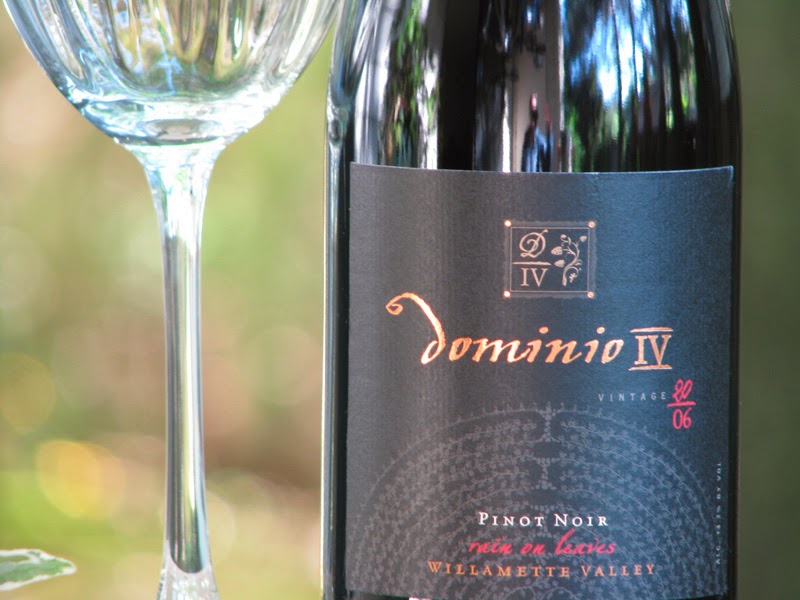


Reuter, with 3 partners, started his operation some 10 years previously. He had studied with his wife, a viticulturist, at Davies. They have travelled the wine world quite widely, including a harvest stint with the late Denis Mortet and another with Armand Rousseau in Burgundy's Côte de Nuits. Hard to find better pinot credentials, if you are looking for that sort of thing! 

Like viticulture, the word Dominio comes from way back in the past. The Spanish use the word to mean land or territory or dominion, whereas the Romans have a secondary meaning of a feast or banquet. Thus the word takes on a sense of being a feast from the land. Dom is also of the sun as in Domingo (Sunday). The number four represents four people, four seasons, four varieties of the grape and four quadrants of the Dominio symbol, the labyrinth. Four is also the number of the earth (for whom I am unsure). Ok, so perhaps we are getting a little esoteric here, and, as regular readers may be aware, I am not particularly into mumbo-jumbo (1). What is in a name after all? Well maybe quite a lot, especially when you learn that Patrick Reuter also writes poetry.


Patrick Reuter outside his winery in McMinnville

The short story of my visit to the Dominio IV facities, which are installed in a converted industrial barn in the suburbs of this small town, is that I found the wines quite fantastic and Patrick Reuter delightful, open, relaxed and coherent in his approach. Most of their small production is produced from purchased grapes, essentially pinot noirs from single plots and with the clone identified on the labels. But I also tasted one of the best viogniers I have ever had from outside the Rhône Valley. It just sung with freshness and intense fruit flavours and the grapes hailed from vines higher up into the mountains that separate Oregon from California. I don't know whether they ripen there every year, but this one was fantastic. Dominio IV also own their own vineyard in the north-eastern, much hotter part of the state that lies close to the border with Washington, along the Columbia River east of Portland. Here they grow Syrah and Tempranillo and the wines I tasted were intensely good. They are into biodynamics, for those interested in esoteric practices, but Patrick seemed very down to earth and did not bore me with any planetary visions. Reuter is clearly pragmatic and keeps his base wines for a future sparkling cuvée, called Flora, in recycled Coca-Cola aluminium drums (see below).


yes, wine and Coca Cola can mix, under certain circumstances!

I highly recommended the wines of Dominio IV to anyone who is in Oregon, and they are well worth looking for anyone elsewhere in the USA. If any ever find their way into France I will be a customer for sure.

For more information, take a look at their website:
http://www.dominiowines.com

Drink well....
(photos by David Cobbold except for the one of the label)

(1).footnote (thanks to Wikipedia): Mumbo jumbo, or mumbo-jumbo, is an English phrase or expression that denotes a confusing or meaningless subject. It is often used as humorous expression of criticism of middle-management and civil service non-speak, and of belief in practices based on superstition, rituals intending to cause confusion or languages that the speaker does not understand. The phrase probably originated from the Mandingo name Maamajomboo, a masked dancer that took part in religious ceremonies.Mungo Park's travel journal, Travels in the Interior of Africa (1795) describes 'Mumbo Jumbo' as a character, complete with "masquerade habit", that Mandinka males would dress up in order to resolve domestic disputes. In the 18th century mumbo jumbo referred to a West African god.

14 Oct 2013

What makes a wine "great"? Barolo Rocche della Annunziata 1999, from Paolo Scavino


The often used (and much abused) term "great wine" usually makes me hesitate and have doubts. Doubts about what is meant by such a laudatory term, doubts about who is using the expression and why, and doubts about whether it has any real signification. Of course, in the end, it all comes down to one's own perception of a wine and the ensuing emotions which may or may not have quite a lot to do with one's immediate surroundings and the company with which one is sharing the wine so qualified.


I recently tasted a wine that I can only describe as being "great", and so I feel that I should start by qualify the circumstances and describe my personal connection with this bottle to give the full context which inevitably influenced, to some extent, my judgment when I tasted the wine. Yet there is a form of self-evidence about the impact of flavours and all the other physiological interactions that seem to surpass the complex issue of context. When a wine gives you an impression of beauty, harmony, balance and intense flavour sensations, you are simply stunned, and then moved by its impact. This is what happened to me just over a month ago when opening and sampling a bottle prior to serving it to my guests and dinner companions at home. And the initial impression was reinforced by drinking the wine at table.

We had three friends to dinner, one of them Italian and two of whom live in Rome. We had already consumed a very stylish Champagne blanc de blanc from Pierre Monsuit and a solidly earthy and very full-bodied Spanish Catalonian wine from the Emporda region near the French border, called Terra Remota, Clos Adrien. This went fine with a chicken tagine but the bottle was now empty and I was racking my brain to see what I could serve to follow it, given its intensity. I enjoy improvising like this, trying to make the wine fit the circumstances, the people and the moment just as much as the food. I suddenly remembered a bottle that had been lying in my cellar for about 10 years and that had been given to me by a producer from the Piemonte region of Northern Italy with strict instruction to be patient before opening it. The moment seemed just right.

Here is the bottle, which had never been graced with its rightful label (as shown above) as it was given to me by the producer having been recently bottled at the time.


As the picture shows, this bottle just carried two tiny stickers on which I could barely read the following words or abbreviations: "Rocche Annon..." and "Paolo Scavino". The cork, as shown below, revealed a little more, including the vintage.


I can well remember visiting this estate and their tasting room during some research on the twin neighbouring appellations of Barolo and Barbaresco. It must have been back in about 2003. At the end of my tasting of the Scavino range, one of Enrico Scavino's daughters (I think it was Elisa) gave me this bottle saying that she hoped that I wouldn't be in a hurry to open it as it came from their best vineyard in Barolo and was far too young to be drunk. I have been resisting the temptation ever since, but the time had now come!

The colour was still remarkably youthful, in tones of deep reddish purple, hardly affected by 14 years of time and very bright. The nose was totally enticing as I poured the wine into a decanter having checked it first for any foul play. I served it to the guests without saying anything, just to see the spontaneous reactions on their faces, as none were wine professionals and I often find this sort of test very revealing. I could see that they liked it a lot as the conversation dried up for a while. When I revealed its identity, the Italian lady said how pleased she was that I has shown something so beautiful from her country at a time when things were so difficult in Italy.

I found the wine totally harmonious, amazingly still full of youthful fruit flavours, precise and yet smooth and velvet-like to the touch. It was mouth-filling but in no way overbearing, or even very powerful. It had plenty of intensity, but was totally refined. It just hit that perfect point of balance between immediate sensual pleasure and a deeper line of complexity that sent echoes down my spine and all through my brain. Mind and body were fused together. When I think that there are some puritanical lunatics (here in France for example) who would like to see wine banned as part of an absurdly amalgamated and stigmatized mass of "alcoholic beverages"!

Yes, there are some wines which, when tasted at the right moment and in the right circumstances, qualify for the term "great". They have that indescribable capacity to totally satisfy mind and body and produce a special quality of emotion. Such wines can bring tears to my eyes in the way that other aesthetic impressions received form paintings, landscapes, writing or music can also achieve. One wants such moments to last forever, but they are, by essence, fleeting.


The beauty of the wine is echoed by that of the landscape around Falletto


For those curious about this wine and its origins, I have gleaned and presented below some of the information that can be found in more detail on the family's excellent web site.


from left to right:  Signora Scavino, Elisa, Enrica and Enrico Scavino

The Paolo Scavino estate currently includes 23 hectares (almost 56 acres) of vineyards, some of which are owned and the rest rented. The family base is in the village of Castello Falletto, within the Barolo designated region of Piemonte, in North-West Italy. Similarly to the situation in Burgundy, and like many of their Piedmontese colleagues, the Scavino vineyards are divided between numerous separate plots (19 of them in fact), some having designated vineyard names, as is the case for this top-of-the range wine from the Nebbiolo grape that is the sole authorized variety in the Barolo appellation. But the Scavino vineyards also produce several other wines, from other local varieties such as Dolcetto and Barbera. The estate was founded in 1921 by Lorenzo Scavino and his son Paolo. Today it is run by Enrico and his to daughters, Enrica and Elisa. The web site, like that of so many other wine producers, makes the claim that their aim is to produce wines that have purity, complexity and elegance. The Scavinos totally fulfill that contract.


The Scavino family in the vineyard: the younger generation now in the front seat.
Rocche dell’Annunziata is the name of a vineyard site within the boundaries of the village of La Morra. It lies at an altitude of 385 metres above sea-level and faces south, south-west. The soil is of limestone with underlying sandstone. The sand blends with the lime to improve drainage. The vines were planted in 1951 and 1991 at a density of 5400 vines per hectares. Grass is grown between alternate rows, and the soil tilled in the other ones.

So how much does it cost?
As I discovered when I looked this wine up on Wine Searcher, a bottle of the same wine is now very rare as there was not much of it to begin with, but it can be found in the USA at around 175 euros a bottle, which is far more than I would pay for a bottle of wine, so many thanks to the Scavino family for this gift (which, it should be mentioned, was not valued at this price level in Italy back in 2003). But you should know that Paolo Scavino also produces a range of wines at far more accessible prices and they are all beautifully made.

So what is the true price of vinous paradise anyway?


18 Jul 2013

What can one tell of a wine from wrapping?


The packaging of all kinds of produce has been used for as long as anyone can remember to make them more attractive to potential buyers, and wine is clearly no exception. Paradoxically, people are in theory quite suspicious of appearances, whilst regularly falling for seductive trappings. Popular sayings in different languages clearly express the idea that packaging bears little or no relation to what is to be found inside. For example : « you can’t  judge a book by looking at the cover », or the French equivalent « l’habit ne fait pas le moine », meaning « you cannot tell a monk by his dress ». But packaging is clearly important and indeed useful to help distinguish one product from another and to situate it somewhere on an aesthetic or economical scale of values, even when these codes are more or less ignored or transgressed by the producer, knowingly or otherwise.


Sparkling Champagne, in particular, was an innovative and expensive type of wine to produce, back in in the 19th century when industrial bottles and machine labeling began to be part of the regular process for packaging wines. To help justify the prices asked and to project an image of luxury and wealth that satisfied the egos of consumers as well as the pockets of producers and retailers, labeling of sparkling wines from the Champagne region got very fancy, as some of the examples above clearly show. It is worth noting that the Champagne region had not yet been delimitated, and even less become an Appellation Contrôlée at this time. Interesting also to note that individual Champagne villages were then considered to be significant, and in fact more so than the term Champagne itself, which had not yet become the significant regional collective brand that was later to be developed.

I have often been struck by the fact that few of my wine journalist colleagues seem to talk much about wine labels or packaging in general. Is this because they consider the subject unworthy of attention, or does it mean that they do not like judging books by covers, with which I tend to agree anyway ? But the subject merits our attention nonetheless, and I personally enjoy many of the efforts of graphic designers and other creative artisans to make the bottles we gaze at on shelves fall into our hands. Our dominant sense is clearly the visual one, so we may as well admit it. Ask any shop manager in the wine section of a self-service outlet, and they will surely tell you that pricing and packaging play the main part in decision-making on the part of the majority of wine buyers whom, it should be underlined, are NOT regular readers of wine blogs, web sites or magazines devoted to what they simply consider (and perhaps rightly) as just another drink.


The appearance of a bottle definitely makes a statement about the producer and the product. Just take a look at any of those created by (or for) Randall Grahm in California to get the point. A couple are shown above. Naturally this kind of label is speaking to a bunch of initiates, who have some access to the words and thought process of someone as sophisticated, witty and creative as Grahm.

It can of course be argued that the best ( ?) and longest-known wines hardly need sophisticated packaging to sell themselves, since they have already found an audience who is often prepared to pay totally absurd sums of money just to possess one such bottle and for whom the label, apart from the prestige it reflects on the owner of that bottle amongst his friends or business relations, is secondary at best. But what about all those other wines, which probably constitute about 99% of the world vinous lake?


Let’s take a look at the more-or-less entry level in price terms. All kinds of ideas have been tried to make wines more accessible to a wider public, and one can but approve of these attempts. One of the latest to come on the market (although I had previously spotted this idea in use for a Provençal wine being sold in Thailand about 15 years ago) is wine in aluminium cans. These small cans (187 milliliters, or the equivalent of a quarter bottle) retail in France for 2,50 euros and have recently been launched by a company called Winestar. Don’t like the name much, but that’s not the point perhaps. I received three of the wines (as shown above) from this new company. A white, a rosé and a red. All were from the vast and usually inexpensive Languedoc region of southern France, and indeed from appellations contrôlées within that. Now I realize that the idea of wine in cans will induce a grimace on the part of many wine buffs, but I say why not? If this convenient manner of carrying and consuming induces large numbers of younger people to the joys of wine, then let’s hope the idea takes off in a big way. It is surely better for them than the sugar-infested mixed alcohol beverages that many consume at the moment.  And it may lead to a greater degree of sophistication and interest in drinks with some refinement of flavour, rather then just alcohol and sugar. One can always dream I suppose. Anyway I decided to taste these three wines from a company that claims to be the Nespresso of wine. Now that's quite a claim since the Nespresso product is of superior quality in its flavours. To be honest, I did not find this to be the case with Winestar, as you will see.  Of course, when one knows that a wine has been served from a can, the natural tendency is to think that it has a metallic flavour, and this happened to me with 2 out of the 3 samples I had. I will have to repeat the test, with other similar wines and with the wines poured into a glass by someone in another room. But, for what they is worth, here are my tasting notes.

Winestar, Corbières blanc 2011
A clean rather soft nose that shows aromas of yellow fruit. Ok on the palate, although it seems a bit firm, more chemical than fruity. Has some body to it but this doesn’t quite hide what I construed, perhaps wrongly, as a mineral and metallic texture.
Winestar, Languedoc rosé 2012
This has pleasant fruit flavours of the grenache/cinsault type.Quite precisely defined and lively on the palate, with persistence of this pleasant fruit character. I still found that it had a lightly metallic finish.
Winestar, Corbières rouge 2011
The nose is oaky and smoky – a bit too much so in fact. This is rustic in texture, and even a bit rough. It is an honest but unrefined wine of the type that one finds very often in this area, although the bad ones are getting thankfully fewer by the year. At least it didn’t seem metallic to me! Next time we’ll do this blind and see whether the metallic feel was a figment of my imagination and prejudice.


Another recent opportunity to test relationships between packaging and wines was given to me by a friend who imports wines from various countries, mostly far away, to France. He was looking at some samples of possible additions to his already extensive range and asked me, as he often does, to give my opinion on them and their value for money.

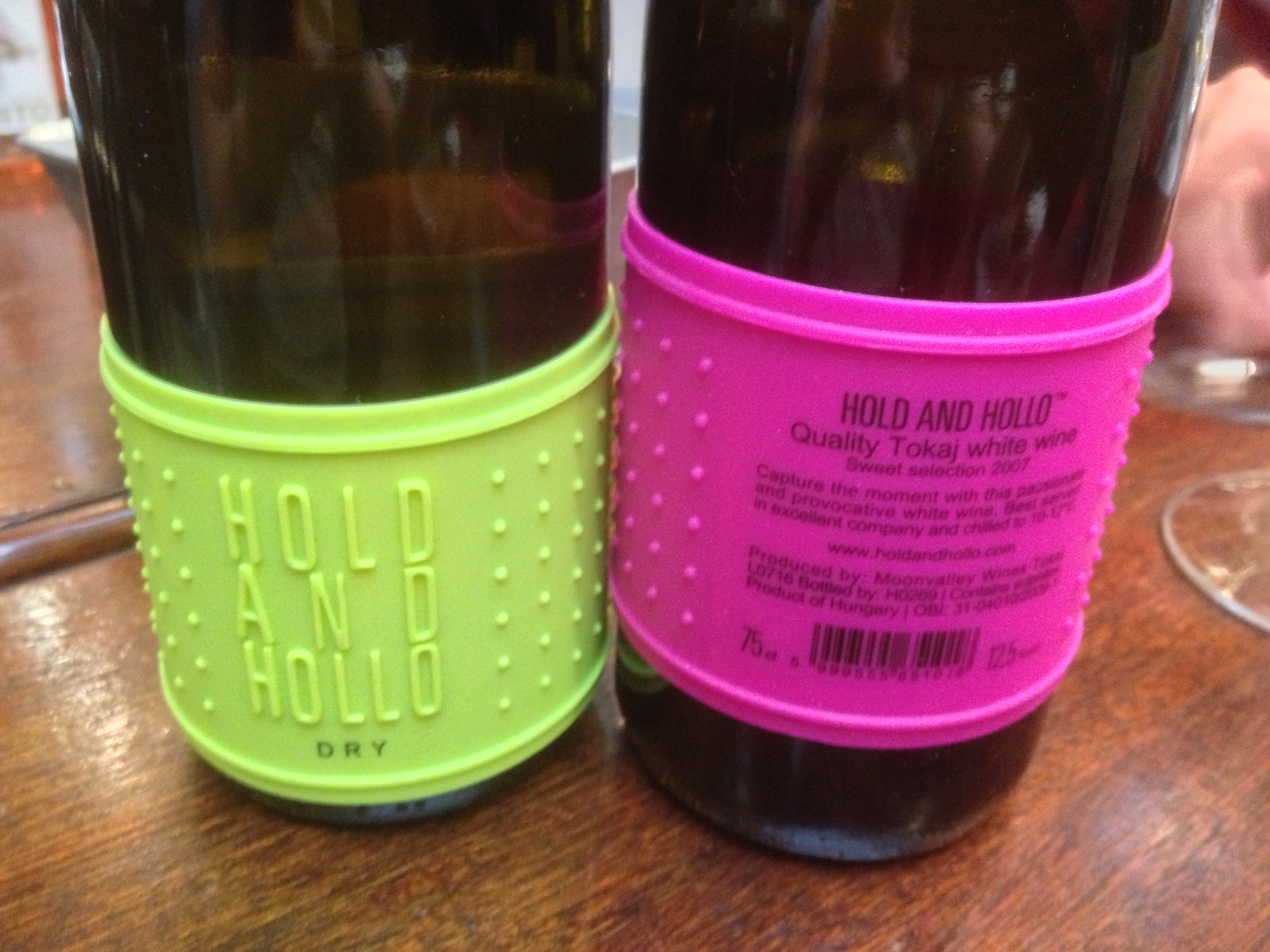
First up were this pair that hail, unexpectedly, from Hungary and the somewhat tradition-bound region of Tokay, best known for its very sweet (and often magnificent) Aszu wines. This pair comprised a dry white and a sweet white, but not an Aszu. Now Hold and Hollo is a pretty strange name for a wine brand and I’m not quite sure that I get it all. I think I grasped the « Hold » part (ha!ha!) as the pimples on the plastic wrap that doubles as a label makes it far easier to grab the bottle out of an ice bucket. But « Hollo » ? Another surprise was the price. Visual creativity is good and I have no objection to these examples, but somehow they convey to me an image of a fairly inexpensive wine, perhaps in the realm of 10 euros or even less. But in fact they would have to retail for at least double that sum. Therein lies, I think, a discrepancy between the target/image and the price. What about the wines? The dry white was excellent, vibrant, firmly structured and lingering. The sweet was a bit ordinary and lacking in zip. So, what else?


These two wines, which hail from the Yarra Valley in Victoria, Australia, seemed to me to have it all. Refinement of textures and flavours (at least the Chardonnay and the Pinot noir, pictured here), creative and easy to read labels, an arresting brand name, Innocent Bystander , and screwcaps to keep the goods in, the air out, and the wine free of unwanted contamination. To add to which, I thought that the back labels, which are too often wasted on a load of guff about brilliant « terroir » and imagined flavours, not to mention trite food pairings, were well and concisely put, saying just enough about the winemaking approach and the place of origin to intrigue one without telling the potential consumer what he or she should be tasting in their glass (see below).


I saw a photo of the winery, which seems as elegantly modern as the packaging of these wines, and which also incorporates a good restaurant. This producer seems to have worked out a fully coherent ensemble in which all the parts link well to the others and the whole is harmonious. Congratulations! 

Another example for the road, with a different story but a similar approach in which aesthetics of some boldness tell a dramatic story. I have a friend, called Raimond de Villeneuve, whose vineyard in Provence was totally devastated by a hailstorm on July 7th last year. Raimond works hard to make ends meet and has made a slot for himself due to the excellence of his wines and a good dose of creativity.  Château de Roquefort is the name of the estate and its winery is far from the latest in high-tech as Raimond is not rich. He has just managed to keep together a family estate, or what is left of it, by hard work and talent. In a few minutes last July he saw everything on the floor, the 24 hectares of vines stripped of leaves and, of course, fruit. Later, after calling a few vigneron friends, the idea emerged amongst them to give Raimond small plots of vineyards here and there to harvest so that he could at least produce some wine and survive. The numbers grew to about 20, including many of the most reputed estates in Provence and the Southern Rhône Valley.


The result, or at least one of them since he also made a couple of other wines thanks to this solidarity operation, is shown above. It is called Red no 2, Grêle 2012 (grêle being French for hail). It cannot bear the name of his estate as the grapes did not come from there. And it is a Vin de la Méditerranée, a vast area covering a lot of South-Eastern France. Indeed the grapes came from estates that are up to 200 kilometers apart. And the wine? Bloody good. Very easy drinking, with lots of lively mediterranean character. An exemplary and flavour-packed « quaffing » wine that has emerged from an exemplary story that shows that some people are, well, good. And the packaging? Raimond’s graphic design has been handled for some time by a friend of his from Austria (or is it Germany ?). Anyway, I feel that this label succeeds brilliantly in conveying both the violence of the original catastrophe, and the subtle blend of all the estate names that slip into the picture like so many autographs on a rugby shirt, forming a sense of team spirit that has been his saviour.

So yes, labels can tell a story, or at least symbolize one or part of one. But you probably need the keys to the full story behind the scenes to make all the connections. The rest is about aesthetics,....just like one's taste for a wine in fact.

2 Mar 2013

Promoting wine in retail outlets

My work and other inclinations lead me to travel a bit and I am often struck by the fact that France, where I live and which is one of the major wine producers in the world, seems to singularly lack imagination, and even elementary good sense, when it comes to encouraging people to try and enjoy its wines in bars and restaurants. 

One of the best examples of this is what happens (or rather what does NOT happen) in the major rail-stations and airports in France, when compared with what I see in other countries. I have already spoken on this blog about the comparison that is to be made between the way wine is treated at both ends of the Eurostar rail link between Paris and London, as well as here about the too-often appalling way some restaurants and bars in France treat what should be a source of pride, customer satisfaction and revenue for them. Such people (and unhappily my example is far from unique!) are ignorant about the produce they sell and very poor at serving customers.

In London's St. Pancras station one can try up to 44 wines by the glass (and in proper wine glasses) in the wine bar, not to mention the separate Champagne bar. At Paris' Gare du Nord the wine selection is miserable and unworthy, and is served in glasses better suited to cleaning one's teeth. In Rome airport one can taste a good selection of wines by the glass, well served and with delicious snacks. I have yet to find anything like this in a French airport. Why this carelessness and lack of interest? A mystery! And one should remember that airports and rail stations are often people's first and last points of contact with a country and hence tend to leave a strong impression on tourists. And France earns big money from tourism. So what the hell are they waiting for?


If someone wants an idea, I tried out a wine bar in Atlanta's international airport a few months ago that has some good ones. Not only is this place well sited, but it has comfortable chairs for clients, a very decent and truly international wine list with a good selection by the glass, and quality glassware to match. And also a great additional promotional idea which is to propose small themed tastings of three different wines that use the same grape or come from the same region, or have some other link to make them comparable. There was a choice of four or five different themes the day I went through and I selected the syrah theme, which included an Australian, a Californian and a Chilean wine. The wines are presented on a small wooden tray with a paper undercloth that explains each wine and its origins. And the wines were excellent too. A perfect way to while away an hour between planes or when waiting to board. Wake up you French restaurant people! 


19 Feb 2013

In praise of (some) older wines, of accessible pricing, and of Zinfandel


The world of wine seems increasingly turned towards a double polarity in the organisation of taste, media coverage, prices and even producers' discourse. At one end of the scale we have usually inexpensive wines that are made to an increasingly high technical standard but which can come from just about anywhere. These wines sell for, let’s say, between 3 and 10 euros mainly in supermarkets around the world. They use grape variety (or appellation) as their essential selling point, apart from price. At the opposite end of the scale we have very expensive wines that claim to be more « authentic »; in any event which are clearly signed by a producer who usually has high media profile in connoisseur circles. These wines are often (but not always) the object of considerable speculation on the part of intermediaries and thus end up in markets at prices than can and often do exceed 100 euros per bottle, and sometimes much more. The gap between these two price extremes, which can be situated at 1 to 1000, has never been so great, but it has also never been so hard to measure in terms of perceived quality. Such is the folly of man, his appetite for things that other men cannot possess, and the distortions of levels of personal wealth throughout most countries in the world. 

Of course this considerably simplifies the reality of wine, its diversity as well as its markets, but I find that the discourse on wine is becoming increasingly polarised, rightly or wrongly, between these two extremes. The whole debate on the role and impact of « terroir » on the flavour of a wine is just a part of this. For those who defend the role of the environment on a wine as the be-all and end-all of quality and interest, the natural tendancy seems to shift towards various forms of elitism within whatever the respective price range may be. And, by the same token, these same people tend to condemn wines that are made to suit markets and price points as indifferent, indeed unworthy examples of the vinous offering.

Another factor in the contemporary wine scene that strikes me as an impingement on diversity is the gradual but significant shift in taste from mature wines (one can read « old » for « mature » if one likes to) to young wines. More and more consumers never taste older wine (ie wines that are over 10 years old), including in the upper echelons of the rapidly stretching price scale. Indeed, as their palates are formed to the tastes of young wines, as soon as they step outside this taste frame they tend to reject the type of smells, flavours and textures that are the necessary result of a wine’s ageing process. Yet the joys and surprises that can be supplied by older wines was brought home resoundingly to me recently when tasting a bottle that had been lying around in my cellar for some time.


Apart from California, where it is widely planted and, in some circles, very well regarded,, Zinfandel is not a grape variety that is well known elsewhere in the world, with the exception of Puglia in Italy, where it is known as Primitivo. In particular, it is not often considered as a variety that ages well, probably on account of its relatively light tanninc structure and high alcohol levels. Apart from the two aforementioned regions of the world, Zinfandel has rarely been planted elsewhere. It has been proven by DNA analysis that it is identical to the Italian Primitivo, and that it originated, in all probability, along the Dalmatian coastline of Croatia, where one can still find fairly rare plantings of its synonyms, Crljenak ou Tribidrag. Croatian origin of this cultivar is not now disputed amongst most experts and would tend to be confirmed by a synonym found in Puglia: Zagarese, meaning « from Zagreb ». The oldest name for the variety is Tribidrag, and can be found  mentioned as from the 15th century in the region of Split. Interestingly, this fits both the sense of the Italian name Primitivo and the Croatian Tribidrag, which derives from the Greek πρωι καρποζ, and which signifies « early ripening ».

So what was the wine that I tasted and which released all this flow of thought?


Blaauwklippen Zinfandel 1996, Stellenbosch, South Africa 


This bottle was given to me by a journalist colleague in South Africa during a trip there several years ago and, I am ashamed to say, has been severely mistreated since by being first stored for years in my garage (too hot in the summer and sometimes too cold in the winter) before finally, for the past few years, gaining a more appropriate place in my electrical wine-cellar that has constant temperature.

I openened this bottle recently at lunchtime, just out of curiosity and expecting to find a thin weedy, acidic and totally oxidised wine. In fact I had brought another wine to the table as a backup, fully expecting to open it. Yet sharing this 17 year-old South African Zinfandel with my colleague Sébastien Durand-Viel was a source of immense pleasure for both of us, as the wine was well alive, vibrant and still full of fruit, showing its age with grace and having developped the level of complexity and subtlety for which one hopes in an older member of this world (vinous or human). We did not open the other bottle!

Blaauwklippen (meaning blue rocks, I believe) is one of Stellebosch’s historic estates, having been founded in 1682. They still produce a Zinfandel and current vintages on the market (2006 or 2007) retail in Europe for around 17 euros a bottle. I am not aware of other Zinfandels produced in South Africa. In Australia, which also has several regions with the mediterranean-type climate that suits this variety, I only know of Cape Mentelle, in Margaret River, that produces some. There are of course many very great Zinfandels from various parts of California (Lodi, Sonoma, Napa) and some, such as the admirable blended versions from Ridge (Lytton Springs and Geyserville) have proven their capacity to age very well. I have also tasted one from France’s Languedoc region, from Domaine de l’Arjolle, although curiously the variety was not officially authorized in France until very recently, so the producer just called it « Z ».

Here are my tasting notes on this wine:

The colour shows considerable evolution with brownish, brick-red edges. Perhaps normal given the above history. The nose is rich and complex, with cooked fruit and leather as the dominant tendancies. Plum pudding also comes to mind. These aromas are born and lifted by considerable freshness, probably quite volatile. This vivaciousness is equally apparent on the palate, but the fruit is still sufficuently dense and smooth to balance the acidity. This wine feels succulent and rich without being overpowering. Its refinement and silky texture makes me wonder just why we tolerate drinking so many wines whose youth tends to produce adolescent agression from most angles. This wine provided sheer pleasure and we easily finished the bottle between us and worked well afterwards all afternoon and a lot of the evening!