A friend sent me a link to this amazing commercial for Sapporo, one of the major Japanese beer brands. Just think what one could do for a wine with this kind of money (and creativity)!
6 Jan 2012


3 Jan 2012
Vote for us please!
I realise that it is an election year in several countries, and that this is a very small time appeal for a few votes for a blog (about wine) to which I contribute once a week here in France where I live. I should add that it is not this blog, which won a prize last year, soon after its inception.
Les 5 du vin (a sort of Fabulous Five of Wine) was founded 2 years ago during a trade fair devoted to Loire wines. An article I happened to write about a wine bar in that region has been selected for the wine blog competition that is run each year by the organizers of that fair. I would like it to win for my colleagues who have worked much harder than I to get it going.
We seem to be in the final and only just ahead in votes at the moment, so, if you happen to have a Facebook account and happen to feel like a quick click of the finger, please go for it! Here is the link:
http://www.wineblogtrophy.com/
Les 5 du vin (a sort of Fabulous Five of Wine) was founded 2 years ago during a trade fair devoted to Loire wines. An article I happened to write about a wine bar in that region has been selected for the wine blog competition that is run each year by the organizers of that fair. I would like it to win for my colleagues who have worked much harder than I to get it going.
We seem to be in the final and only just ahead in votes at the moment, so, if you happen to have a Facebook account and happen to feel like a quick click of the finger, please go for it! Here is the link:
http://www.wineblogtrophy.com/
2 Jan 2012
Dennis Lehane

I am reading a remarkable book by the American authour Dennis Lehane. It's original title is The Given Day, although this has curiously been translated in the French edition I am reading into "Un Pays à l'Aube", which, translated back to English, would produce "A Country at Dawn". I often wonder what goes on in the minds of the publishers/translators of book titles; even more so in the case of films! Another matter to deal with at some point perhaps...

Dennis Lehane
I have previously read a couple of Lehane's books : Mystic River and Gone, Baby, Gone. Both are excellent, and share with The Given Day the capacity to portray with realism an era, places, and a social/political/family situation whilst telling a good story. Lehane is sometimes classified as a crime writer, which he is not, at least in the usual sense of that term. Even if his books may describe at some point criminal cases or situations, their main theme is usually an event or chain of events that fit into a social and/or problem, usually historic, and which he denounces in a way that is, to me at least, far more effective than most political writing. I remember reading him for the first time because of an article somewhere that strongly recommended three contemporary US crime writers: Lehane, Michael Connelly and George Pelecanos. I bought books by all three, and have since read many by the last two, who are indeed excellent "crime" writers, amongst the best anywhere. But Lehane is different. I was moved by Mystic River, which was made into a very good film version by Clint Eastwood. Another of Lehane's books, Shutter Island, has recently been adapted to the big screen.

You need to be prepared for a long haul when you embark on one of Lehane's books. The Given Day is all of 850 pages long in the edition I am currently reading. In this book there are several characters whose destinies come together at various points. Real, like Babe Ruth the baseball player, or fictitious like Luther Lawrence and Danny Coughlin, they all gradually gather flesh and substance as the plot unravels, whilst retaining that shroud of mystery that keeps you wanting to know more. And the story tells me more about the USA in the period towards the end and just after the First World War than anything else I have read. Boston and its area forms the geographical base for much of Lehane's writing, as indeed for that of another author whose work I have also recommended in this blog, Robert Parker, who died early in 2010 and who was very much the true blue crime writer.
The way Lehane deals with the differents layers in his characters' lives, from the personal, through the family and the work environments, all the while fitting the whole that into a general social and political landscape is just masterful. Racial, social and economic issues are there all the time, entwined with the lives and struggles of the poeple whose stories unfold, gradually, carefully and often painfully.
Lehane is a seriously good writer, so read on...
1 Jan 2012
Happy New Year to all
I'm not a great fan of fixed-date celebrations, but it does seem like a good moment to wish all of you readers, and especially the brave and happy few who have dared to become members of this blog, a very happy year in 2012.
I started this activity late in October 2010 and, since then, over 185,000 pages of this blog have been visited. I had no idea, when starting, that it would lead to this, or indeed what I was doing. Still not too sure on the latter score!
I think I made the right decision to entitle the blog "More than just wine", seeing as how not a single wine topic has made it into the top 10 of the most visited pages! In this hit parade, a couple of articles on cricket come first (thank you India!), followed by articles on painting, travel, motorcycles, music and people. And, thanks to cricket, the country that has chalked up the greatest number of visits is India, ahead of the USA, the UK, France, Canada, Germany, Australia, Italy, Spain and the Netherlands.
I have not done a New Year card this year but here is the one from the rugby team (Stade Français Paris) whose varied fortunes I follow and sometimes relate. No, they're not very conventional, which is why I like them.

I'm off into another wine area (The Rhône Valley) for a week's work of tasting wines and talking to wine producers, so I may not have time to post much over the next few days. I will leave you an article in waiting perhaps.
Take care, drink well and selectively, and enjoy everything that is enjoyable
I started this activity late in October 2010 and, since then, over 185,000 pages of this blog have been visited. I had no idea, when starting, that it would lead to this, or indeed what I was doing. Still not too sure on the latter score!
I think I made the right decision to entitle the blog "More than just wine", seeing as how not a single wine topic has made it into the top 10 of the most visited pages! In this hit parade, a couple of articles on cricket come first (thank you India!), followed by articles on painting, travel, motorcycles, music and people. And, thanks to cricket, the country that has chalked up the greatest number of visits is India, ahead of the USA, the UK, France, Canada, Germany, Australia, Italy, Spain and the Netherlands.
I have not done a New Year card this year but here is the one from the rugby team (Stade Français Paris) whose varied fortunes I follow and sometimes relate. No, they're not very conventional, which is why I like them.

I'm off into another wine area (The Rhône Valley) for a week's work of tasting wines and talking to wine producers, so I may not have time to post much over the next few days. I will leave you an article in waiting perhaps.
Take care, drink well and selectively, and enjoy everything that is enjoyable
29 Dec 2011
I quite like Marmite
Some may say that I go from the sublime to the ridiculous in successively treating subjects such as the drawing of Rodin and Marmite, a very humble English foodstuff. But life is full of changes of scale and contradictions, so here goes...
Marmite is the name given to a food spread made in Britain, although New Zealand also produces its own version (unfortunately with added sugar; yuck!), and Australia as well (under the name "Vegemite" in the case of Australia, which is a country that prides itself on its individuality). The name derives from the French word for a specific kind of cooking vessel (either made of metal or earthenware) in which one prepares soups or stews, and the connection is that Marmite (the foodstuff) was originally supplied in an earthenware pot. I suppose another connection is that this stuff is seriously reduced and also very salty. The earthenware jars were replaced by glass jars in the 1920's. Although it looks like treacle, Marmite is salty and not at all sweet, but it is just as thick in its consistency. There is also a thinner version in plastic (re-yuck) jars, but that is definitely not the real thing: in fact it's rather like one-day cricket compared to proper five-day test cricket.

Unlike me, Marmite is vegetarian. It even says, emphatically, 100% vegetarian on the label. I am unsure as to whether one can be 99% or 75% vegetarian. Why not in a sense? The problem is that these poeple do tend to be a little extremist, so you probably wouldn't be considered as kosher. Marmite is made with yeast extract which started off, I believe, as a by-product from beweries. So we have Marmite thanks to British beer. Since it makes you pretty thirsty, I guess we should have a couple of beers on hand when eating the stuff. It also contains, apart from salt (about which I have already banged on a bit) the following stuff, according to the back label: vegetable extract (including celery, although they curiously mention celery in the bit on spices!), Niacin, Thiamin, Spice Extracts, Roboflavin, Folic Acid, Vitamin B12. Not sure than all this makes it more desirable to me, but such are the traps of modern health and foodstuff regulations.
I have yet to find a Frenchman who likes Marmite, but I am sure that such a person exists. I like it quite a lot, but in periods. As you might guess, I am in a "like-it-a-lot" period right now. The official web site for Marmite tries to divide you into two polarised categories : "love it", or "hate it". Bit extreme for me!
What does it look like? Essentially an apparently unappetizing sticky dark brown paste that oozes slightly when placed in a sloping surface (a bit less so than honey).
What does it taste like? Hard one this. If you made a kind of soup base from vegetable stock cubes and then reduced it until what was left was almost sticking to the saucepan, I suppose that you would be quite close. The strength of the flavours gives Marmite a lot of "bite", so I prefer putting butter on bread or biscuits before spreading the stuff on them. And I rarely eat butter.
And please don't ask me what wine to drink with the stuff...
I have recently heard of an interesting variation on Marmite, using yeast from another favourite dark-coloured substance: Guinness

If anyone cares to send me a pot of this (limited) edition, I would be eternally grateful
Marmite is the name given to a food spread made in Britain, although New Zealand also produces its own version (unfortunately with added sugar; yuck!), and Australia as well (under the name "Vegemite" in the case of Australia, which is a country that prides itself on its individuality). The name derives from the French word for a specific kind of cooking vessel (either made of metal or earthenware) in which one prepares soups or stews, and the connection is that Marmite (the foodstuff) was originally supplied in an earthenware pot. I suppose another connection is that this stuff is seriously reduced and also very salty. The earthenware jars were replaced by glass jars in the 1920's. Although it looks like treacle, Marmite is salty and not at all sweet, but it is just as thick in its consistency. There is also a thinner version in plastic (re-yuck) jars, but that is definitely not the real thing: in fact it's rather like one-day cricket compared to proper five-day test cricket.
Unlike me, Marmite is vegetarian. It even says, emphatically, 100% vegetarian on the label. I am unsure as to whether one can be 99% or 75% vegetarian. Why not in a sense? The problem is that these poeple do tend to be a little extremist, so you probably wouldn't be considered as kosher. Marmite is made with yeast extract which started off, I believe, as a by-product from beweries. So we have Marmite thanks to British beer. Since it makes you pretty thirsty, I guess we should have a couple of beers on hand when eating the stuff. It also contains, apart from salt (about which I have already banged on a bit) the following stuff, according to the back label: vegetable extract (including celery, although they curiously mention celery in the bit on spices!), Niacin, Thiamin, Spice Extracts, Roboflavin, Folic Acid, Vitamin B12. Not sure than all this makes it more desirable to me, but such are the traps of modern health and foodstuff regulations.
I have yet to find a Frenchman who likes Marmite, but I am sure that such a person exists. I like it quite a lot, but in periods. As you might guess, I am in a "like-it-a-lot" period right now. The official web site for Marmite tries to divide you into two polarised categories : "love it", or "hate it". Bit extreme for me!
What does it look like? Essentially an apparently unappetizing sticky dark brown paste that oozes slightly when placed in a sloping surface (a bit less so than honey).
What does it taste like? Hard one this. If you made a kind of soup base from vegetable stock cubes and then reduced it until what was left was almost sticking to the saucepan, I suppose that you would be quite close. The strength of the flavours gives Marmite a lot of "bite", so I prefer putting butter on bread or biscuits before spreading the stuff on them. And I rarely eat butter.
And please don't ask me what wine to drink with the stuff...
I have recently heard of an interesting variation on Marmite, using yeast from another favourite dark-coloured substance: Guinness

If anyone cares to send me a pot of this (limited) edition, I would be eternally grateful
28 Dec 2011
Rodin, drawing and the body
The human body has been an inspiration for so many artists that it would be pointless to try to name them. Few men have represented the female body as well, nor in such an openly sexual manner, as Rodin. One could think of Picasso or Schiele, of course, but Rodin was in this respect a forerunner. If Rodin is best known as a sculptor, he clearly considered his drawing work as a "finished" part of his art, to the extent that he organised several exhibitions of his drawings, organised according to themes, during his lifetime: for example in Berlin in 1903.
There was, recently, a totally fascinating exhibition of about 300 of Rodin's drawings of the human body (mostly, but not exclusively, female) on show at Paris' Musée Rodin, to which here is a link.
http://www.musee-rodin.fr/en
Although accomplished draughstmanship was a necessary part of Rodin's skills as a sculptor, he apparently only started drawing more freely, and on a daily basis, towards the end of the 19th century when he was over 50. Rodin lived between 1840 and 1917, and so was a contemporary of the impressionists, yet his scupture, although often relatively free in its execution, was very much part of "official" art of his time, unlike that of impressionist painters or their immediate successors like the fauvistes. His drawing work (which includes pencil drawings, washes, watercolours and cut-outs) is another story. This was clearly a personal journey on Rodin's behalf. The subject matter and the treatment are there to prove it.

The eroticism of many of these drawings is evident and essential, and is been a large part of their attraction to many. But there is more to his looking at and representing the bodies of his models than this (one could perhaps ask, if one was of the Freudian persuasion : "is there ever more than this?").
For example, take a look at Rodin's treatment of the line as a major, but not unique, component of the draughtman's options. In the drawing above, Rodin has worked fast, gradually determined what is a defining line for a shape or succession of shapes. His reworking of the lines adds not only a sense of movement to the figure, but, as alternatives, depth and ambiguity to the forms. And the strengthened lines not only show his decisions, but add intensity to the subject. Forms are also enhanced by etchings and then rubbings of the pencil on the paper. The drawing technique is both fundamentally sure and occasionally hesitant, showing intensity of observation and sexual emotion.

This line drawing is a little different, and throws out echoing ripples to two other glorious draughtsmen : Matisse and Schiele. The line is synthetic, almost continuous, and, I supect, is derived from a series of previous drawings. Only the head and hairline have caused Rodin to hesitate and that may have to do with the very substance of hair. Below is a drawing by Schiele, who also took the erotic theme quite far. But Schiele seems more calculating, somehow less spontaneous in his excecution then does Rodin. This seems to be the case at any rate from the strength and sureness of his outlines

Comparisons with Matisse seemed evident to me at various points in this exhibition. Here is a Matisse drawing:


This progressive refinement of line and shape also came to involve colour as well, and the freedom of Rodin's use of colour again sets him ahead of his time, at the same time throwing one back to certains aspects of wall paintings from Ancient Rome for instance.


What is very clear from this show is how much other 20th century artists owe to Rodin. And the fact that Ridin was a complete visual artist, not just the sculptot that has rightly earned him his fame. What is so impressive in the drawings is his constant and persistent searching for the right line, the line that can summarise the impossible: in other words an outline of a moving (in both senses of the word) human body. And the variations in his approaches to this one subject show that perseverance that amounts to an obsession.
For example the purity and refinement of this, which also seems very graphic for a sculptor...

Or the graphic invention shown here (not to mention the acrobatic skills of his model!)...

Then the more sculptural intensity of this:

Or the synthetic mastery of movement here...

Rodin's mastery of complex shapes produced by several bodies together is well-known through his sculptures. But it all begins here, quite simply and with a pencil....


There was, recently, a totally fascinating exhibition of about 300 of Rodin's drawings of the human body (mostly, but not exclusively, female) on show at Paris' Musée Rodin, to which here is a link.
http://www.musee-rodin.fr/en
Although accomplished draughstmanship was a necessary part of Rodin's skills as a sculptor, he apparently only started drawing more freely, and on a daily basis, towards the end of the 19th century when he was over 50. Rodin lived between 1840 and 1917, and so was a contemporary of the impressionists, yet his scupture, although often relatively free in its execution, was very much part of "official" art of his time, unlike that of impressionist painters or their immediate successors like the fauvistes. His drawing work (which includes pencil drawings, washes, watercolours and cut-outs) is another story. This was clearly a personal journey on Rodin's behalf. The subject matter and the treatment are there to prove it.

The eroticism of many of these drawings is evident and essential, and is been a large part of their attraction to many. But there is more to his looking at and representing the bodies of his models than this (one could perhaps ask, if one was of the Freudian persuasion : "is there ever more than this?").
For example, take a look at Rodin's treatment of the line as a major, but not unique, component of the draughtman's options. In the drawing above, Rodin has worked fast, gradually determined what is a defining line for a shape or succession of shapes. His reworking of the lines adds not only a sense of movement to the figure, but, as alternatives, depth and ambiguity to the forms. And the strengthened lines not only show his decisions, but add intensity to the subject. Forms are also enhanced by etchings and then rubbings of the pencil on the paper. The drawing technique is both fundamentally sure and occasionally hesitant, showing intensity of observation and sexual emotion.

This line drawing is a little different, and throws out echoing ripples to two other glorious draughtsmen : Matisse and Schiele. The line is synthetic, almost continuous, and, I supect, is derived from a series of previous drawings. Only the head and hairline have caused Rodin to hesitate and that may have to do with the very substance of hair. Below is a drawing by Schiele, who also took the erotic theme quite far. But Schiele seems more calculating, somehow less spontaneous in his excecution then does Rodin. This seems to be the case at any rate from the strength and sureness of his outlines
Comparisons with Matisse seemed evident to me at various points in this exhibition. Here is a Matisse drawing:

And here is one by Rodin, which happens to also use a technique involving cutting out around a watercoloured drawing, a technique that was also extensively used in various ways later by Matisse (usually with gouache I think).


What is very clear from this show is how much other 20th century artists owe to Rodin. And the fact that Ridin was a complete visual artist, not just the sculptot that has rightly earned him his fame. What is so impressive in the drawings is his constant and persistent searching for the right line, the line that can summarise the impossible: in other words an outline of a moving (in both senses of the word) human body. And the variations in his approaches to this one subject show that perseverance that amounts to an obsession.
For example the purity and refinement of this, which also seems very graphic for a sculptor...

Or the graphic invention shown here (not to mention the acrobatic skills of his model!)...

Then the more sculptural intensity of this:

Or the synthetic mastery of movement here...

Rodin's mastery of complex shapes produced by several bodies together is well-known through his sculptures. But it all begins here, quite simply and with a pencil....

and continues here, with a large chunk of marble and a kiss...

24 Dec 2011
How to get rid of undrinkable wines over Christmas and the New Year
Usually wine writers use the festive period to try to persuade you to part with plenty of hard-earned cash by suggesting some wildly expensive wines, most of which are so rare that you can't find them anyway. I am going to adopt another approach and show you how this is in fact the ideal moment in the year to clear your cellar (or cupboard, or kitchen shelf) of some of those bottles of wine that have been hanging around and which you haven't yet resigned yourself to pouring down the drain.
Since many of you will be stuck with sizeable chunks of your respective families for a few days, and since the majority of these either do not care that much about wine, or else will be too pissed most of the time to pay great attention to the finer points of the vino that you are serving them, this is the time to get shot of those wines that you have kept too long, or are slightly ashamed of, or indeed those sorts of wine that you love in theory, but can never find anybody else who likes them enough to get around to pulling the cork.
Serve from the decanter and, if anyone asks you what it is, say that the label fell off but it was given to you by your grandfather, uncle, a cousin in the wine trade or whatever comes to mind.
Let's start with the case of a red wine that you have had for ages and which is well over the top. In other words its colour has faded to something close to an autumn leaf, its smell reminds you of old horse manure (or perhaps vinegar), and its taste is both watery and acidic. You need to find a decanter (or an empty bottle with a smart label on it) and grab a bottle of ruby port or other red fortified wine. Don't waste your vintage port on this job, but LBV or Ruby Reserve will do fine. You pour about 3 or 4 centilitres of port (this will amount to around 5% of the final volume) into the decanter and then add the red wine in question. Taste the result and, if it hasn't yet become palatable, add a bit more port.
Let's start with the case of a red wine that you have had for ages and which is well over the top. In other words its colour has faded to something close to an autumn leaf, its smell reminds you of old horse manure (or perhaps vinegar), and its taste is both watery and acidic. You need to find a decanter (or an empty bottle with a smart label on it) and grab a bottle of ruby port or other red fortified wine. Don't waste your vintage port on this job, but LBV or Ruby Reserve will do fine. You pour about 3 or 4 centilitres of port (this will amount to around 5% of the final volume) into the decanter and then add the red wine in question. Taste the result and, if it hasn't yet become palatable, add a bit more port.
Another situation could be that you have a bottle or two of wines that nobody ever drinks because they think they are too weird, too sweet, too acidic, or whatever. In this instance it is best to have two bottles, each one of a different category. For example a bottle of Vin Jaune (dry Sherry will do also), and a bottle of Sauternes (any sweet white wine will do here). These are two types of wines whose consumption is on the decline, presumable because fewer and fewer people like them, but you can substitute anything else you have lying around and whose taste does not suit your guests. Liebfraumilch is usually a good bet ! Anyway, find a large decanter or jug and pour both wines into it. Stir well and taste. If the result is awful then you can pour in down the sink and that settles the problem. If it is decent, then you have invented a new wine and your guests/family will either think you are a genius, or will just drink it without paying any attention (more likely).
Yet another situation, which calls for diplomatic skills beyond most of us, is the bottle that was given to you a year ago by mother/father-in-law (or out of law, as the case may be), or by some other significant and elder member of the family. You are not sure about the merits of the wine the bottle contains but you fear the worst. If the person who has given you this bottle is present, this is the moment you have been waiting for! Open the bottle with some ceremony, pour a little into your glass, and ostensibly sniff it. Smile (yes, you can), but say nothing at this point. Pour it for the guests (those that drink at least) and then carefully watch the person who gave it to you as they taste it. The scenario can go different ways at this point:
1). If the wine is awful, the chances are that they won't say anything. This is the worst option as you will be forced to taste it. If they then ask you what you think of it, you can kick for touch by saying that you "find it very interesting/complex/unusual" or "this wine takes me on a journey" (this will probably confirm their opinion of you as a pretentious twat). In any event avoid taking more than that first sip, since you can always drink some water and wait for better times.
2). If they are honest and say it is awful, then the problem is solved and you can pour it down the sink and find something drinkable.
3). If the wine turns out to be good, then the problem is also solved and everyone is happy. You then have the added option of going sycophantic and saying something like "I have been waiting since .... to share this wonderful present with you". This will win you brownie points.
There are many other situations that one can think of, but I am sure that you get the general idea. Be creative, and Happy Christmas to you all!
23 Dec 2011
Get Closer to the Edge, fast
A good friend recently gave me a DVD version of the recent documentary film, TT/ Closer to The Edge, also visible in some countries on the big screen and in 3D (now that could be scary!). Here is the official trailer, which, as usual, only gives you the shadow of the real thing...
All I can say, if you love motorcycles and motorcycle racing, is get your hands on this as soon as possible. It has to be the best-made film about bike racing that I have ever seen. And not just any race: Closer to the Edge is about the mythical and totally crazy Isle of Man TT. It focuses on the preparation for and the full racing week of the 2010 edition, which saw the likeable and highly individual Guy Martin, who has yet to win one of these but is a regular favourite, survive a memorable crash at about 170 mph that saw his bike literally explode. He says in the film, on his hospital bed: "I'll be back: he's just making me work for it." And indeed he raced there again in 2011, making a second and 3 third places in four races. I have mentioned Martin and the TT before, in this article which includes a film sequence of one of Guy's practice laps around the legendary mountain course.
The film is not just about one rider though. It's about the whole thing, including the drama, the people and all the rest. There is some very moving footage of the widow and children of Paul Dobbs, a Kiwi rider who was killed in one of the 2010 races. She says some strong things, such as "you can't change what you've got, but you can at least decide to enjoy it or not". Don't look back, but just remember, in other words
You may find it hard to follow Guy Martin when he is talking. This is partly because he talks even faster than he rides a bike! Someone said to me that he sounds like Donald Duck with a speeded up voice effect. But the man is funny, quietly determined, and does not run with any pack. I hope that he wins one of these soon, probably after listening to Otis Redding:
What is so good about this film?
The emotions
The contrasts
The speed
The madness
The drama
The work
The history
The people
The machines
The filming
The sound track
The editing
Go for it!
All I can say, if you love motorcycles and motorcycle racing, is get your hands on this as soon as possible. It has to be the best-made film about bike racing that I have ever seen. And not just any race: Closer to the Edge is about the mythical and totally crazy Isle of Man TT. It focuses on the preparation for and the full racing week of the 2010 edition, which saw the likeable and highly individual Guy Martin, who has yet to win one of these but is a regular favourite, survive a memorable crash at about 170 mph that saw his bike literally explode. He says in the film, on his hospital bed: "I'll be back: he's just making me work for it." And indeed he raced there again in 2011, making a second and 3 third places in four races. I have mentioned Martin and the TT before, in this article which includes a film sequence of one of Guy's practice laps around the legendary mountain course.
The film is not just about one rider though. It's about the whole thing, including the drama, the people and all the rest. There is some very moving footage of the widow and children of Paul Dobbs, a Kiwi rider who was killed in one of the 2010 races. She says some strong things, such as "you can't change what you've got, but you can at least decide to enjoy it or not". Don't look back, but just remember, in other words
You may find it hard to follow Guy Martin when he is talking. This is partly because he talks even faster than he rides a bike! Someone said to me that he sounds like Donald Duck with a speeded up voice effect. But the man is funny, quietly determined, and does not run with any pack. I hope that he wins one of these soon, probably after listening to Otis Redding:
What is so good about this film?
The emotions
The contrasts
The speed
The madness
The drama
The work
The history
The people
The machines
The filming
The sound track
The editing
Go for it!
22 Dec 2011
What's in a name?
The short answer to this question is going to be "well, quite a lot actually", but let's not get ahead of the game.
On February 26th, 2011, I posted a rather snide, ironical article (you can see it here) on this blog about a French wine appellation in the Rhône valley that had recently changed its name from Côteaux de Tricastin to Grignan-les-Adhémar. Although I stand by my position as to over-long and hard-to-pronounce names for wine regions, I have recently visited this region in the central part of the Rhône valley, near the town of Montelimar, and I now understand much better why it was in fact necessary to change the appellation's name. So, mea culpa.
Sometimes images can be more efficient than words to explain a problem. They are certainly faster and easier to understand. Which of the two images below would you choose to symbolise your wine region?


I think the answer is evident. And it so happens that these images encapsulate the issue here. Tricastin is the name of a region just south of Montelimar. Its name, which goes back to an ancient tribe that lived around there, was duly bequeathed on the nearby vineyards. Then along came a nuclear power station which not only took on the same name, but also started having a few problems. The result on the image and sales of the local wines was dramatic. So the producers put in a request to the French wine gods (Institut National des Appellations) for a change in name. These vineyards actually lie on a rocky geological structure that has nothong whatever to do with the low silt land upon which the power station is built down by the river Rhône, so there is no possible risk of any "leaks" into the vineyard land. But French customers were clearly turned off by the mere association and few of these wines are exported to countries unaware of the situation and the associations.
The vineyards lie on hilly and plateau ground around the village of Grignan and its very imposing château (see above) where Madame de Sévigné dwelt, at the end of her life, back in the 17th century. The original idea was to simply name the wines "Grignan", but infortunately this name had already been taken by a tiny number of producers (one cooperative winery in fact) that turn out some fairly indifferent stuff in the lower vin du pays category. Despite the fact that Coteaux de Tricastin was a fully-fledged appellation contrôlée, and producing greater quantities of better wines, they were refused the right to call themselves Grignan and had to add on the rather ungainly "les Adhémar". French wine law can be anything but rational!
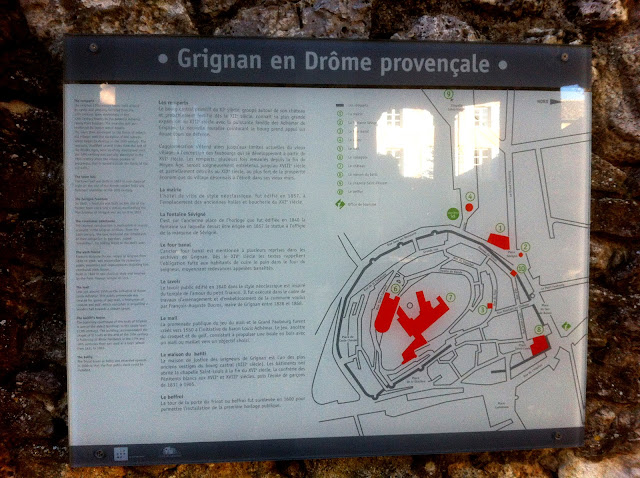
This southern part of the Drôme département lies on the left bank of the Rhône and forms the northern outpost of the huge southern Rhône wine region that stretches down to and beyond Avignon, on both sides of the river. The other main agricultural activities here are lavender and truffles. The red wines use a blend of the classic Rhône grape varieties : syrah, grenache, cinsault, carignan, mourvèdre, plus a newcomer, the metisse marselan (a cross between cabernet sauvignon and grenache). Syrah has to account for at least 30% of the plantings, but apparently the producers are free with their blends (thankfully). The white wines, on the increase, use viognier, marsanne, rousanne, grenache blanc, clairette and bourboulenc. Again, the viognier has to make up 30% of plantings.

Because of the viognier ingredient, the white wines are quite aromatic. In some cases they can also be a bit too soft for my taste, but the best ones retain freshness and make a very good match for truffle-flavoured dishes, or probably asparagus, although I have not tried that. Being tender and perfumed, they are also very enjoyable on their own. The best producers are Domaine de Montine and Domaine de Grangeneuve.
The syrah component, and the climate, which is a bit cooler than in more southerly parts of the Rhône, provides structure and some degree of freshness to many of the red wines. Some producers even produce 100% syrah cuvées, but the majority use grenache as well and sometimes a bit of the other varieties. The best ones (at least according to the 40 odd wines I tasted blind) are Domaine de Grangeneuve, Domaine de Montine, Château de la Croix Chabrières, Domaine Ferrotin, Domaine Almoric, Domaine Saint Luc, and Baron d'Escalin (Château Destin). There is also some rosé produced.

On February 26th, 2011, I posted a rather snide, ironical article (you can see it here) on this blog about a French wine appellation in the Rhône valley that had recently changed its name from Côteaux de Tricastin to Grignan-les-Adhémar. Although I stand by my position as to over-long and hard-to-pronounce names for wine regions, I have recently visited this region in the central part of the Rhône valley, near the town of Montelimar, and I now understand much better why it was in fact necessary to change the appellation's name. So, mea culpa.
Sometimes images can be more efficient than words to explain a problem. They are certainly faster and easier to understand. Which of the two images below would you choose to symbolise your wine region?


I think the answer is evident. And it so happens that these images encapsulate the issue here. Tricastin is the name of a region just south of Montelimar. Its name, which goes back to an ancient tribe that lived around there, was duly bequeathed on the nearby vineyards. Then along came a nuclear power station which not only took on the same name, but also started having a few problems. The result on the image and sales of the local wines was dramatic. So the producers put in a request to the French wine gods (Institut National des Appellations) for a change in name. These vineyards actually lie on a rocky geological structure that has nothong whatever to do with the low silt land upon which the power station is built down by the river Rhône, so there is no possible risk of any "leaks" into the vineyard land. But French customers were clearly turned off by the mere association and few of these wines are exported to countries unaware of the situation and the associations.
The vineyards lie on hilly and plateau ground around the village of Grignan and its very imposing château (see above) where Madame de Sévigné dwelt, at the end of her life, back in the 17th century. The original idea was to simply name the wines "Grignan", but infortunately this name had already been taken by a tiny number of producers (one cooperative winery in fact) that turn out some fairly indifferent stuff in the lower vin du pays category. Despite the fact that Coteaux de Tricastin was a fully-fledged appellation contrôlée, and producing greater quantities of better wines, they were refused the right to call themselves Grignan and had to add on the rather ungainly "les Adhémar". French wine law can be anything but rational!

Grignan is a medieval village built on a rocky outcrop around its chateau, which was a fortress before being transformed in the 17th century
This southern part of the Drôme département lies on the left bank of the Rhône and forms the northern outpost of the huge southern Rhône wine region that stretches down to and beyond Avignon, on both sides of the river. The other main agricultural activities here are lavender and truffles. The red wines use a blend of the classic Rhône grape varieties : syrah, grenache, cinsault, carignan, mourvèdre, plus a newcomer, the metisse marselan (a cross between cabernet sauvignon and grenache). Syrah has to account for at least 30% of the plantings, but apparently the producers are free with their blends (thankfully). The white wines, on the increase, use viognier, marsanne, rousanne, grenache blanc, clairette and bourboulenc. Again, the viognier has to make up 30% of plantings.

Lavoir, or wash house, in Grignan
Because of the viognier ingredient, the white wines are quite aromatic. In some cases they can also be a bit too soft for my taste, but the best ones retain freshness and make a very good match for truffle-flavoured dishes, or probably asparagus, although I have not tried that. Being tender and perfumed, they are also very enjoyable on their own. The best producers are Domaine de Montine and Domaine de Grangeneuve.
The syrah component, and the climate, which is a bit cooler than in more southerly parts of the Rhône, provides structure and some degree of freshness to many of the red wines. Some producers even produce 100% syrah cuvées, but the majority use grenache as well and sometimes a bit of the other varieties. The best ones (at least according to the 40 odd wines I tasted blind) are Domaine de Grangeneuve, Domaine de Montine, Château de la Croix Chabrières, Domaine Ferrotin, Domaine Almoric, Domaine Saint Luc, and Baron d'Escalin (Château Destin). There is also some rosé produced.

Château de Grignan
So I wish this young appellation every success in its venture to refound itself, especially as this movement has been abetted by a more stringent set of rules applied to production in order to raise the level of quality across the board. I also hope that they will, in the end, be able to shorten their name to Grignan. The wines certainly offer excellent value for money since they retail for between 5 and 15 euros a bottle in France. I even bought some myself.
all photos by David Cobbold
21 Dec 2011
1000 years of annoying the French

Stephen Clarke is, like myself, an Englishman who lives in France. I have not read any of his other books, but I couldn't resist this one and read its 650 pages with considerable enjoyment.
The premice of the book is an exploration of the often complex relationships between our two countries (France and England) over the past 1000 years or so, as codified in the myths that surround key periods, events or symbolically weighted people or objects. For example and pêle-mêle, the invasion of England by the Normans, various battles, Mary Queen of Scots, the invention of sparkling Champagne, the guillotine, Napoleon, de Gaulle and WWII, the Channel tunnel, and so on.

Stephen Clarke
Clarke has clearly gone to some trouble to seek out source material and so the facts are clearly laid out, often side-by-side with the legends that have grown to shroud these facts, particularly in French history books or common lore. His angle is mostly ironic and often with an English bias, as indeed the title suggests, but the core of the book is actually quite serious and mostly solidly researched. Yet this book makes no pretence at any form of historical analysis. It tells stories, or snippets of stories, in a series of cameos to illustrate events, things or people which have acquired legendary status in history books on either side of the (English) channel. He has stated in an interview that he finds that the French do tend to distort or conceal facts of their history to a greater extent than the English, especially in school history books.
To illustrate how reality is often misconstrued or even hidden by some versions of historial events, the example of Joan of Arc is quite eloquent. In fact she was captured by French soldiers under Burgundian command, then abandoned by the French king Charles VII who refused to pay her ransom, then tried for heresy by French priests. When she avoided being caught out by trick questions during a very long trial, these priests condemend her to be burnt as a relapsed heretic, for wearing trousers and armour! They then handed her over to the English for execution. So the English got the blame for her death!
There are many other examples, including the little-known facts that sparkling Champagne was invented in England (I could have supplied Clarke with more evidence in this case) as was the guillotine. The book is often very funny, and Clarke tells a good story. He is at his best when he delves into the complexities of relationships and major events, such as the Hundred Years war, the Stuarts, or Napoleon. The book has its weak points and parts, as Clarke occasionally lapses into facility, as if he was getting a bit tired of his angle, but it is generally excellent. The ironical chapter on de Gaulle (who, by the way, was known as "Joan of Arc" by his British hosts) and his containment by the Brits (and Americans) during the war is most enlightening. I would liked to have seen a chapter on sports, and particulary on rugby, a game which seems to epitomise the feeling of rivalry, occasional admiration and frequent lack of fair play that are still so much a part of our slightly schizoïde relationship. "When fictions become facts" could have been its subtitle, so clearly does Clarke strip away the spin that has been put by some official French historians on events that have brought our two countries together, whilst keeping them firmly apart, over the centuries. It might be interesting to see a Frenchman living in England do the same thing the other way around, but would he find the same gap between the "official" versions and the facts?
Read on....
Subscribe to:
Posts (Atom)