5 May 2011

Wine of the week: Stirbey Cramposie, from Romania

I have just returned from a few days spent in the vineyards of Romania, where I learnt a lot, met some fine people, and discovered some grape varieties of which I had never heard before and whose wines I had certainly never tasted. I think that wine is, as much as anything, about travelling outside of your self whilst exercising a form of introspection of your sensations. And these sensations emerge on different levels, both sensorial, emotional and intellectual, mixing surprise and recognition (in alternation), memories and awakenings, elation and, sometimes, boredom through repetition.

One thing that you will not encounter in Romania, at least if you stay away from "international" grape varieties, is repetition and boredom!  I am not saying that all the wines made here from international grape varieties are boring. On the contrary, some of them are excellent and could stand well against international competition. I tasted some excellent cabernets, merlots, syrahs, pinot noirs and sauvignon blancs, for example. But travelling to a country for the first time, and especially to a country that has a long-standing wine-making history (older than France anyway), what I hope for above all is to be surprised, to learn, and to discover something different. Here is one of the wines that I enjoyed during the past days and which fits this bill perfectly. There are more to come!


Stirbey is a smallish (25 hectares of vines) family estate in the attractively hilly and wooded Dragasani district that lies about 150 kilometres to the west of Bucarest. It overlooks the broad valley formed by the River Olt, which flows south from the Carpathians into the Danube (see top photo). The estate (apart from the catastrophic communist interruption!) has been in the Stirbey family for centuries, and has now thankfully returned there. The current owners have regenerated the vineyard, rebuilt the winery and are making some excellent wines with the help of Oliver Bauer, a very cheerful and friendly winemaker from Germany.

Oliver works for the Kripp-Stirbey couple and is as conviced as are the owners of the merits of local Romanian grape varieties. They have planted or, in some cases, reclaimed in older vineyard plots, the following local varieties: cramposie, feteasca regala and tamaiosa romaneasca (whites), and the very interesting red novac. Alongside these they also grow sauvignon blanc, cabernet sauvignon and merlot. All the wines are impressive for their limpid, lifted style (very little and deft use of oak, and only for some of the reds), and their apparent capacity for ageing. The winery only re-opened less than 10 years ago, so it is of course early days to be talking about ageing for these wines. Yet I tasted a 5 year old Feteasca Alba that has taken on an added dimension with regard to its younger cousin.


The wine I want to talk about today is probably not one that will conquer the world. It is called Cramposie Selectionata (meaning "selection"). Cramposie, I was told, is a very old variety that goes back in Dacia to pre-Roman times. For those non-latinists out there, Dacia was the name the Romans gave to this province of their empire, and to which the poet Ovid was exiled. Maybe he drank some wine from Camposie? I hope it will give me similar inspiration! In any case, I would not mind being exiled here, provided that I could live in the country as the local small town is fairly depressing!

The wine I tasted at Stirbey is light (in colour, as in alcohol). Light, crisp and lively white wines are not perhaps the most popular style in today's markets. But this wine is all that one could want on a hot summer's day, or indeed as a refresher after tasting a bunch of tannic young red wines as a substitute for beer (something us winos tend to resort to on occasion). As you can see from the photographs, its colour is so pale that one could almost confuse it with water. Its has a delicately floral nose and it just tiptoes onto the palate with such fragrant delicacy that you feel your body come alive, as after a cool shower. A finely refreshing glass that begs for another one, since the acidity is there but in no way agressive, and the texture has been beautifully handled. No wonder they sell out of this every year!


I will have some more to say about this, and other estates, in a future and more general article on Romanian wines. It should be noted that the domestic wine market in Romania favours white wines over reds, although the latter are increasing their share. I have seen this wine on retail at prices between 7 and 9 euros in Romanian, Austrian and German markets

all photographs by David Cobbold


3 May 2011

Rembrandt hotel in Bucarest, and what makes for a good hotel

The Rembrandt Hotel in Bucarest (Romania) may not look all that impressive from the outside, but it provides, and in the right manner, everything that I need (and like) from a hotel in a city. Read on...


So just what do you need from a city hotel?

I guess that travellers’ requirements of a hotel can vary a bit, but maybe not that much. I find that mine are fairly simple, and, although a little refinement can make all the difference between the purely utilitarian and the relaxing and even life-enhancing, this refinement has nothing to do with rampant “luxury”: it has to do with the owners thinking about the kind of people who might come to their hotel, and their corresponding needs.


I should state straight away that I dislike large hotels: for their crowds, their impersonality, their endless dark corridors and look-alike bedrooms, etc. I do not need people to carry my bags nor wait on me hand and foot. And who needs 10 different bathroom products which clutter the wash-basin area? Or four towels per person? I suppose that a television set in the room can be useful or distracting, but I am very happy without one most of the time (unless it is showing rugby, cricket or motorcycle racing that is!).

museums turn into banks, and banks into cafés in Bucarest, but all with a special style

So what exactly is required, apart from a small, human scale to the hotel?

A good situation has to be the first requirement. If your hotel is in the wrong place, most of what follows will not really help much. And the right place usually means, for a town hotel, a fairly central location, if possible in a quiet pedestrian area, with not too much night-time noise around it and with good connections for the traveller (parking, trains, buses, taxis etc). Friendly and helpful staff has to be number two. Then we need bedrooms that are simple and quiet (good acoustic insulation from the outside and from neighbours is essential), which I like to be decorated with sober good taste, not too colourful, and using natural materials as much as possible. Good lighting that can be simply modified, and that includes a light strong enough to make reading in bed something other than eye-torture or involving gymnastics. Free wi-fi, obviously (why on earth should one pay extra for this these days?).

Then come those small personal touches, inspired by the owner's ideas, that make that extra differnce, like the local weather forecast chalked on a blackboard in the breakfast room (see photo below)...


To resume the general approach that should transpire in the place, one should feel “at home” but with a difference that stems from a sense of eager discovery that is part and parcel of travelling. The guideline of any such hotel should go something like this: keep it simple and relaxed, make it look and feel good, and keep things working.


How many places do this well? I have no idea, but probably a growing number. The trend towards “boutique” hotels has clearly done a lot in this direction. But they need not have the glossy and useless trappings of so-called luxury to make them good. There is one in Bucarest, Romania that I tried recently for one night and that has got things just right. It is called The Rembrandt Hotel.


If you go to Bucarest, you could do worse than giving this place a try. It also has some really fine, simply elegant and yet functional furnishings, beautifully made of oak (no varnish or other crap on it either), that gave me additional pleasure as a former cabinet-maker.
 
Rembrandt Hotel
Str Smärdan 11
Bucaresti
tel : 40 21 313 93 15
www.rembrandt.ro

1 May 2011

Nachbil winery: reinventing Transylvania

You do not know much about Romanian wine? You have never tried any? You think that the only thing to have come out of Transylvania is Count Dracula?


In the cemetery of Beltiug, in Transylvania, as night falls

Answer yes to any of these 3 questions and you should definitely read what follows. Yet the case I am about to describe is not a unique example of the good things happening to wine in Romania, one of Europe's oldest wine-producing countries. It is however quite exemplary and, hopefully, will help create emulation and put Romania back on the world wine map where it should have remained but for the stupidity of human politics. 


hand work to finish the new plantings

Planting a vineyard involves numerous constraints and obstacles, like most other human endeavours. But just try to imagine re-generating a vineyard destroyed by 50 years of destructive stupidity when you are living and working in another country and having to give your instructions mainly by telephone. This was the way that Johann Brutler, who comes from the village of Beltiug, just 20 kilometres into Romania from the Hungarian border, started his Nachbil winery on ground his family had owned prior to the rampant communist catastrophe.

an early start in the vines of Nachbil


Beltiug, in north-western Romania, is one of a series of villages in the province of Satu Mare that used to have, before the communist episode, a flourishing wine-producing activity going back at least to the early 18th century. At this time, German- speaking Swabians were given tenure in this and neighbouring villages by the Austro-Hungarian emperor. The Brutler family were part of that, so Johann has made a return to some deeply-set roots. Time seems to have stood still in this village where only a few of the small houses that front the old underground cellars have been restored, and where horse-drawn carts on the roads do not cause any heads to turn.


entrance to a traditional cellar in Beltiug, Romania

Despite all this, Johann Brutler has not set out to re-create a vineyard purely out of nostalgia for a bye-gone era. The approach of this very likeable man whose eyes shine with intelligent energy forms a coherent blend that incorporates all due respect for the past and its best practices, whilst thinking in step with the times, and often out of the box. He has planted a wide range of grape varieties, some of which are local, others coming from Austria, France or Germany. The vines are organically farmed but plantings resort to the latest mechanised and laser-abetted equipment from Austria. The reclaimed strips of land are ploughed and manured, but their natural topography is left well alone, to avoid modifying the hillside landscape and destroying the sub-soil structure. Wine-making techniques follow a similar path, eschewing heavy interventionism but using modern equipment according to available means. Brutler and his business partner now have 16 hectares in production, with another 9 currently being planted, and he is living next to his cellar with his wife Katherine, both fully engaged in this activity as artisan vine-grower and wine-maker. Yet when he started, back in 1998, he did so with just 0,2 hectare whilst living and working in Germany, where he and all his family had gone to escape Ceaucescu and the paranoic havoc he had created.

Means are often the name of the game for a budding but modestly endowed fine wine producer like Brutler, as banks do not lend cheaply in Romania. And acquiring land here is both complex and expensive, since individual holdings are tiny and often bereft of any legal documents, which inflates the bank accounts of solicitors but is of no benefit to the seller. So expansion has been organic and steady, despite the vision of this man who has in his pocket all the plans for a modern winery alongside the old one that will remain as an ageing cellar. Yet he does not want to grow further than what will be an estate of 25 hectares of vines (and almost as many grape varieties). For the moment, the beautifully designed labels of the Nachbil range can only be seen on Romanian tables, but I will hazard a guess that this situation will shortly evolve, so impressive are the wines I tasted.

Johann Brutler and his son Edgar

Johann, who is aided by his son Edgar, who studied at Geisenheim and has a full-time job as cellarmaster of the Leo Hillinger winery in Austria’s Burgenland, has developed a range of wines that are in perfect phase with this relatively cool climate and whose style is both personal and modern, in the best sense of both terms. I particularly enjoyed his delicate and stylish whites that sell locally for prices between 5 and 15 euros, and, of the reds, all of which could easily speak for themselves at international levels, his Trei Gratii (meaning three graces, but one can also read grape varieties, of which there are also three) and his Syrah, whose character varies deliberately from one vintage to another according to the weather pattern.

I don’t expect that Brutler, whose connection with wine started as a wine lover (he is a great fan of German riesling), will ever stop experimenting and learning. His latest venture is to plant 2 hectares of sylvaner, which he says has a local origin. I really wish there were more people like him, as they bring life and energy back to a place without destroying it.

 
The range of red wines from Nachbil


Red varieties planted: cabernet sauvignon, merlot, syrah, pinot noir, blaufrankisch

White varieties planted: riesling, sauvignon blanc, chardonnay, sylvaner, pinot blanc, pinot gris, welschriesling, furmint, feteasca regala, mustoasa de Maderat, altesse, chasselas doré, muscat d’Ottonel, baras, grünspitz

contact information
SC Weingut Brutler & Lieb
447040 Beltiug, jud Satu Mare, Romania
tel : +40 261 870 200

all photographs by David Cobbold


26 Apr 2011

The Great Escape

John Sturges's film The Great Escape was shown on French TV yesterday. Watching it (mainly to see Steve McQueen, Charles Bronson and James Coburn again, and of course for the motorcycle scenes that McQueen stunted himself, together with his mate Budd Ekins), I was often reminded of this brilliant sketch by the British comic pair Armstrong and Miller on the same theme. If you don't already know of this series, you can find it on Youtube. The juxtaposition formed by the scenes, costumes and accents from these RAF types during WWII with contemporary suburban slang talk is a brilliant idea.

24 Apr 2011

Husqvarna 250 WR from 1979

We are getting a bit confused with the numbers here, and I forgot to take my camera with me the other day when I went to collect my latest find (or folly, of you prefer). She is Swedish, and will become motorbike number 14 in purely chronological terms. I shall try to explain...


We will maybe straighten out the numbers a bit first, not that they matter in the slightest. All will become clear when I have actually got my hands on the modified Norton Commando that I told you about in the last article of this series. I said that this Norton was going to be bike number 14. In fact it will be number 15 since I recently found a 1979 Husqvarna WR 250 (the enduro version of the motocross bike) at a reasonable price given its apparent condition. Since I bought it and am now running the thing, it logically becomes bike number 14, and the revamped Commando, due to appear again late May or early June, will take 15th place. Ok, so what? What about this bike then?

The photo above is not even of my bike, altjhough it is the same model. Maybe I will get around to taking some pics sometime and show you. For the moment I am going to take it out to the country and hit the dirt to see how it works. In fact by the time you read this I will be there!

I have always liked Huskies and yet this is the first time I have owned one. I would probably have most liked to have a four-stroke version, but the prices are a bit out of my reach, and the simplicity of this one is very attractive. Here is another picture, this time of a 1981 model but there were ony detail changes betwwen the two versions I think, so you get the general idea. It is light and basic, robust, with a two-stroke motor, and you can virtually place the front end where you need to. About what is needed for an enduro machine, and probably good enough for me.


It now remains to be seen how an Italian, a Brit and a Swede will get on together in my garage. I'll keep you posted on this European menage-à-trois.

22 Apr 2011

Inspired by the uncertainty principle

In case there be any misunderstanding here, I should state at the outset that I have close to no scientific background or culture, but that, although I usually find scientific discoveries and theories hard to grasp on a scale that runs from 0 to maybe 3, full grasp being rated at 20, they often fascinate me by their apparent implications in other fields. This may cause me to over-construe or misinterprate these implications, but so what?  

I read in a book the other day an explanation of the Heisenberg uncertainty principle in quantum mechanics that got me thinking about possible implications in other fields.

Maybe we should start with the definition of this theory that I found in Wikipedia (where else?)

In quantum mechanics, the Heisenberg uncertainty principle states by precise inequalities that certain pairs of physical properties, such as position and momentum, cannot be simultaneously known to arbitrarily high precision. That is, the more precisely one property is measured, the less precisely the other can be measured.

Published by Werner Heisenberg in 1927, the principle implies that it is impossible to determine simultaneously both the position and the momentum of an electron or any other particle with any great degree of accuracy or certainty. This is not a statement about researchers' ability to measure the quantities. Rather, it is a statement about the system itself. That is, a system cannot be defined to have simultaneously singular values of these pairs of quantities. The principle states that a minimum exists for the product of the uncertainties in these properties that is equal to or greater than one half of ħ the reduced Planck constant (ħ = h/2π).


Werner Heisenberg

If one applies this principle to other fields than quantum mechanics, the implications are huge. In the section of my profession devoted to tasting and rating wines, for instance, it validates my instinctive feeling (albeit based on years of experience) that any attempt to make the tasting procedure appear to be fully objective is a total illusion. The very fact of observing a smell or a flavour alters that smell or flavour. Added to which, each individual being a separate system, there is no chance that the observations made by two individuals can correspond exactly one with another.

The same would obviously apply to other aesthetic experiences. Take the case of painting for example. When one looks at a painting, one can feel one's own perception changing in time. One can also alter one's impressions of a work by shifting, even slightly, from side to side or by looking at it from closer or further away. This, to me, is something akin to the Uncertainty Principle. And putting two observers in front of the same painting results in two very different systems of observation being created, as each person brings to their system not only their particuler and individual physical and intellectual capacities, but also their separate past experiences and present moods, all of which will influence their way of looking and interpreting what they see. Hence the object observed is NOT quantifiable, and is ever changing.

Does this mean that we should not try to exchange our points of view on aesthetic experiences, since the chances of these being understood or felt by another person are quite slim? I think not, as we need to create common ground to live together, and part of that common ground is built through our exchanging points of view on what we observe in the world around us.


20 Apr 2011

What to read in the Financial Times

I read various newspapers, in an irregular manner. By that I mean that, although I have my preferences, I hold no newspaper subscription (apart from bike magazines that is) and try to take a look at a wide range of papers from time to time. But I rarely buy a paper more than three times per week.

I see the Financial Times regularly when travelling, but I only buy a copy very occasionally. It is often on offer for free on planes or in hotels, and I usually take it. Although I skip all the financial stuff which does not interest me, I nearly always find plenty of very good articles to read. In fact it is a great newspaper, since it confides its columns to people who can write and who know their subjects well.

On the topics that regularly interest me, the Arts articles are usually excellent, as is the wine section in the Weekend issue, written (usually) by Jancis Robinson. Amongst the regular contributors who write about business issues in a general way that links them to what I consider to be the real world (ie human beings), I always read what Lucy Kellaway has to say, as she is a brilliant columnist. She is shown on the top left-hand corner of the image below, and her column is usually to be found on a page called Business Life, which is quite suitable as she indeed covers the link between the two words.


In a copy of the FT (dated Monday April 18th 2011) that I picked up recently on a trip to London, she wrote about the salaries and bonuses of top executives, and the difficulty of finding clear information and honest justification for these amidst the waffle that fills the pages of companies' annual reports. She nearly always manages to make her subjects both clear and funny, and this article is no exception. I cannot resist quoting a couple of passages from it.

"I have just spent the morning doing something that has left me feeling bored and grumpy. I have been reading annual reports and proxy statements, concentrating on the bit where companies try to justify why their top person got paid quite so much. What has annoyed me isn't just the fact that most chief executives earn more than they are worth: this has been the case for such a long time that outrage fatigue has set in. Instead, it is the increasing quantity of flannel and pseudo-scientific analysis in which the numbers are now wrapped."

She goes on to give three examples, from the annual reports of Barclays, Hewlett Packard and Kraft. About the latter, she says this: "my favourite statement this year is Kraft's, which seeks to explain why Irene Rosenfeld got a bonus of $2.1 million in return for missing her financial targets. Just in case anyone is simplistic enough to think that if you don't hit the target you don't get a bonus, the report pulls out of the hat a whole new set of reasons for why she deserved one. Some of these are pathetically mundane....but other are more puzzling. "Improved talent pipeline developed through retention of Cadbury leaders" it says. I think this horrible, tortuous phrase means that Rosenfeld has hung on to a few top people at the confectioner - which isn't the impression one gets from reading the newspapers."

Kellaway concludes her article thus: "It makes me wish for a return to the bad old days when companies simply named the sum paid to the top people. No explanantions or excuses were given. Shareholders didn't have the foggiest idea of how the figures were arrived at, but then, for all the pages that I've ground through this morning, I'm none the wiser either. The bland numbers, stripped of all excuses, would surely be easier to grasp - and harder to defend. And they could be made harder still by the addition of one further figure: the ratio of the pay of the person at the top to the person at the bottom."

That's the stuff Lucy!

Read on ....

17 Apr 2011

The wine of the week is a Beaujolais

I have recently spoken, and perhaps too often, about wines costing 20 euros a bottle or even more. I am about to amend my evil ways, at least for a while, although we all know that the fickle finger of fate may intervene at any time. This weeks's wine costs a mere 5 euros from the estate that produces it!


The wines of Beaujolais, just north of the city of Lyon, have been much maligned over recent years, most probably on account of too many bad wines coming from this beautiful region, usually under the appellation Beaujolais Nouveau, but not exclusively. I should say that there are good Beaujolais Nouveau as well. This wine is not "nouveau". It has in fact just been released from the 2010 vintage and it is one of the most delicious drinks of red wine that I have experienced for a while. To give you some idea of how much I like it, I bought a case of 6 bottles less than a week ago when visiting the producer and I only have 3 left! It is true that I have had a little help from my friends. But it is equally true that I always have a lot of different wines hanging around waiting to be tasted. So this means something.


Domaine Les Bruyères is a small wine estate whose main commercial activity (it is also a family home) is renting appartments on the estate (these are known as gîtes in France). You may have trouble finding it as the name is also used by many other estates, often in other wine areas, so here is the contact:

Anne-Dominique et Bernard VACHON, Les Bruyères, 573 Chemin St Jean, 69220 Pommiers (near Saint Lager) tel : 06 80 84 14 71

And here is a picture of the buildings, looking towards the wing that harbours the gîtes. It does not unfortunately show the surroundings, which are beautiful, but the vines in the foreground are the ones that produce the wine I am talking about here. To enquire about this form of rental, you should go to the web site of Gîtes de France, Beaujolais (section gîte rural). The reference numbers of the 2 charming appartments whose façades are to be seen in the photograph are 1525 and 1526.


I really like the label of this wine (see above), as it is simple and elegant, showing the name Beaujolais in a finely legible script, with the estate and the owners' names printed clearly but in smaller type below. The back label tells a story about the place it comes from, avoiding any bla-bla about the wine, which is allowed to speak for itself. And this wine speaks very well and clearly.

Its aromas remind us of ripe and fresh fruit, with just a whiff of woodland that adds a vision of the hills beyond the vines. On the palate, the texture is smooth and quite full, surrounding the crisp fruit flavours that are vivacious and finely tuned. The first glass makes you want another one, always a good sign for this type of wine whose light alcohol levels compared to so many modern wines are a real joy for the hedonistic drinker who hates getting drunk!

The same producer also makes a very good rosé, sold, at the same very reasonable price, under the name Gamay rosé (gamay is the red Beaujolais grape).

I think I am am going to buy a few more cases of the red Beaujolais, as it has to be the ideal summer red wine. And maybe a bit of rosé too...


16 Apr 2011

My 14th bike will be a modified Norton Commando 850

Yes, the attentive reader will probably have not only noticed the future tense, but may also realise quite soon that this bike has already featured on these pages. It is in fact my 11th bike, recently re-purchased, but with quite a few modifications that are currently being carried out by Frank Chatokhine in his workshop near Chartres.

I spoke about this project in my New Year's bike resolution article :
http://morethanjustwine.blogspot.com/2010/12/new-years-bike-resolution.html

Now here is a visual reminder of what the bike looked like just before I took it to the good doctor Chatokhine. Not bad, I know, but one is never satisfied!


The basic model is a Mk11A roadster, which I first had rebuilt many years ago. At this time I had the large Interstate tank fitted (as seen in this photo above).

I have yet to see the finished machine, for the very good reason that it doesn't yet fully exist, except in my mind and on the specification sheet that I worked out with the help and advice of Frank. So this is really just a good excuse to do a little advance drooling before this project finally materializes. I should add that I fully expect there to be an ongoing element to this project, with other modifications to come as I ride this machine in its new form and see what works best and what does not.

Let's have a look at what it might look like. None of these pictures are exactly right, as they are all of other bikes, but each of them contains some of the parts and aspects that will be included in my project.


For a start the large tank on my existing bike will go, not because I dislike it, but because it needs to go in order to fit the nicely shaped and finished (and far more confortable than the original sack of sludge and pebbles that was the Norton standard seat) American seat made by Corbin. The new tank will be a metal (I dislike fibreglass, especially for fuel tanks) Roadster model, as indeed this bike orginally carried. This is proven by the triangular side panels, as the true Interstate model has larger side panels. This means a paint job on both the tank and the side panels (black with gold striping for both). The picture above shows the general idea quite well, although my bike has a grey-painted frame and black mudguards (mods that date from the previous rebuild and that I have decided to keep for now). The wheels will be rebuilt on alloy rims, again as for the bike in this photograph and fitted with modern Avon tyres. I am not a purist and the Dunlop K81's date a bit in terms of performance.


Here is another modified Commando with a Corbin seat and black mudguards, although the paint job on the tank is different (and quite successful too). Mine will also stick to the "pea-shooter" silencers (not that silent really!) as shown on the first two pictures, and primary case will not be black either. 


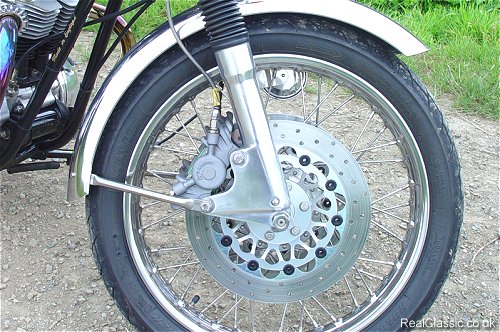
Braking is one of the main weak points on the Commando in its original form, so the front disc will be changed for something similar to the one above, together with a different master cylinder and pipes. The fork will be overhauled but basically remain unchanged although I may add a brace as there will just be a single disc at the front.


Although I love the cast aluminium alloy pieces of the original footrest supports, the pegs are set too far forward so I am having Norvil rearsets fitted like on this machine. I am not going for clip-ons or dropped bars however as I feel a flat handlebar is more confortable. I had one on my first Commando (the Fastback model) and liked it. We shall just see how the riding position turns out and adjust if needed.

There will be a few other minor mechanical and electrical modifications, to improve some practical details, such as electronic ignition, a dry battery, an anti-return valve on the oil tank, and so on. I do not like the big, boxy air filter much so two smaller individual filters will be fitted to the Amal carbs, a bit like on the bike below. This will entail some modification of the battery tray that lies behind the filter. And the equally boxy Norton rear light will be changed for a smaller, sleeker model from a US Triumph. My bike has no indicators fitted, so we will leave it that way too. The rear view mirror will be compact and folding, fitted to the end of the bar. The general philosophy is to keep things simple. Maybe a single carburettor in the future?


Hopefully I will be able to show you the real thing in a month or two.

Footnote (a bit more than a couple of months later)
And here are some images of the finished machine....


Ride well!


15 Apr 2011

What does luxury mean for you?

Given the blatant commercial abuse and overplay of the term "luxury" these days, with an incessant avalanche of increasingly vulgar advertising for so-called "luxury" goods and services of all kinds, I sometimes feel just a little sympathetic even with the Chinese authorities, who appear to want to ban the use of the "l" word altogether.

One evening this week, while passing through my local street market, I suddenly had a small flash of inspiration. I was not aiming to buy anything, but the desire for some kalamata olives (you know, those juicy purple ones that are quite big but not huge) suddenly came over me. Buying them was not that easy, and ended up costing me more than I anticipated. It was not that I got carried away in my purchase by taking on tons of the things, or that I veered off the straight and narrow of my inintial inspiration by trying all kinds of other goods. No, the stall-holder simply did not have any change for the 20 euro note that I handed him. So I offered to go and find some change and plunged rather shamedly into my local book shop which is conveniently situated just 20 yards from the changeless olive merchant. I say shamedly since I usually stride in there with a distinct purpose and a specific book or list thereof in mind. Not this time. I just wanted to find a book priced at 15 euros so that I could pay for my kalamata olives with the left-over from my 20 euros note. After a bit of wandering around the shelves, a sudden inspiration hit me. (Again, you say? That makes twice in one day. Take it easy or you will blow a fuse!). I read, some time ago, a short book by Julian Gracq and found his writing quite wonderful, and it had occurred to me within the last month that it was time that I explored his work further. So I found a small tome of his whose price fitted my initial aspiration towards purple olives and bought it. 15 euros for his first novel, called au Chateau d'Argol (182 pages which you have to separate with a knife or other blade-like object as in former times, from the publisher José Corti).


Back I went to the olive stall and happily collected my olives. I then proceeded to finger my way into the plastic bag that contained them and start eating them on my walk home, enjoying their softly textured saltiness and experiencing a ripple of happiness through, I assumed, having indulged myself in an absolute luxury: ie something that I didn't really need, that I hadn't at all planned, and which nevertheless gave me considerable pleasure.


Here are the olives that survived, back in my kitchen. Doubtless they will give me additional bursts of pleasure in the hours and days to come, forming a salty version of the proustien madeleine. 

So what is the point of all this? Well I suppose it is just to say that luxury in not necessarily big, or costly, or hard to get, or glitzy, or far away, or a piece of bagage with silly letters written all over it. Luxury is, for example, an unexpected moment, a crack in time, a turn of the head to find something or someone that makes you smile. And, in this case, I will look forward to reading Julian Gracq this weekend whilst eating olives. Double time!