Showing posts with label good looking. Show all posts

31 Dec 2013

Building stone walls and paving

There is for me something deeply satisfying in the work involved in building stone walls, stone paths and paved areas. Such work, which can be physically demanding on account of the weight and abrasive nature of the items as well as the repetition of tasks, combines the physical and the useful with the aesthetic, like indeed many forms of craftsmanship. I have, in the past, practiced the trade of carpenter/cabinet-maker and I would say the same of that too. I don't think of the end products of either of these crafts as works of art. They are made by hands and tools and the human mind, but, above all, they are functional. Art is, by definition, useless, and so is perhaps essential in other ways.


The photographs in this article show some of the stone work I currently have in progress in Gascony. All of it uses local materials, much found, some purchased. Very little mortar (lime and sand, with an occasional dab of white cement) has beeen used, except for some of the bottom and top layers, and the angle stones. As the walls have been back-filled with rubble and small stones for extra drainage, and then with earth, this dry stone technique should enable surplus water to find its way out without creating undue pressure. At least that is what I hope! 


work in progress: the second layer terrace is under way in this photo, but is now more or less finished, as below, taken from the mid-level and with plantings in progress


the second-level terrace, now finished apart from the topping stones, still to be cut and laid.

I cannot pretend to be an expert in building rough stone walls, and I make many mistakes for sure, but I do apply myself when I work at this and try to do a good job. So far, the ones I have built seem to be holding up alright, but time will tell I suppose. We are definitely not in the pyramid league here! This project revolves around a two layer stone terrace with a mostly stone (I will be replacing the non-stone parts with stone steps) stairway leading up 17 steps and linking the top level to the bottom via an intermediary terrace which I have also paved. Since these pictures were taken, I have started to extend the bottom layer to the left of the staircase. The system will be similar on each side, with some changes in levels to adapt to the ground.


As well as some of the steps (temporary), the pathway that leads from the house to this staircase is made of river-bed pebbles that come from the Garonne river, nearby (see first photograph below), which are also used, alternately with irregular off-cut slabs salvaged from a local stone-cutter's yard, to pave the middle terrace part (bottom two photographs below).


Plantings are under way on the top terrace, and also in beds set into the middle level. At the bottom level lies a wide, sloping and grassed field with a lake at the bottom of it, about 100 metres from the bottom wall and, in between, some fruit trees that I have planted and which will probably be increasing in numbers.

This article also shows, below, some photographs of stone paving in other places that I have seen and thought to photograph. These will probably provide inspiration for future work.


Stone floor paving inside a chateau currently being restored: Château de Fargues, in Sauternes, near Bordeaux. An example of how to do it!


pebble stone paving in Granada, Spain


At the end of last-summer's work sessions, I cremated my favourite espadrilles which had been worn out by so much unsuitably hard effort. At other times I try to wear more suitable footgear for this work. 


25 Sept 2013

The beauties of Granada (1/2)

No, this article is NOT about Andalusian ladies!


The Alhambra (in the background, with the Sierra Nevada range beyond) from the top end of the Albayzin district, which is the old moorish part of the city

I recently spent a couple of days in this Spanish city, partly working, partly just wandering about. Granada is the capital of the eponymous province within the region of Andalusia in southern Spain. It is certainly most famous for having been the last capital of the moorish colony in Spain, under the Almohad dynasty that was finally defeated by the catholic armies in successive battles as they gradually advanced south between 1212 and 1248. Anyone who doubts (and current affairs sadly lead to such doubts) the extent of refinement to which some forms of islamic culture have engendered, would be well advised to visit the Alhambra, not to mention reading the works of such as Averroes, which is the latinized name for the philosopher, poet, mathematician, astronomer, etc., whose full name was Abu'l-Walid Muhammad ibn Rouchd of Cordoba, usually shortened to Ibn Rouchd.


A 19th or early 20th century painting of one of the inner courtyards of the Alhambra palace, seen in the fine art museum on the first floor of the Charles V palace that is now part of the Alhambra complex.


The best-known visible legacy of this cultural high-point of muslim culture is of course the Alhambra palace, a place of immense refinement and beauty which I had visited a few years ago during a bike trip to the region. This time I did not revisit the Alhambra as such visits need to be booked ahead and queued for. And I dislike queuing intensely. Anyway there is so much else to enjoy and admire in Granada and this is my subject here.


Doors are a constant and beautiful features of many old buildings (this one of a church currently being renovated along the Darro river)


Another one that mixes cedar (the mouldings) and walnut (the main panels). I love old doors. This one to what may well have been a former merchant's house, again along the Darro river.


Granada is also an significant student city in Spain and this is apparent from the high proportion of younger people walking or bicycling around the streets. There must be almost as many students as there are tapas bars here. I will return to the latter subject in a while. Geographically speaking, Granada lies in the north-eastern corner of the region of Andalusia, at the base of the Sierra Nevada mountains where one can ski in the winter. The water resources that result from this are what made the construction and plantings of the Alhambra possible, as Granada is built, at an altitude of just over 700 meters, at a point where three rivers flowing from the much higher Sierra Nevada range converge: the Beiro, the Darro and the Genil.


a good tapa dish, served free to bar patrons


The practice of tapas, however irregularly it may be followed throughout Spain and even Andalusia, is to me a joy of refinement and a sign of true hospitality on the part of the bars that maintain this tradition of serving a free small dish of varied foodstuffs, often quite elaborate, to customers who order a drink. It makes me want to stay there and order some more, which indeed I always do. A proper tapa is more than a few olives or, God forbid, some rancid peanuts or horrible crisps. Shown above is a typical example of a good tapa dish : small broad beans in olive oil with some soft red peppers and ham cooked with them.


water destroys roads. Just imagine what it does to your intestines

the 1 pm rush hour at Castaneda. hard to find a slot at the bar before 2, when they all go to lunch

The essence of a good tapas bar is ambience, a good selection of wines, and varied tapas dishes. A dose of humour also comes in handy 


Tapas bars in Granada may be traditional, like this excellent one above, Bodegas Castaneda (and a big hello to Alan S who introduced me to this place on a previous visit), or more modern, like this one, called Mariscal, next to the Corte Inglès department store.


and, if you turn around, you will see this fabulous collection of hams and other delicacies forbidden to muslims, as the bar backs onto a major delicatessen in which I saw people queuing up for hours to do their shopping.


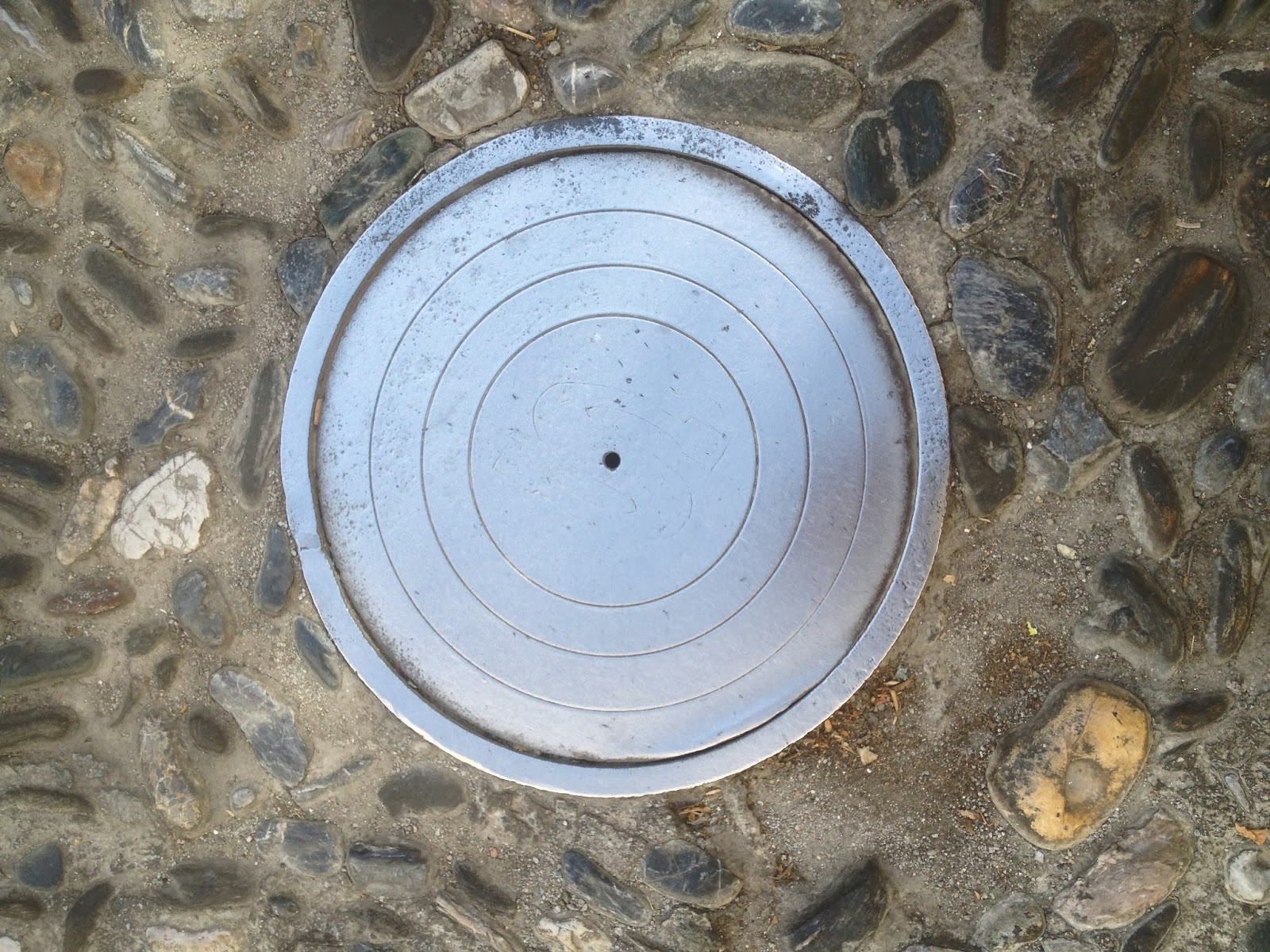
Walking in Granada is a constant joy, partly because the city has managed to keep motorcars out of much of the centre and the many narrow streets that naturally discourage our 4-wheel friends. But also on account of the often beautiful pavements made of small stones hammered into sand and then cemented into intricate and functional designs.


Manhole covers look good too...


A biker can find occasional solace by checking the machinery parked outside some bars, like this KTM 1190 RC8R. A ride up to the Sierra Nevada? Just miss the manhole covers on the way out of town.


More about Granada and its attractions quite soon.....

20 Jul 2013

My 16th bike is a modified Suzuki GSXR 1100

You never thought that I would talk about Japanese bikes on this site? Wrong, dead wrong as I am far from sectarian in bike-likes, even though I may have periodic preferences.  Anything with wheels can be fun, and anything with 2 wheels and a motor is usually plenty of fun. I have total respect for any motorbike, even if I would not want to own many of them. Way back in the past I did once own a Honda 175 twin and, for running around streets in London near where I once lived and playing kiddies in paddocks, a 50cc Monkey Bike.

I have admired many Japanese motorcycles and Japan is clearly one of the all-time most creative and prolific producers of bikes. I hold fond memories of watching Mike the Bike howling between the curbs, walls and hedges on the Isle of Man circuit on Honda 6's and 4's. And some legendary machines I would really like to own, like the Honda RW30.

But, amongst the many more accessible, mass-produced machines that have made Japanese motorcycles dominate in just about every category of motorized 2 wheelers, there is one engine and frame that have always appeared to me as a sculptural work of motorcycle art, albeit of the art brut kind: the Suzuki GSXR of the air and oil-cooled era. The rectangular section aluminium frame was quite revolutionary when introduced in about 1984 and these bikes, initially of 750cc before also coming out in a big-bore 1100 cc version, were at the time the fastest on the road and were directly derived from the Suzuki endurance racers that were at that time cleaning up on the circuits.


This Suzuki GSXR 1100 is originally from about 1991 but has now  been considerably modified, freed of all fairings, and is now sitting in my garage.

Not being a purist or a "collector" of original machines that have to have everything in place just as it came out of the crate, I like to see some improvements and/or modifications made to most bikes. This is about two things. Firstly actual improvements and adaptations to one's current usage, since, after all, many items or pieces of technology have improved over that past decades (just think of tyres, to take just one example). But also the idea that a motorbike is such a personal (and, agreed, egotistical) piece of machinery that one may as well go to it and make it more distinctively individual by doing (or, in my case, mostly having done) various modifications for aesthetic and technical reasons. Customizing is the name of that game, I suppose.

A while ago I saw in the excellent French magazine Café Racer (www.cafe-racer.fr) an article on a workshop out in the eastern suburbs of Paris called KMP (and here is their web site, in French:www.kmp.fr‎) which specializes mainly in GSXRs of various eras, and their rebuilding and transformation into customized machines of various types. And the prices they were asking for these renovated and modified machines looked pretty reasonable, given the work that had presumably gone into them. So, after a few months secret longing and some saving-up, I finally took the plunge and went to see them with firmish intentions. Very friendly and informative was Christophe, the boss, and he showed me a bike that I had in fact spotted in the Cafe Racer article. I remembered liking its sober grey livery with a see-through section in the tank to check fuel level, its polished frame and spoked wheels. It still needed a bit of work and I asked for a few other mods also, so I finally got it back home about 6 weeks later.


What's it like to ride? Bit of a pig in traffic, added to which the carburetors need a bit of sorting still as it misfires between 4 and 5,000 rpm, which is just what you don't need when accelerating! The braking is great and it feels like a rail in bends although it is pretty physical to turn. The tiny electronic rev-counter/ digital speedo doesn't work but I'm having that changed for something better and more legible. Not sure I will do 500 kms per day on this but it's a blast to ride. The Hindle silencers say they are homologated, but I'm not sure by whom or for what. Maybe the man was called Hindle Homologated? As it is impossible to see what speed you're actually doing, I tried playing it by ear but soon realized that I had no chance there as I am far too used to singles or twins that rev much lower. Instead I constantly find myself feeling for higher gears that seem to be missing from the gearbox. I suppose I will get used to this motor running at way above 8,000 rpm or whatever.

The bike is currently back with KMP for the necessary adjustments. Will tell you more soon. I suspect it has been overbored to about 1240cc. She looks the part anyway, so I am pleased with my piece of sculpture. Can my driver's licence resist though?


Ride well and safely.

14 Mar 2013

Street art can be beautiful and/or fun

This says : "Reciprocity is a mystery". I like that...

Actually this is on a window and not a wall, but I am sure that you get the idea. Most graffiti (sometimes pompously called "street art") that I see is ugly and garish and has been inflicted, undesired, on public places, just adding another layer of ugliness to areas which are already blighted, and sometimes acting as acne on otherwise quite acceptable faces of architecture. But there are occasional graffiti artists whose works I see on walls here in Paris that make me smile, or think, or laugh, or indeed several of these. The one above is on the window (in the window?) of the tourist office near where I live, and it is clearly signed by someone going under the intriguing pseudo of Miss-Tic.

The first "street art" of this type of which I have a clear memory were the finely-drawn posters of the french poet Rimbaud that I saw stuck on dilapidated walls in Paris's 14th arrondissement in the late 1970's (see below).


These were my first contact with the remarkable work of the French artist Ernest Pignon Ernest, about whom I have written on this blog here.

With perhaps more humour, but a lesser sense of history, more recent street artists have done some fun things on the walls of the Butte aux Cailles district in Paris' 13th arrondissement. It should be remembered that this district is still a bastion of artists' studios and was a hotspot for rebellion during the Paris Commune movement in the 1870's, as well as during the "events" of May 1968, almost 100 years later.


Spontaneous and involuntary forms of sculpture are also a feature of what can loosely (and sometimes pompously!) be called street "art". The two photographs below are taken on the Pont des Arts, a pedestrian bridge across the Seine that links the Louvre to the Ecole de Beaux Arts. There is another bridge similarly decorated with lovers' padlocks a bit further upstream. I find this far more interesting than most so-called "installations" that one sees in galleries. The locks shine like gold in the sun and are densely packed on either side of the bridge. This has an interesting optical/kinetic effect as one walks across the bridge. Of course the scale and the site help a bit!


On a recent visit to the Slovenian capital of Lubljana, I saw the beginnings of a similar installation on a bridge there, so perhaps there will be, at some point, an international circuit to be followed of lovers' bridges. Better than that damned da Vinci Code circuit that seems mercifully to have died out. Love is eternal after all...


And if you go to this article, you will discover another good piece of graffiti that I spotted in Lubljana (one picture of it is below).


16 Feb 2013

More thoughts about Edward Hopper

I published, about 10 days ago, an article on Edward Hopper and promised to return to this subject shortly, so here we are. 


As a form of alternative to Hopper's painting of city life and cityscapes, with those clearly defined lines and forms, the highly contrasting tones with bright, diagonal, often very theatrical lighting and deep, menacing shade, as well as the paradoxical loneliness of the scenes shown (yes, we are so alone but yet with so many people all around in the big city!), there is also his equally realistic and demanding take on landscapes and seafronts along the windblown north-eastern coast of the USA. But, despite the feeling of rural tranquillity that so often pervades these works, Hopper was never afraid of introducing the 20th century and its mechanical inventions into that rural scenery, almost as a way of using strong contrasts, just as he did with his works showing both the inside and outside of buildings, light and shade, intense against subdued colurs, and so on. These contasts I tried to show, to some extent, in the previous article. The watercolour below is a good example of this organic/mechanical antithesis and it does not shirk the fact that there is something ominous in the encroachement of man and his objects into the natural world.


As indeed is shown in the above engraving, where nature is literally cut in two by the railroad. Hopper is, to me, a master of engraving, and perhaps even more so than that of oil painting or watercolours.


The above engraving, which I find admirable, is not of the rural category as to its subject matter. But it perfectly illustrates Hopper's skills as a draughtsman and engraver. The composition leans on the dynamics provided by diagonals, held in check and balance by vertical lines and the rythm inherent to the framework of the subject (a subway train at night) whilst adding intensity to the central subject (a man and a woman engaged in conversation). The use of black and white, and the nuances of shading that bridge the gap of these contrasts, are also very finely handled. Drama and intimacy are latent in both subject matter and the composition that serves this.


This one, which is clearly part of the meticulous build-up of preparatory studies that led Hopper to his Nighthawks masterpiece, uses the diagonal element in composition almost to an extreme and to the point of imbalance. What finally holds it together is the solitary human figure in the foreground.


If we take a closer look at certain of his engravings, the influence of the great masters of the past, such as Rembrandt, become very clear. And to what extent the use of strong side-lighting produces both contrasts and dynamics in the whole composition.


Strong lighting is a regular feature of Hoppers paintings as well and this can have an artificial as well as a natural source. In this sense, Hopper shows very clearly the interactions between his painting and contemporary cinematography. I mentioned Lang and Hitchcock in my previous article, but they are not the only examples. And the way the subject matter is treated has an obvious cinematogaphic feel to it. In the above painting, one can image the scene before, just as well as the one to follow.


In this painting too, one is intensely aware of possible scenarios into which it slots. In fact someone once said of this painting that you can imagine in that the bank robbers have just left to commit their hold-up, having filled up with gas served by the man at the pump who barely looked at them as he cleaned the car's windshield before closing down his station.


Another painting that also shows just how daring Hopper could be in his compositions is this one, which again clearly illustrates the apparent antagonism between the city and the country, the man-built and the natural, the well-lit and conforting against the dark and menacing. His way of cutting off part of the building, both horizontally and laterally, is reminiscent of the use of a zoom on a camera.


As I started this article by talking about Hopper's vision of rurality, I should perhaps finish with one of his paintings in which neither man nor man-made objects (apart from a suggested track) play any part. Hopper is a painter of apparent tranquillity who manages, somehow, and quite subtly, to distill in most of his work a subterranean dose of anguish that is perhaps part and parcel of the 20th century.

5 Feb 2013

Edward Hopper: light, shade, and composition

Nighthawks, 1942

Most people will have already seen, in some form or another (usually a postcard or a poster) the above painting of Edward Hopper, called Nighthawks. It is undoubtedly his most famous work and was part of the recent and magnificent exhibition of Hopper's work that I finally saw last week in Paris, at Le Grand Palais. This exhibtion, which was on for 4 months, has broken all attendance  records here in Paris for major exhibitions, apart from that devoted to Monet. It received some 780,000 visitors. This is a problem for the attentive visitor as the crowds are so considerable that it can be hard to spend time in front of some pictures. But back to the real subject, which is of course the work of this considerable artist.

The above work contains many of the the recurrent themes and techniques used by Hopper in his paintings : Light and dark (chiaroscuro for those who have studied Italian painting), the power of colour, the dynamics provided by the diagonal in a composition, the play of inside/outside (generally through windows), and the obvious loneliness of his human sujects. Usually these elements are used two by two, or three by three, in his paintings. But in Nighthawks they are all there at once. It should be added that this painting also illustrates the considerable interactions between Hopper's work and films. Fritz Lang and Hitchcock, amongst others, surely influenced him, while he in turn certainly influenced both Wim Wenders and David Lynch. Perhaps all of this explains why this painting can be considered as Hopper's masterpiece. 


Room in New York, 1932

Taking the last theme, that of loneliness, this is well illustrated in many of Hopper's works and it is often (but not always) loneliness within the couple as in the above painting. The tools of strong horizontal and vertical construction, just given a flick of dynamics by a couple of diagonal directions and strong use of light and shade, are well in evidence here, as is the use of colour contrasts (red against green).


Conference at Night, 1949

Few of Hopper's paintings use the power of the diagonal and the contrast of light and shade with such power as this painting, called Conference at Night, which also shows his clear will to symbolise, as well as to dramatise scenes by removing almost all details that do not serve the construction of the painting. This is why it is inexact to describe Hopper as a "realistic" painter. He uses a form of realism to make a symbolic representation of a stutuation or theme.

Cape Cod Morning 1950

The above painting plays directly on the contrast between the inside and the outside, man-made and natural, while showing how the two are indispensable to each other. Hopper clearly experienced this intensely in his regular stays and through his many works produced along the north-eastern coast of the States where he had a studio, using his wife as his sole female model (I believe she was intensely jealous). The ouside lights up the interior, whereas the interior puts the outside into perspective through the contrast between rectilinear, man-made shapes and the softer forms of nature. Again, diagonals subtly point the eye to the right side of the painting, which is apparently less intense than the left side.

Early Sunday Morning, 1930

Hopper is perhaps never stronger in his daring use of composition and his subtle use of colour as when he stays in town. In this picture, the influence of the cinema on Hopper and his subsequent influence on it are both very evident. One can in fact imagine the travelling shot or the next scene.

Pennsylvania Coal Town, 1937

Light, once again, strong but subtle use of colour, compositon that mixes verticals and horizontals with a dash of diagonals to give directions to the eye. And of course light, the all-powerful, all-embracing light that is life, both to us and to Hopper's pictures. Hopper is, in a real sense, a "timeless" painter as his work seems to form a continuuum in which it is hard, apart from his early work, to situate a sequential evolution in his style. Twenty years separate the Early Sunday Morning painting from Cape Cod Morning, but one could never tell that just by looking at them. Maybe that is why his paintings come through so very clearly to us today. 

I will be returning to Hopper shortly, as there is much more to be said.