Showing posts with label places to go. Show all posts

25 Sept 2013

The beauties of Granada (1/2)

No, this article is NOT about Andalusian ladies!


The Alhambra (in the background, with the Sierra Nevada range beyond) from the top end of the Albayzin district, which is the old moorish part of the city

I recently spent a couple of days in this Spanish city, partly working, partly just wandering about. Granada is the capital of the eponymous province within the region of Andalusia in southern Spain. It is certainly most famous for having been the last capital of the moorish colony in Spain, under the Almohad dynasty that was finally defeated by the catholic armies in successive battles as they gradually advanced south between 1212 and 1248. Anyone who doubts (and current affairs sadly lead to such doubts) the extent of refinement to which some forms of islamic culture have engendered, would be well advised to visit the Alhambra, not to mention reading the works of such as Averroes, which is the latinized name for the philosopher, poet, mathematician, astronomer, etc., whose full name was Abu'l-Walid Muhammad ibn Rouchd of Cordoba, usually shortened to Ibn Rouchd.


A 19th or early 20th century painting of one of the inner courtyards of the Alhambra palace, seen in the fine art museum on the first floor of the Charles V palace that is now part of the Alhambra complex.


The best-known visible legacy of this cultural high-point of muslim culture is of course the Alhambra palace, a place of immense refinement and beauty which I had visited a few years ago during a bike trip to the region. This time I did not revisit the Alhambra as such visits need to be booked ahead and queued for. And I dislike queuing intensely. Anyway there is so much else to enjoy and admire in Granada and this is my subject here.


Doors are a constant and beautiful features of many old buildings (this one of a church currently being renovated along the Darro river)


Another one that mixes cedar (the mouldings) and walnut (the main panels). I love old doors. This one to what may well have been a former merchant's house, again along the Darro river.


Granada is also an significant student city in Spain and this is apparent from the high proportion of younger people walking or bicycling around the streets. There must be almost as many students as there are tapas bars here. I will return to the latter subject in a while. Geographically speaking, Granada lies in the north-eastern corner of the region of Andalusia, at the base of the Sierra Nevada mountains where one can ski in the winter. The water resources that result from this are what made the construction and plantings of the Alhambra possible, as Granada is built, at an altitude of just over 700 meters, at a point where three rivers flowing from the much higher Sierra Nevada range converge: the Beiro, the Darro and the Genil.


a good tapa dish, served free to bar patrons


The practice of tapas, however irregularly it may be followed throughout Spain and even Andalusia, is to me a joy of refinement and a sign of true hospitality on the part of the bars that maintain this tradition of serving a free small dish of varied foodstuffs, often quite elaborate, to customers who order a drink. It makes me want to stay there and order some more, which indeed I always do. A proper tapa is more than a few olives or, God forbid, some rancid peanuts or horrible crisps. Shown above is a typical example of a good tapa dish : small broad beans in olive oil with some soft red peppers and ham cooked with them.
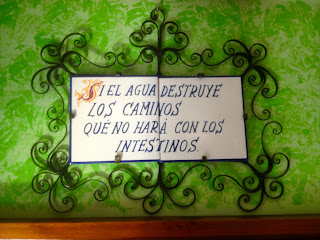

water destroys roads. Just imagine what it does to your intestines

the 1 pm rush hour at Castaneda. hard to find a slot at the bar before 2, when they all go to lunch

The essence of a good tapas bar is ambience, a good selection of wines, and varied tapas dishes. A dose of humour also comes in handy 


Tapas bars in Granada may be traditional, like this excellent one above, Bodegas Castaneda (and a big hello to Alan S who introduced me to this place on a previous visit), or more modern, like this one, called Mariscal, next to the Corte Inglès department store.


and, if you turn around, you will see this fabulous collection of hams and other delicacies forbidden to muslims, as the bar backs onto a major delicatessen in which I saw people queuing up for hours to do their shopping.


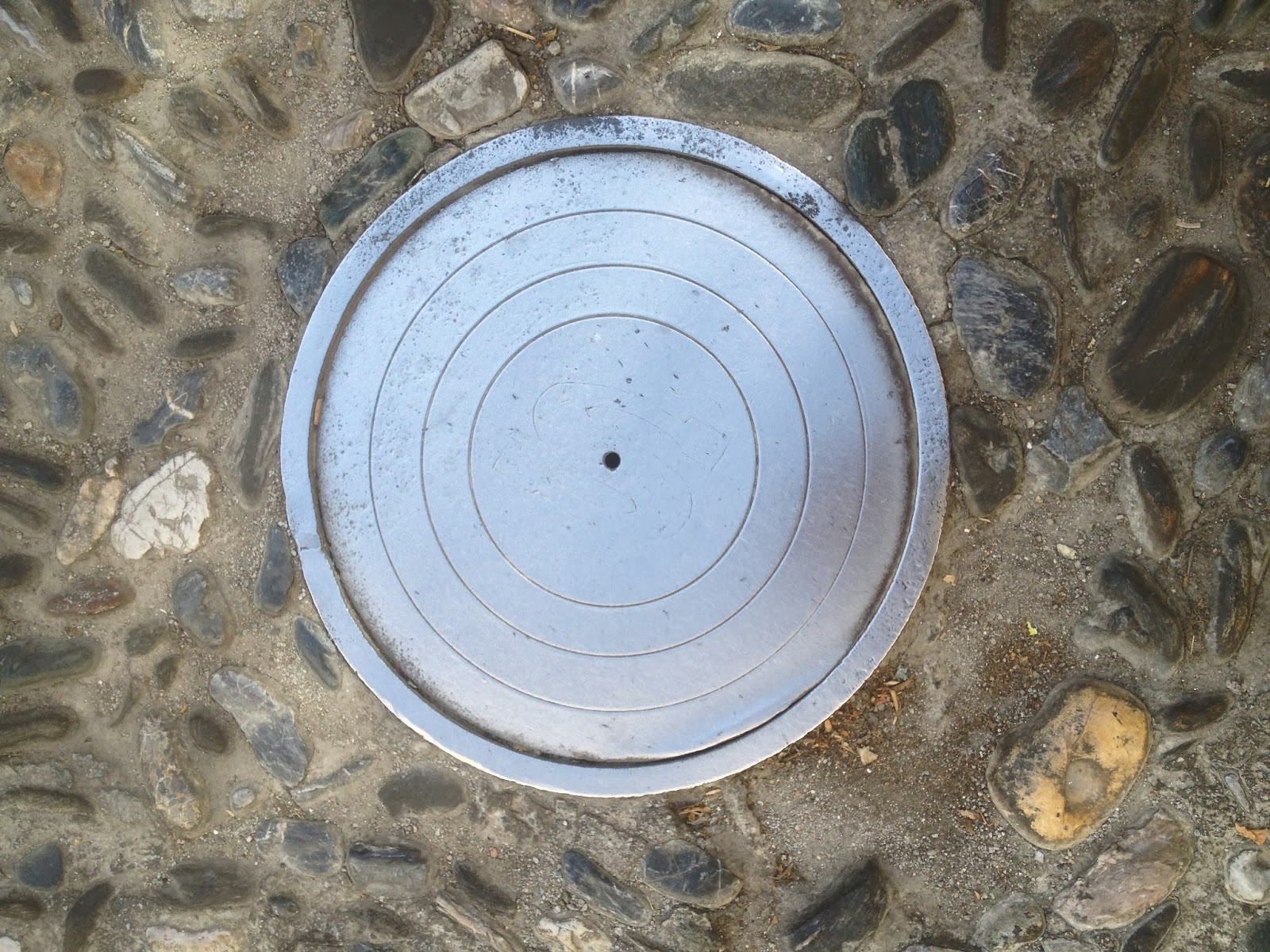
Walking in Granada is a constant joy, partly because the city has managed to keep motorcars out of much of the centre and the many narrow streets that naturally discourage our 4-wheel friends. But also on account of the often beautiful pavements made of small stones hammered into sand and then cemented into intricate and functional designs.




Manhole covers look good too...


A biker can find occasional solace by checking the machinery parked outside some bars, like this KTM 1190 RC8R. A ride up to the Sierra Nevada? Just miss the manhole covers on the way out of town.


More about Granada and its attractions quite soon.....

14 Mar 2013

Street art can be beautiful and/or fun

This says : "Reciprocity is a mystery". I like that...

Actually this is on a window and not a wall, but I am sure that you get the idea. Most graffiti (sometimes pompously called "street art") that I see is ugly and garish and has been inflicted, undesired, on public places, just adding another layer of ugliness to areas which are already blighted, and sometimes acting as acne on otherwise quite acceptable faces of architecture. But there are occasional graffiti artists whose works I see on walls here in Paris that make me smile, or think, or laugh, or indeed several of these. The one above is on the window (in the window?) of the tourist office near where I live, and it is clearly signed by someone going under the intriguing pseudo of Miss-Tic.

The first "street art" of this type of which I have a clear memory were the finely-drawn posters of the french poet Rimbaud that I saw stuck on dilapidated walls in Paris's 14th arrondissement in the late 1970's (see below).


These were my first contact with the remarkable work of the French artist Ernest Pignon Ernest, about whom I have written on this blog here.

With perhaps more humour, but a lesser sense of history, more recent street artists have done some fun things on the walls of the Butte aux Cailles district in Paris' 13th arrondissement. It should be remembered that this district is still a bastion of artists' studios and was a hotspot for rebellion during the Paris Commune movement in the 1870's, as well as during the "events" of May 1968, almost 100 years later.


Spontaneous and involuntary forms of sculpture are also a feature of what can loosely (and sometimes pompously!) be called street "art". The two photographs below are taken on the Pont des Arts, a pedestrian bridge across the Seine that links the Louvre to the Ecole de Beaux Arts. There is another bridge similarly decorated with lovers' padlocks a bit further upstream. I find this far more interesting than most so-called "installations" that one sees in galleries. The locks shine like gold in the sun and are densely packed on either side of the bridge. This has an interesting optical/kinetic effect as one walks across the bridge. Of course the scale and the site help a bit!


On a recent visit to the Slovenian capital of Lubljana, I saw the beginnings of a similar installation on a bridge there, so perhaps there will be, at some point, an international circuit to be followed of lovers' bridges. Better than that damned da Vinci Code circuit that seems mercifully to have died out. Love is eternal after all...


And if you go to this article, you will discover another good piece of graffiti that I spotted in Lubljana (one picture of it is below).


29 Nov 2012

Go to Lubljana!

I recently spent a couple of days in the capital of Slovenia, Lubljana, whilst attending a wine fair there (about which I will have more to say in another article). First visits to a country or city are often, but not always, the most impressive, as one is, literally, at one's most impressionable, acting like a sponge to all that is new, strange and beautiful around one. All that it ugly too, for that matter. As I said, a sponge...

This article will take the form of a commented snapshot album of small (or larger) things seen. I did not systematically take photographs of everything I enjoyed here, as there was so much and I really prefer just soaking it it, at least the first time around. Suffice it to say that I loved this old city, at least the central part, blissfully car-free and which I visited extensively by foot. I would highly recommend a stay in Lubljana to anyone. The people are very friendly and helpful, the hotels good and reasonably priced, the food and the wines too....what more could you want? I even found an Irish bar that shows rugby games and has 83 beers on offer! A slice of paradise, I tell you!


The dragon is the emblem of Lubljana. This is one of the many turn-of-the-20th century sculptures to be found in Lubljana, and it is one of four of these beasties that guard one of the bridges that span the Ljubljanica River. The bridge is called, not too surprisingly, the Dragon Bridge, and it leads to the splendid market were you can see scenes like the two below, buy great fresh goods, or eat and drink in surrounding cafés. It was designed by the Croatian architect Jurij Zainovich (the bridge I mean).


Lubljana, at least the old town, seemed to me to be happily low profile and discreet, and most of the streets are gloriously free of those dreadfully ubiquitous "big brand" shops (mostly cloths) that totally pollute almost all of the world's cities these days, making you wonder just where you are at times. On the contrary, the streets I walked were full of shops selling odd antiques, books, locally made stuff of all kinds, good food, and cafés and restaurants of all descriptions (and I didn't see a single Chinese restaurant!). Add to this the fact that it's architecture is quite fascinating, occasionally off-key with great colours on some of the facades, and full of sometimes quirky details and a true sense of craftsmanship. I found some similarities in feel to Prague, with perhaps a more "southern" touch.


The lamp post above, like several others and the famous triple bridge (see first photo below), was designed by the local architect Joz Plecnik. As you can see, Lubljana also looks great at night, with some very subtle lighting making the buildings look sharp and intricate, yet very different one from another. 


Presumably some of the strange objects that I saw in the street were due to the pre-Christmas decorations, like this giant teepee-like construction (above) that went the height of a two-story house and stood on the fork between three streets near my hotel. And decorations of various descriptions seem to be into hanging objects, like this collection of shoes supended between two buildings.


Or this one...


There are many more padlocks on either side of this bridge, left apparently by lovers who have sealed a pact, presumably throwing away the key to their hearts into the river below (youth is so rash...but then are they all youths?).

There is also evidence in the streets of contemporary art and contemprary philosophy colluding. What is the world coming to?


And if you want a reasonably priced hotel recommendation for Lubljana, here it is. 

http://www.adorahotel.si/

My room was very comfortable, practically designed, simple, light, impeccably clean and inexpensive. And the staff were particularly helpful and friendly. What more could you want?

Get going!


25 Oct 2012

The Barnes Collection in Philadelphia


I happened to be in the city of Philadelphia recently to do a job and managed to find the time to visit what has to be the most amazing collection of art of all descriptions that I have ever seen. I am of course referring to the Barnes collection, which is now harboured in a modern building right in the centre of Philadelphia.
 
 
The Barnes Foundation building in Philadelphia
 
The story of Albert Barnes is a remarkable example of an American success story. He was born into a working-class family in 1872 and grew up in Philadelphia. He obtained a medical degree at the University of Pennsylvania before pursuing his studies in Germany. Back in the USofA, Barnes, togther with Herman Hille, discovered an antiseptic silver compound called Argyrol that was used to prevent infant blindness. Having gone into the pharmaceutical business in 1908, the Barnes Company made a fortune thanks to the success of Agryrol. Barnes had already begun collecting and went on to buy extensively art of many kinds and periods, with an emphasis on French impressionists and post-impressionists. He created the Barnes Foundation back in 1922, whose stated aim was to «promote the advancement of education and the appreciation of fine arts ». He died in 1961, aged 79, leaving a testament that I will mention later on.
 
 
Dr Barnes

Many things are remarkable about this collection: its size, its eclecticism, the depth it shows in the collections of the works of numerous artists, and the way it is set out and hung. Dr. Barnes left his collection, via a Foundation, to his city, stipulating that it should neither be moved from his town house nor the works altered in their positions on the walls. The problem was that his house, although quite large, did not have the facilities to accomodate an increasing flow of visitors and was situated (it still is, and it harbours another part of the Barnes Foudnation: that devoted to his wife's botanical collection) some way out of the city centre of Philadelphia, and with very little parking space and inadequate public transport. So it was decided to move the collection into a modern building situated in the centre of town. This created some conservative furore, but I think they made the right decision. To respect at least part of Barnes' wishes, the shapes and proportions of the original rooms have been reproduced within this modern building, along with the very idiosyncratic hanging set-up devised by Barnes himself.


The original Barnes home, from which the collection has now moved


The central ground-floor gallery in the new building, which also reproduces the lighting of the old Barnes house. One can just see part of the Matisse triptych high on the left, fitting into the arches. And another strange feature of this hanging are the hundreds of old door fittings, which Barnes also collected, on the walls in between the paintings like so many punctuation marks. 
 
 
Now about the paintings and other works to be seen here. First of all you need to book your ticket ahead if you hope to get in, as they wisely limit the numbers of people allowed in at one time. Luckily I had my press card with me! Second you had better allow yourself at least two hours, and better still three. There are more Renoirs, Cézannes and Matisses here than anywhere alse I can think of. And there is much, much more besides.
 
I have to admit to disliking the paintings of Renoir. I know this is not a widely-held point of view, but I consider him to be a bad painter: all that sloppy softness and women who look like they are made of Spam (anyone remember Spam?). I think Renoir is the David Hamilton of painting, although his women must outweigh the Hamiltonian nymphette models by about three to one apiece. There is no getting away from Renoir in this place though, as there are usually several on each wall. They just pop up all over the galleries, like bad pennies. This is partly due to the fact that Barnes clearly had a big thing for Renoir, and partly due to his practise of hanging paintings from different styles and periods together, and often in rows three or more high on densely cluttered walls.
 
Once one gets used to this clutter, the hanging becomes legible and often very interesting. The anachronism in particular can be most illuminating. In one gallery I saw, surrounding the inevitable blotch of Renoirs, a Titian next to a fantastic (and anonymous) 15th century German portrait of a woman, followed by some fabulous Chinese painting on what seemed to be silk. Barnes clearly not only had a sincere and profound love of art, but also a very good eye. Or there is a Milton Avery next to a Puvis de Chavannes, and that works really well too. And so on. I found the hanging and its surprises one of the joys of visiting the Barnes collection, after an initial recoil that we can call the Renoir-repulsion syndrome.
 
 
one of the many and admirably musical (think Bach) Cézanne still-life works in this collection
 
 
Manet, for instance, of whom there are just a few stellar paintings in this collection, is an infinitely better painter than Renoir, even when he is at his most spontaneous and loose, in terms of composition and technique. But the next most important collection here, in terms of numbers of works by a single artist, must be that of Cézanne. Apples, pears and oranges everywhere! This must be the biggest collection of Cézanne still-lifes anywhere in the world. And there is much more, including some stupendous landscapes and a great portrait of his mother. But Cézanne, like Matisse but unlike Renoir, is a truly great painter. He had to struggle a bit at the beginning, but when it started to click for him...wow! Cézanne builds his paintings, shaping them like a craftsman. You can see it just as much in his watercolurs, of which there are several, as in his oils, of which there are many here. His paintings are usually architectural, often constructed like written music. They do not seem spontaneous, yet they breathe life, through the vibrations, the constant conversations between shapes and colours. His use of perspective is dynamic, offset from a central viewpoint and so never static, as in the work below...


Another strong point in Cézanne's work is that most subsidiary parts of his paintings hold up on their own, such is the architectural quality of their overall composition. Next time that you look at one, just try blocking off the vision of half or a third of it with your hand and see for yourself. 
 
What else is to be seen here? You name it: a few Gauguins, some good early Picassos, a fabulous series of Henri "Douanier" Rousseau, the odd Toulouse-Lautrec and Seurat, and a mass of Matisses, from the very good to the indifferent (Matisse, like Cézanne and Van Gogh, was not a "natural" draughtsman, unlike Picasso). Oh, and a very good Frans Hals, etc, etc. I will have to do another article on this place as there is just too much to say!
 
Meanwhile here are a few more images of some of those I mentioned....a bit like the Barnes hanging, all mixed up.


Now do you want to go to Philly? Here's the main place to go.....


And you can try this restaurant (actually they have several, I understand, but I tried Barbuzzo's for lunch) when you are there. There wine and beer list is is good, the place is simple and friendly and the food is ok: