Showing posts with label Tastes good. Show all posts

5 Dec 2013

Dominio IV, an exemplary small Oregon winery

During the summer of 2012 I was spending a couple of weeks on holiday along the north-western coastal and forest areas of the USA. I had more or less resolved not to visit any wineries, and therefore that I would probably not be talking much about the wines of Northern California and Oregon on this blog, although I did relate some of my travel experiences. And I pretty much kept to this resolve, at least until now, some 15 months later. In a general sense these things just creep up on you and move you to investigate something and get back into what is, after all, as much a passion as it is a job for me. Then, sometimes also, they linger in your mind for quite a while until you finally decide to do something about what you have experienced. Like a dream that you cannot quite decypher the next day but which hangs around in your head like late morning mist in a valley. So here it is...


Sculpture of a horse (life-size), made of driftwood and seen in the Portland Art Museum. It is made with driftwood. I forget to note the artist's name. When travelling up the western coast, I noticed how much driftwood littered most of the beaches and wondered what I could do with it. Now I have some ideas!


I had not visited Oregon before, so was naturally curious at some point to try a few local wines. Production of wine in this state (which is surprisingly only the 4th largest producer amongst the states of the USofA) began quite recently, in the late 1960's or early 1970's. Since then the learning curve has been pretty steep, at least if the winery that I visited during my trip is anything to go by. Some of the wines that I tried during this 2 week journey, by the glass, in restaurants and wine bars here, were indifferent, but the majority were good to very good, and one, tasted one evening, just sung out to me. I was staying in the small town of McMinnville, south of Portland, and which seems to have the making of being the wine capital of the Willamette Valley. This long valley, bordered by hills, is Oregon's principal wine region and is home to the majority of plantings of its star grape variety, Pinot Noir. 


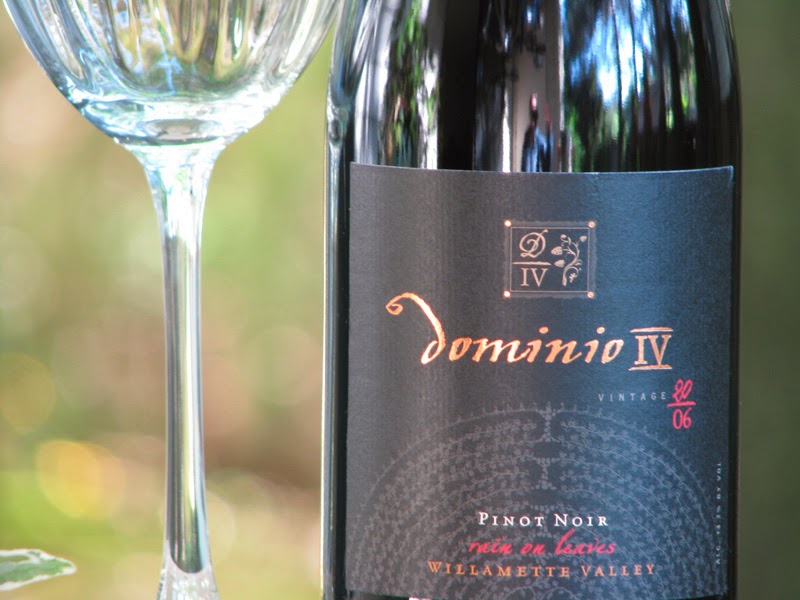
The Oregon Hotel is the old hotel (they say "historic" locally, but then, in the western US, anything over 50 years old is considered to be historical) of this town and is part of the impressive empire of the McMenamin brothers, who are brewers, wine producers, hoteliers and restaurateurs, their empire spreading through the states of Oregon and Washington. Their hotels are fun, volontarily off-beat, and full of mainly 1970's musical nostalgia and loads of historical references to the past lives of their buildings that have been quite creatively restored. But their restaurants make the bad mistake of serving only their beers, which are good enough, and only (at least by the glass) their own wines, which are quite underwhelming. So we ate out that night, and luckily so! There was not a lot of choice in McMinnville, so I was happy to find a decent selection of wines (of Italian and Oregon origin) by the glass in Nick's Italian Café, right by the hotel. Michael, the helpful and knowledgeable wine waiter there, poured me three Oregon Pinot Noirs, and the second one just hit the spot for me. It was soft at first, then firming up on the palate, with lovely fruit and balance. It had that velvety texture of the finest Pinots and tasted better at each sip. I loved it from the start and it kept growing on me as I gradually emptied the glass, checking it against the other two which were very decent wines. The producer was intriguingly called Dominio IV and this particular Pinot, one of a range, was poetically named "Rain on Leaves". As I was later to discover, the wine-maker and co-owner, Patrick Reuter, is also a poet. It was from the 2007 vintage, which, according to waiter, sorted out the men from the boys in terms of local wine production. So I asked about this producer and it turned out that the winery was in town and I was able, then and there, to make an appointement to meet Reuter next morning, to talk with him and taste some more wines.


Reuter, with 3 partners, started his operation some 10 years previously. He had studied with his wife, a viticulturist, at Davies. They have travelled the wine world quite widely, including a harvest stint with the late Denis Mortet and another with Armand Rousseau in Burgundy's Côte de Nuits. Hard to find better pinot credentials, if you are looking for that sort of thing! 

Like viticulture, the word Dominio comes from way back in the past. The Spanish use the word to mean land or territory or dominion, whereas the Romans have a secondary meaning of a feast or banquet. Thus the word takes on a sense of being a feast from the land. Dom is also of the sun as in Domingo (Sunday). The number four represents four people, four seasons, four varieties of the grape and four quadrants of the Dominio symbol, the labyrinth. Four is also the number of the earth (for whom I am unsure). Ok, so perhaps we are getting a little esoteric here, and, as regular readers may be aware, I am not particularly into mumbo-jumbo (1). What is in a name after all? Well maybe quite a lot, especially when you learn that Patrick Reuter also writes poetry.


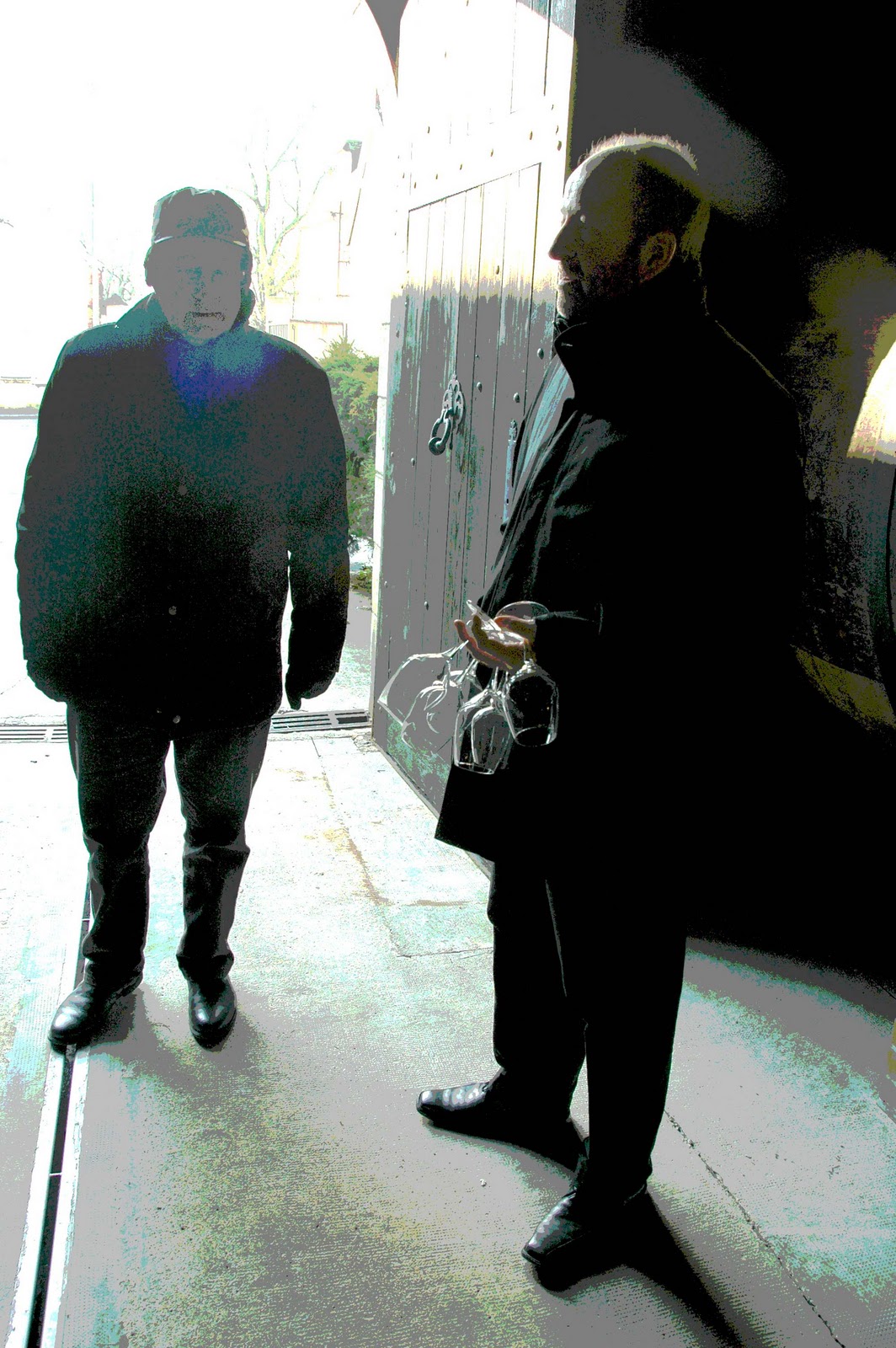
Patrick Reuter outside his winery in McMinnville

The short story of my visit to the Dominio IV facities, which are installed in a converted industrial barn in the suburbs of this small town, is that I found the wines quite fantastic and Patrick Reuter delightful, open, relaxed and coherent in his approach. Most of their small production is produced from purchased grapes, essentially pinot noirs from single plots and with the clone identified on the labels. But I also tasted one of the best viogniers I have ever had from outside the Rhône Valley. It just sung with freshness and intense fruit flavours and the grapes hailed from vines higher up into the mountains that separate Oregon from California. I don't know whether they ripen there every year, but this one was fantastic. Dominio IV also own their own vineyard in the north-eastern, much hotter part of the state that lies close to the border with Washington, along the Columbia River east of Portland. Here they grow Syrah and Tempranillo and the wines I tasted were intensely good. They are into biodynamics, for those interested in esoteric practices, but Patrick seemed very down to earth and did not bore me with any planetary visions. Reuter is clearly pragmatic and keeps his base wines for a future sparkling cuvée, called Flora, in recycled Coca-Cola aluminium drums (see below).


yes, wine and Coca Cola can mix, under certain circumstances!

I highly recommended the wines of Dominio IV to anyone who is in Oregon, and they are well worth looking for anyone elsewhere in the USA. If any ever find their way into France I will be a customer for sure.

For more information, take a look at their website:
http://www.dominiowines.com

Drink well....
(photos by David Cobbold except for the one of the label)

(1).footnote (thanks to Wikipedia): Mumbo jumbo, or mumbo-jumbo, is an English phrase or expression that denotes a confusing or meaningless subject. It is often used as humorous expression of criticism of middle-management and civil service non-speak, and of belief in practices based on superstition, rituals intending to cause confusion or languages that the speaker does not understand. The phrase probably originated from the Mandingo name Maamajomboo, a masked dancer that took part in religious ceremonies.Mungo Park's travel journal, Travels in the Interior of Africa (1795) describes 'Mumbo Jumbo' as a character, complete with "masquerade habit", that Mandinka males would dress up in order to resolve domestic disputes. In the 18th century mumbo jumbo referred to a West African god.

4 Nov 2012

Simple pleasures in food

I enjoy food, and by that I mean good quality food, made with decent ingredients which are well-prepared. And not too much of it at one time. But, despite the fact that my work is concerned with the workings of taste and particularly its applications to wine, I am definitely not what is known as a "foodie", that is to say someone totally obsessed with whatever goes into his mouth. I don't care a lot for fancy restaurants, for example. I prefer to eat in places that make me feel at ease. They must serve decent food for sure, but the atmosphere of these places, and the friendliness of the service is at least as important than what is in my plate. I happen to know a few famous chefs and appreciate very much, on occasion, eating their cuisine. But I would never make a thing of going to such places regularly, even if I had the means to do so. For instance, I simply cannot imagine booking ahead seats in a fashionable restaurant. If they can't take me when I show up or call that same morning (rare event) then I will just go someplace else or stay at home. So you can be sure that you will never find me standing in a queue (real or virtual) for any restaurant, unless of course I am truly starving. The rest is pure snobbery.


oeuf à la coque on the floor of my kitchen in Gascony


When one feels the need to get back to basics, like when strong feelings flow around you, during seasonal changes, when life is hard, intense, stressful, beautiful or otherwise powerful, the simplest foods are often the best. This morning, for me, it was a boiled egg.

Living in France and spending more than half my time speaking the French language, I am often struck by differences in the senses behind expressions or words that describe the same object, event or process between English and French. I have occasionally, on this blog, underlined the impoverishement of sense that prevails in the translations of film or book titles from English to French. But, in this instance, the impoverishement would seem to run in the other linguistic direction. The French term for "boiled egg" is "oeuf à la coque". This means "egg in its shell", and I like this far better than "boiled egg". Not sure why, but I do. The very definition provided in the inevitably useful Wikipedia is quite enough to put one off the English version, far too basic and flavourless in its expression.

"Boiled eggs are eggs (typically chicken eggs) cooked by immersion in boiling water with their shells unbroken. 
(Eggs cooked in water without their shells are known as poached eggs, while eggs cooked below the boiling temperature, either with or without the shell, are known as coddled eggs.) Hard-boiled eggs are either boiled long enough for the egg white and then theegg yolk to solidify, or they are left in hot water to cool down, which will gradually solidify them, while a soft-boiled egg yolk, and sometimes even the white, remains at least partially liquid."


 the same egg on the table, to show that we can be sophisticated down in the country!

There is something quintessential, amost primitive, about the egg in its shell. It doesn't matter whether it comes from the chicken or another bird. Just the size (and the flavour, to some extent) varies. The shape is strong yet refined with its variable taper on each end. I have heard that the strength of an egg-shell lies way beyond it thickness, signifying perfect design and strength/weight ratio.

A friend once told me that French table protocole stipulated that there were 7 forbidden practices to be avoided at all costs in refined society, when confronted with an "oeuf à la coque".

1). Do not place the egg sharp side down in the egg cup.
2). Never cut off the top of an oeuf à la coque with a knife. One can bash it with a spoon or cut it off with a spoon.
3). Never use a silver spoon to eat one (for the very good reason of undesirable chemical reactions affecting flavour).
4). Do not dip slices of bread or toast into the egg once opened.

This is the point at which I part company with these rules of good behaviour, so I will spare you the others, especially as I cannot remember them anyway! As you will notice from my photographs, I was not about to not obey rule 4 anyway. On the contrary, dipping a slice of fresh and firm bread (or toast) with its crunchy crust into a soft-boiled egg is one of the morning's great pleasures. Eminently sensual, of course. Rules 1, 2 and 3 are just plain common sense. 


6 Jun 2012

Which wine to drink with spicy food?

If you just want an answer to this question, you can skip to the bottom of the page!

When I am in my cynical vein, I sometimes feel that the whole topic of wine and food "matching" is simply a good excuse for selling books on the subject. I suppose I should know, as I am responsible for a few of these, as requested by various publishers. Public demand seems to lie behind this spate of "litterature", and I find that questions linked to the topic are indeed among the most frequently asked in the wine classes that I teach. This curiosity (or should we call it "bafflement"?) seems to be quite widespread, and is probably born out by the fact that amongst the 20 or so books that I have written or co-written on and about the subject of wine, the best-selling one is entirely devoted to the subject of wine and food pairing.

(and to assume my cynicism to the hilt, here is a link to enable you French-speakers to buy this book, which I compiled in partnership with a food speicialist, Pierre-Yves Chupin, and which acts as a double-entry dictionary that can operate either from the wine side or the food side)
http://www.amazon.fr/Vin-cherche-plats-David-Cobbold/dp/2215094249

To be perfectly honest, the more I live and try different wines and foodstuffs together, the less I feel that I have any real certainties about the topic. My only heartfelt piece of advice to anyone would go something like this : "just try what you feel like drinking at that moment with what you have on your plate, or vice-versa. You have as much chance of enjoying the experience as you will by reading all this theory written about the subject of the do's and dont's of wine and food pairing!"

But of course there are some foodstuffs that make matching a wine to them tricky, and one of them is clearly spicy food. Just by chance the other day I was having lunch alone at home, next to my office, after a tasting session on some rosé wines which seem to be all the rage at the moment here in France. Being alone and in a hurry I micro-waved a one stop meal which happened to be curry based. As I had two bottles, one red and one white, open and to hand, I decided to see which one went best with this slightly spiced dish, which used chicken and rice as its mainstay. 


The red wine was a gloriously deep and aromatic thing from the Corbières region of France's Languedoc. Named, rather mysteriously, Atal Sia, (which I understand means "so be it") this is a relatively upmarket cuvée from the 2009 vintage produced by a very reliable estate called Ollieux Romanis, from which I have never had a bad wine. This particular cuvée retails for slightly less that 20 euros. I had tried it the evening before and it was quite glorious, full-bodied without being overpowering, pungent with wild herb and garrique-like aromas, quite smooth in texture yet strongly lingering on the palate. A journey to a wild and rocky place, yet a civilised journey. For those interested, this wine is a blend of various grapes used in the Corbières appellation, with carignan making up almost 50%, the rest being divided between grenache and mourvèdre, plus just a pinch of syrah. 


The white wine was an off-dry Riesling (so many are just that these days, without even declaring their residual sugar, but that is another problem) from Alsace and produced by an estate with which I am not familiar. The estate is called Domaine du Windmuelh (yes, it means "windmill" in the Alsatian dialect of German), and the cuvée is called Riesling Vieilles Vignes 2010. The wine was perfectly good on its own and, probably on account of its slight sweetness that balanced its fine acidity, reminded me more of the delicate German stye of rieslings that the usual Alsace style which tends often towards more alcoholic power and so less sugar. This wine would, I expect, have qualified for the spätlese category had it been German. I do not know what it costs but I suspect in the vicinity of 10 euros.

Some authors recommend going for a rich and slightly spicy red wine to match the spices of a curried dish. I have never found this to be good advice and indeed it didn't work at all in this case. The powerful Corbières red, glorious on its own, lost all its depth and finesse and tasted like a rather ordinary rough red when I tried the curry dish with it. On the other hand, the Riesling just sung out! It fruit was enhanced, its fine acidity balancing the richness of the sauce and its small amount of sweetness was sufficient to master the low-level fire engendered by the curry. The whole experience was refreshing and enhancing for both the dish and the wine. I suppose that puts it close to the elusive "perfect match" category.

24 Apr 2012

Two really good wines

After the first wave of electoral fever here in France last weekend, I felt like drinking something from other places.

Guess why? Well, the stupidly xenophobic party currently called "National Front" that has virtually no programme except for taking France out of Europe and throwing all non-French people out (I am hardly exagerating!) managed to get about 18% of the votes here on Sunday. At least they came in only third. In a way, it might have been better in the long run for them to come second, then they would have had to show their real and rotten mettle and would have been soundly beaten in the next round. Perhaps not on second thoughts.

Enough of that and on with some good things in life, ie 2 really good wines that I drank with friends the other evening.


1). Weingut Schloss Sommerhausen, Auxerrois Extra Brut Vintage 2004, Franken, Germany

On the left, the aperitive wine is a very fine sparkler from Germany's Franken (Franconia) region, in the centre of the country. This is probably one of the coldest wine-making regions in the world, and you can feel this in the incredibly fresh and crisp nature of this wine. The makers are obviously experts at producing sparkling wines, as this has very fine bubbles and just as much, if not more delicacy than many Champagnes. The bottle we drank was made from the rare Pinot Auxerrois grape, and was very lightly dosed as an Extra Brut (less than 5 grams, I expect). Amost clear as water in its colour, but the flavours are all there, with an incredibly delicate touch, perfect balance and good length. It leaves the palate feeling very alert and refreshed, wanting another glass. 
I have seen it on sale at around 25 euros, which is not cheap, but it is well worth that. It goes to prove that one can find treasures amongst the vast mass of usually indifferent German sekt.

And here is a picture of part of their vineyards. Need some south-facing slope to get grapes ripe here, I expect:


2). Mazzei, Fonterutoli Chianti Classico 2009, Tuscany, Italy

On the right of the top picture, a more classical choice (no play of words intended!) with this really good Chianti Classico from the very old family Mazzei, who have been established in Tuscany since 1435. That of course has no bearing on their ability or will to make a good wine or not, but it is a fact nonetheless. The wine is just about everything one could want from a modern Chianti: finely textured and full of fruit, with that gloriously juicy freshness that seems so regularly present in Italian reds, especially from hilly Tuscany,and just enough structure to ensure that it has the character to go with flavoursome dishes. This is not a huge overpowering wine: it proves once again that it is not necessary to be "big" to be beautiful!
I paid a little under 20 euros for this in a retail shop in Paris and it was worth every centime. When wines are that good, they just disappear so fast that you need another bottle. I didn't have one so we remained very reasonable in our consumption that evening.  

15 Apr 2012

Wines of the week: Le Roc des Anges in the Roussillon

Its not that I am getting to be blasé or anything, but it does happen that weeks can go by without any single wine in particular really impressing me. About a fortnight ago I tasted a very special Valpolicella from Masi, but I didn't take any notes or photos at the time: I was enjoying it too much! I taste many wines in most weeks, and some may be good or even very good. But not that many leave me with that kind of feeling that I want to try them again as soon as possible, maybe even buy some, or perhaps go to see the place they come from.

Maury Op. Nord 2009 from Domaine Les Terres de Fagayra,
and Roc des Anges vin de pays des Pyrenées Orientales 2008


Last week a couple of the wines from an estate called Le Roc des Anges (the Angels' Rock: great name for a place) did all three things for me. Actually one of them is called by another name as it comes from a different estate, but they are both made by the same wife and husband team, Marjorie and Stéphane Gallet. This other wine is a red fortified Maury and is called Op. (for Opus) Nord from the 4 hectares estate that the Gallets acquired 4 years ago and which is named Domaine Les Terres de Fagayra.


The Roussillon is the name given to French Catalonia, and its capital is Perpignan, which a painter whose work I dislike, called Dali, famously described (actually its railway station) as "the centre of the world". But then he was the number one poseur. The area lies against the north-east Spanish border, squeezing itself into the narrow band of land between the Pyrenees mountains and the Mediterranean sea, wrapping itself around the mountains in a precarious balancing act. Although much of the plains and coastal reaches of the Roussillon have been ruined by the usual horrific sub-urban sprawl, laced with motorways, "commercial" zones, caravan sites, billboards and the rest of the usual trash, most of this region is ruggedly beautiful land which bears the imprint of its violent topography, not to mention past wars, winds that may blow for more than half the year, hot sun and frequent droughts.

Marjorie at work in her winery

The Gallets met while they were both oenology students at Montpellier University. Marjorie started the estate more or less on her own as Stephane had a job managing a large estate nearby called Mas Amiel. Now they work together. The 26 hectares of Le Roc des Anges are comprised of something like 50 different plots of vines, which, in this rock-strewn and constantly folding landscape makes for some very variable orientations, altitudes, and soil types, not to mention the varieties planted since they have acquired, bit by bit, many plots planted with old vines. This hard-to-work area has been progressively abandoned by the older generation of local vinegrowers, who, with rare exceptions, did not make their own wines but delivered their grapes to merchants or cooperative wineries. As there is an altitude factor involved, their whites are incredibly fresh for southern whites, but it is the reds, or one of them, that I am going to try to describe here. 


This is produced from a plot of very old (over 100 years) Carignan vines. I first sampled this wine, in Marjorie's first vintage, back in 2002 and it knocked me out then. This week I tasted the 2008 vintage. Don't be fooled by the label and the 1903 printed in bold type: that is the year in which the vines were planted. 

Carignan is a much maligned grape variety as it was for some time planted in the wrong places. But is particularly suited to this extreme climate and the low yields than result from the terrain and the lack of water, as it retains acidity despite the summer heat. Hence it never feels heavy, as can be the case with grenache, also widely planted around these parts. Carignan produced from old vines can be quite remarquable, like this one. 

The aromas are as intense as they are closely intermingled, and so are pretty hard to describe. The have shades of spices, wild black fruit, wood smoke and seem rich and warm without being overbearing. The natural warmth of the flavours is perfectly tempered by the ingrained acidity which makes the wine seem vibrant and crisp. The texture is still slightly rough, but that simply evokes images of the ruggedly sharp rocks that litter the land. The freshness continues right to the finish, drawing the wine along a passage of flavours that continue to delight one. I would like another glass please.


The Maury is comparable to a Vintage port on account of the fortification technique used to produce it. It is hence slightly sweet, having been fortified with 10% added alcohol during fermentation. But its tannins, acidity and texture are sufficient to make one almost forget the 16.5% alcohol content. Made with Carignan and Grenache (I think) it will probably last for a long time and I would be very interested to try a bottle in 20 years or so if I'm still around. Maybe I shouldn't have another glass of this, but it tempts me....here's some blue cheese, let's see if that works.


And here is the link to their very well-designed web site, in case you want to know more: http://www.rocdesanges.com/fr/index.html

As for me, I think I'll be heading there sometime this summer on my new bike (that's another story to be told sometime soon).


2 Apr 2012

What makes a wine "great"? The example of Shafer Hillside Select from Napa

I have also addressed this topic in an article, published today and in French, on another blog that I share with four other wine accolytes called "Les 5 du Vin" . This article is a bit different though, so those who read French and both blogs will be spared much repetition.

The question of what defines a "great" wine will never be fully answered, as all aesthetic judgements are invitably, to a great extent, personal. Then there are the usual semantic issues: what sense do we impart to the word great? We sit in the sun and have a beer after some physical and mental effort and say "this feels great". Obvously this sense is different when we talk about a "great" wine as opposed to a "good" wine. A "great" wine implicitly takes us into another vinous dimension, mixing the sensual with the analytical and involving our memory, all being intimately linked to an intense sense of pleasure or well-being.

maybe these are the places in the brain where we experience great wine?

I tend to think a bit about this question every time I get to taste a wine that strikes me as being exceptionally good. Of course the taste element here is primordial, but is that sufficient? After all, taste is personal, and, like all forms of aesthetic judgement, one's taste can be questioned and even disowned by those who have different tastes. Yet, in the matter of wine, there tend to be currents of consensus which establish reputations for "great" wines. These reputations, propagated by media and word-of-mouth, duly increase demand which goes on to inflate the prices, adding that financial ingredient that serves (for too many people!) as an indicator to "greatness". So, can one retort that all this is bullshit based on someone's personal opinion and then reflected by snobbery backed up by high prices? Not entirely, and for two main reasons.

First of all, earning more money from a product enables the producer to invest larger sums in improving it, or at least in maintaining its initial quality. This is eminently true in the case of wine. Bordeaux's 1855 classification was based on the trading values of each wine, but those values reflected market perception by a number of different professional actors, not just a single person's opinion. And the additional funds that are received by the most expensive wines enable their owners to maintain or increase investments, hire the best people, and generally do everything they can to stay at the top of the reputation hierarchy whilst still earning good money. The notion of consensus of opinion is also an essential element of a wine's reputation, and these opinions necessarly come from a wide spread of experts: ie professionals who have long experience in tasting different wines and who can apply the notions of relativity, prediction and reliablity to the wines thay are tasting.

Prediction and reliability? Yes, because the time factor is essential in the notion of a great wine. Great wines can stand the test of time in a way that other wines cannot manage. They must also be consistent in their quality, as far as possible, and despite the variations in weather conditions. They will differ whilst staying on a comparable quality level. What mother nature cannot provide, man has to compensate, usually by restricting production to allow only the best grapes to be retained to make the "great" wine. 

So we have three essential qualities that have to be united in a "great" wine. Perceptible quality, above that of the majority of its peers, regularity of that quality, and the capacity to age gracefully for as long as possible. I will put aside the price factor which tends to be a corollary of the previous three, unhappily for those of us without considerable means. All these requisites are met by a wine from Napa Valley that I had the good fortune to taste recently through a series of 17 consecutive vintages, running from 1993 to 2007.


The wine in question is the Shafer Hillside Select Cabernet Sauvignon, which is one of the top range of wines from this Napa producer, from their hillside vineyards in the Stag's Leap District. The Cabernet is part of the Hillside Select range, itself one of other sub-ranges in the Shafer portfolio. Shafer is not a huge, but a sizeable producer with an excellent reputation for consistency. The family moved to Napa in 1973 and this wine, I believe, was first produced in 1978. We are on the Silverado trail here, and this naturally brings to mind the amazingly far-sighted words of Robert-Louis Stevenson, back in the early 1880's, in his account of his honeymoon voyage called The Silverado Squatters. One should bear in mind the context of these words, which coincided on the one hand with the end of the gold and silver rushes in California and on the other with the demise of European vineyards caused by the louse called phylloxera: "so, bit by bit, they grope about for their Clos Vougeot and Lafite. Those lodes and pockets of earth, more precious than the precious ores, that yield inimitable fragrance and soft fire.....The smack of Californian earth shall linger on the palate of your grandson." Stevenson did not know at the time that phylloxera in Europe would be circumvented by grafting, but he got the future of Californian vineyards right!


Early plantings at the future Shafer estate in the foothills


Shafer are neighbours of the famous Stag's Leap Wine Cellars, whose 1973 Cask 23 won the famous "Judgement of Paris" event held in Paris in 1976, when, in a blind tasting, French tasters rated it above the best from Bordeaux at that time. This success firmly put Napa on the fine wine world map and encouraged many other entrepreneurs to come and settle there. Now Napa Valley, between the mountain ranges that border it to east and west, is wall-to-wall vineyards.


The home of Shafer and part of their hillside vines running up the sides of Stag's Leap towards Atlas Peak


Looking back down the Stag's Leap sector, from behind the Shafer house and winery


Since the proof of the pudding is in the eating, let's get down to the wines and how they tasted. I started the tasting with the oldest vintage in the series, 1993, since age should comes before youth (in tasting), since the more powerful alcohol and tannic structure of the younger wines would have overpowered the more delicate older vintages. I have picked out my favourite wines from this continuous series of 17 vintages. But they were all very good to excellent. In fact  it was the most consistant long series that I can remember in any vertical tasting, together with Ridge Montebello, from the Santa Cruz region.

Prices for these wines in Europe can very a lot, according to the vintage and the country in which you are buying (as well as the merchant). One can find some of the vintages I tasted in France, for instance, at prices between 150 and 350 euros per bottle. They may well cost less in the UK on account of greater presence of US wines and so more competition. This makes them less expensive at the moment than their equivalents from the Bordeaux left bank (1st and 2nd growths), many of which have been hit by rampant speculation recently. Yet it still puts them out of my own reach, but then we don't all deserve greatness, do we? 

Shafer Hillside Select Cabernet Sauvignon 1993
Seamless, yet still taught, with smells reminiscent of pencil sharpening (lead + cedar shavings) over an undercurrent of fruit. As elegant as it was on the palate, just gliding along, still firm and upright, enrgetic yet restrained, very fine in its texture. Lovely balance and good length. Still quite youthful and surely good for another 20 years if needed.


1995
Profound and heady on the nose, with very fine fruit aromas and just a touch of that pencil lead that is so characteristic of aged cabernet sauvignon. The flavours are more broadly spread that for the 1993, but the texture is just as fine, and perhaps more so. Deliciously elegant finish.

1998
The nose is full and yet quite tender in its fruit. The texture on the palate is a touch closer to velvet than to silk, and the wine has seemingly greater power and body than the previous ones. Very good and perhaps more classically Napa in its style.

1999
Magnificent nose that is both fresh and finely tuned in its fruit and other aromas. The flavours on the palate are just as beautiful. It seems just a touch warmer that some but everything is in good balance. A splendid wine.

2000
Rich, rounded and very intense in its fruit aromas that shos great clarity. Solidly built and very long, its tannins are still quite noticeable but have a lovely velvety texture that shows their integration.

2001
Magnificent nose, both youthful and profound. Complex and elegant. Although still quite taught and firm through its tannins, this is a truly majestic wine that will become even greater with time. Its natural power has beeen perfectly harnessed and this will run for ever.

2004
The nose has the edge if finesse that suits me, alongside its considerable depth of fruit. Extremely velvety in its texture, which will become more refined in time, this has density, great length and charm.

2005
The nose is rather closed, but the substance seems very compact and extremely promising on the palate. This is clearly a stylish wine that does not just rely on its power to impress one. Balance and harmony are there, in the making. Just add some patience!


Father John and son Doug Shafer


None of the other vintages disappointed me in any way, although I did feel that there is a drift towards higher levels of alcohol wih the most recent ones. These are clearly wines for the long haul. I know that more and more people insist on drinking their wines young, when they can resemble the rather nasty-sounding "fruit bomb" descriptive used by some people. This is not the case with this wine, which usually shows admirable restraint. But I do feel that it amply rewards ageing and most of the vintages that I tasted will probably be around for longer than me and be all the better for that!

Yes Shafer Hillside Select Cabernet Sauvignon qualifies in my book as a "great" wine.


4 Feb 2012

Champagne Jacquesson: care at all stages makes fine wine

Champagne vineyards in winter. Smoke comes from shoots being burnt during the pruning operations. Here in the upper Marne valley, vineyards are limited by woods at the top end and by the river below. The limestone sub-soil often shows through (photo DC).


Champagne is a marvellous drink. It refreshes you in the summer, feels as cristal-clear as the air can be in the winter, and it improves your frame of mind at all seasons. But just saying "Champagne" is insufficient. Which Champagne? How is it made, and by whom? What results and impact does the whole approach of the producer and their process have on the wine's flavours, and so on, are just as important questions as with any other wine. Because, of course, Champagne is to be regarded just as any other wine, and definitely not simply as a sparkling substance that derives from a vaguely understood technical process having perhaps something to do with grapes at the outset!

There are considerable differences between the sizes of Champagne's many producers. Some are huge, like Moët and Chandon or Veuve Clicquot, and often very respectable too in terms of the average quality of their wines, even with annual production figures counted in 10's of millions of bottles. Some are of medium size and with perhaps a more focused style that may or may not be to the tastes of all drinkers. In this bracket I would spontaneously name Charles Heidsieck, Pol Roger, Deutz and Bollinger for instance. These lists being far from exhaustive, naturally.

The river Marne and vineyards bordering it, just downstream from Epernay (photo DC).

Quite a bit smaller, with an annual production of under a million bottles, is the family-owned house of Jacquesson, whose base is in the small village of Dizy, just across the river Marne from the town of Epernay. The scale of operations at Jacquesson is closely linked to their will to control each and every part of the process and to craft wines that are true to the raw materials they have in the vineyards and from purchased grapes. This is a fairly banal statement that you can read in many wine producer's brochures or hand-outs. But in this case it happens to be true, although means, or the lack of them, inevitably have a bearing as well, given the cost of acquiring vineyards in Champagne. Although the name of Jacquesson is long-standing in Chamapagne, this house has been under current ownership for about a generation. Despite the fact that Champagne seems to lie in a world of permanenant expansion, the Chiquet brothers, Jean-Hervé and Laurent, have actually scaled back the size of their operation over the past few years in order to be able to ensure a full control on the quality level of the bottles they produce, and to produce only the wines they themselves like, and with a singular approach to the range they produce. This is a craftsman-like operation where evry detail counts in the process.

The Chiquet brothers getting ready for a tasting in their cellars. Yes, it was frigging cold that day! (photo DC)

Most Champagne is sold without a vintage being shown on the label. This is necessary in such a marginal climate for growing grapes, since the quality of these grapes can vary so much from year to year. Wines from good years are held in reserve and then blended with a larger quantity of the latest harvest to ensure a certain constance in both quality and style. This blend acquires, over time, the seal of a "house" style, helping it to be recognised taste-wise and form a part of that producers's identity. Jacquesson has a slightly different approach to this matter. Considering that each harvest has its particular character, even when blended with about 30% of older wines, they allot a number to each blend, and that number changes each time the blend is made. Thus the current non-vintage blend from Jacquesson bears the number 735 (this numbering system has its origin in the house's archives), the next cuvée will bear the number 736, and so on. So, without bearing a vintage number, each cuvée has its own identity.

In the tasting room, the Chiquet brothers show, once again, their attention to detail by placing this glorious poster of the Willi's Wine Bar collection smack in front of where the journalist sits. This can only have a positive effect on one's thoughts about the wines being tasted! (photo DC)

We tasted 5 of these non-vintage wines, from the future 736, which will only be released at the end of 2012, back to the 732. The main part (67%) of the cuvée 736 comes from the 2008 harvest, and contains just over 50% chardonnay, with about 30% pinot noir and 20% pinot meunier. It is a splendid wine, very aromatic, finely textured, delicate and with incredible length on the palate. For me it looks like it will be the finest of the series that I tasted. The 735 (based on the 2007 harvest) is currently in markets. It is more powerfully expressif than its future successor, more generous but less tightly-knit. The flavours are broadly spread and yet precise. The 734 (based on the 2006 harvest) seems more chalky in its texture, as if it contained more chardonnay in the blend. It also shows a slight touch of bitterness and is less generously expressive than the 735. The 733 (based on the 2005 harvest) has lovely aromas, is taught and very fruity on the palate, with a creamy feel to it. Its seems simpler that the 735. Finally the 732 (based on the 2004 harvest) is firmly structured and a little austere, as was the nature of this vintage. Its flavours are restrained but pure and it shows no sign of ageing.


The other part of the range, which is only released in the best vintages, is a series of three single vineyard vintage Champagnes, each from different villages and separate vineyards owned by the firm. There is also, in some years, a very fine rosé with real colour to it.
We first tasted the three single vineyard Champagnes from the 2002 vintage.
Corne Bautray (the name of the plot), is from the village of Dizy. We visited the 1 hectare plot, which is right at the top of the hill with woods at the top end. It faces south-west and is entirely planted to chardonnay. The nose is airy and very fine. It is rich and broad in its flavours, starting well-spread on the palate, then becoming finer and more delicate on the finish. A savoury and very satisfying Champagne. I would have said that it contained some meunier, but it doesn't. (18/20). 
Champ Caïn is from the village of Avize, the other side of the Marne river in the Côtes des Blancs. The plot, which I didn't visit, is a the foot of the slope, facing south and entirely planted to chardonnay. The nose is initially quite discreet then opens up showing floral and fruity aromas, with a marked hint of lemon. Very beautiful. The palate shows the precision, light and joy of a Vermeer. The feel is exceptionally fine, etched and harmonious. The flavours build gradually, always with finesse, and are very lingering. A truly magnificent wine. (19/20).
Vauzelle Terme is from the village of Aÿ, which borders on Dizy to the east. The nose seems much broader and perhaps less refined than those of the previous two wines. It has a smoky edge to it. The flavours are also broader, softer and less precise. Very ripe fruit that seems almost sweet on the palate. A very good wine but I was rather less enamoured of it than with of other two (maybe I took my eye off the poster?). (16/20)
Finally we tasted the rosé. Called Terres Rouges, it comes from the village of Dizy and is much younger, from the 2007 vintage.
I confess to a clear preference for rosés that assume their colour difference. In other words, I am less attracted to those pale, wishy-washy rosés that seem to be imitating a white wine, in fact as if they were apologetic for NOT being white. I feel that the whole point of a rosé is to be different from both red and white wines. More colour also equals more flavour in general, and this wine was no exception. Its beautiful deep pink colour leads to deliciously clear and fruity flavours. This did not seem hugely complex, and perhaps lacks a bit of ageing, but it is still very good. (15/20) 


In the Jacquesson vineyard above Dizy (the Corne Bautray plot) looking south and west towards Epernay (photo DC)

Of course before getting the reward of tasting such a beautiful series of wines, one has to do the basics. That implies trying to understand what is the approach behind (or rather before) the wines. This clearly begins in the vineyards. We visited three different plots, two in Dizy and one in Aÿ. All are grassed over and cultivated under the vines, except for one, much flatter, which is ploughed almost entirely. The slopes in this part of Champagne are not huge, but given that the rock base is chalky limestone and the top soil is clay, it doesn't take much to encourage this top soil to head downhill. If one wants the soil to breathe and live, with some micro-fauna in it and so on, it is best to refrain from the all-too generalised practise of putting weed-killer everywhere and transforming the surface appearance to something close to concrete. But tilling the soil and leaving it uncovered exposes one to landslip. So grassing between the rows of vines is a good answer. Naturally one has to cut the grass, which means more work. What comes first in terms of your priorities?

Vines in Aÿ using the Cordon de Royat training system (photo DC).

Vines in Champagne can use one of two different training systems: Chablis or Cordon de Royat. The picture above shows the Cordon de Royat system, favoured by Jacquesson as it allows the bunches to be spread out wider on the vine, and makes it easier to remove leaves in the summer, thereby allowing air in and preventing rot from setting in during bad weather. All these details can count in reducing the need to spray anti-rot substances like sulphur and copper, or synthetic sprays. Jacquesson have a basically organic approach to their farming, without being dogmatic about it. And their holistic approach, which favours prevention over curing, has clearly created some emulation amongst neighbouring plots. Every detail counts, obviously, when one follows the process through.

From Russia, with love. Jean-Hervé Chiquet in the tank room


In the world of wine, a lot of bullshit is talked involving the hold-all term "tradition". What exactly people mean by "tradition" or "traditional" is never quite clear, but it usually implies an strong inference that "things were better before, and so we stick to old-fashioned ways". This is mostly rubbish, and often dishonest rubbish at that, but in some instances, tried and true old methods can be the best solutions for certain situations. In the case of pressing grapes to make wine in champagne, the old vertical presses which hold 2000 or 4000 kilos of grapes can be an excellent way of controlling the quality of pressing if the volumes are not too big. So Jacquesson use these traditional presses, and insist on the grapes they purchase to complement those from their 30 hectares of vineyards being crushed on their own presses. 
In the wine-making process, Jacquesson uses a mixture of stainless steeel tanks, large oak vats and small oak barrels to ferment and hold their wines. The choice of which vessel to use will be determined by the type and the volume of the wine batch involved. Each batch will have its home, allowing precision in the final blending, not to mention traceability.


The fact that a former owner of the firm Jacquesson, and who gave it its name, invented the wire and cap system of holding Champagne corks in their bottles may or may not be of interest to lovers of Champagne. What seems more important to me is that the painstainking process of producing their wines has gradually, and quite recently, raised the name Jacquesson, as run by the Chiquet brothers, firmly amongst the very top quality rank in Champagne today. Their grapes come from Grand Cru and Premier Cru vineyards, either tended by their own teams or known to them as neighbours. These vineyards are farmed ecologically and thoughtfully. They press all the grapes, eliminating first and last pressings to retain the purest and most delicate juices. Then they take their time about making and ageing the wines: the current non-vintage has had four years ageing, and the vintages have had 11 years. All this, and many other details, add up in the end. You can see the results when you taste the wines. As always, the proof the the pudding is in the eating, not just the wrapping, even if the wrapping is most elegant in the case of the Jacquesson bottles. Attention to detail again....


 all photographs by David Cobbold

29 Dec 2011

I quite like Marmite

Some may say that I go from the sublime to the ridiculous in successively treating subjects such as the drawing of Rodin and Marmite, a very humble English foodstuff. But life is full of changes of scale and contradictions, so here goes...

Marmite is the name given to a food spread made in Britain, although New Zealand also produces its own version (unfortunately with added sugar; yuck!), and Australia as well (under the name "Vegemite" in the case of Australia, which is a country that prides itself on its individuality). The name derives from the French word for a specific kind of cooking vessel (either made of metal or earthenware) in which one prepares soups or stews, and the connection is that Marmite (the foodstuff) was originally supplied in an earthenware pot. I suppose another connection is that this stuff is seriously reduced and also very salty. The earthenware jars were replaced by glass jars in the 1920's. Although it looks like treacle, Marmite is salty and not at all sweet, but it is just as thick in its consistency. There is also a thinner version in plastic (re-yuck) jars, but that is definitely not the real thing: in fact it's rather like one-day cricket compared to proper five-day test cricket.


Unlike me, Marmite is vegetarian. It even says, emphatically, 100% vegetarian on the label. I am unsure as to whether one can be 99% or 75% vegetarian. Why not in a sense? The problem is that these poeple do tend to be a little extremist, so you probably wouldn't be considered as kosher. Marmite is made with yeast extract which started off, I believe, as a by-product from beweries. So we have Marmite thanks to British beer. Since it makes you pretty thirsty, I guess we should have a couple of beers on hand when eating the stuff. It also contains, apart from salt (about which I have already banged on a bit) the following stuff, according to the back label: vegetable extract (including celery, although they curiously mention celery in the bit on spices!), Niacin, Thiamin, Spice Extracts, Roboflavin, Folic Acid, Vitamin B12. Not sure than all this makes it more desirable to me, but such are the traps of modern health and foodstuff regulations.

I have yet to find a Frenchman who likes Marmite, but I am sure that such a person exists. I like it quite a lot, but in periods. As you might guess, I am in a "like-it-a-lot" period right now. The official web site for Marmite tries to divide you into two polarised categories : "love it", or "hate it". Bit extreme for me!

What does it look like? Essentially an apparently unappetizing sticky dark brown paste that oozes slightly when placed in a sloping surface (a bit less so than honey).

What does it taste like? Hard one this. If you made a kind of soup base from vegetable stock cubes and then reduced it until what was left was almost sticking to the saucepan, I suppose that you would be quite close. The strength of the flavours gives Marmite a lot of "bite", so I prefer putting butter on bread or biscuits before spreading the stuff on them. And I rarely eat butter.

And please don't ask me what wine to drink with the stuff...

I have recently heard of an interesting variation on Marmite, using yeast from another favourite dark-coloured substance: Guinness


If anyone cares to send me a pot of this (limited) edition, I would be eternally grateful