Showing posts with label Motorbikes and other objects. Show all posts

9 Nov 2013

Ducati Hyperstrada: test ride of bike number 17

Hyperstrada with its bags on

I attempted to explain here why, and under what circumstances, I acquired this, my seventeenth slice of two-wheeled heaven. It has been about a month now and so it is high time to tell you more about how my almost new Ducati Hyperstrada (don't like the name very much, any more than the looks, but what can you do?) feels when ridden under different conditions of route and weather. I have now put almost 3,000 additional kilometers on the clock and have ridden it on B-roads, A-roads and motorways, all for some distances, and all with great enjoyment, even if motorways are always boring on a bike.


The bottom part of the  821 cc Testasretta engine that gives this bike plenty of fire. Large diamater exhaust pipe must help a bit too.

First and above all I am very happy with my choice, which I guess is the main thing. The engine is far more flexible than that of my previous regular mount, a KTM Duke 690, which i names "little big bike". It is also naturally faster (although who really needs more speed under today's road-riding conditions and restrictions), much smoother (vibrations from a V-twin being automatically less intrusive than from a single) and more confortable on long rides. And I like the sound it makes too! What makes this happen? Well, first of all the fabulous 821 cc water-cooled V-twin engine which has all the power you can use on roads, plus a lot of character and good torque. This classes as a mid-sized engine by current standards, but, when I started riding bikes, it would have been in the big category. In any event, it delivers the goods and has more than enough power for what one needs on the road. I have found overtaking easy and predictable, and the power/weight ratio just right. Pulling away from lights is also a joy and one just has to watch for unwanted wheelies, especially when in the "sport" mode on the computer that controls power delivery and the electronic safety devices, to which I will return. It also sounds good with the standard silencer, which will save me quite a few euros on a replacement article. Now I don't like making noise in towns, but accelerating out of bends in the open coountry and hearing that cross between a bark and a growl under my seat just puts a smile on my face. We stay kids somewhere I suppose.


you can see the single rear shock-absorber on the left-hand side. I dislike the bird's beak front, but there it is.

Coming back to the flexibility issue, although it is smaller, this motor is far better in this respect than my previous Ducati, a 2005 Multistrada 1000dS. It will pull away from below 2000 rpm without complaint. Just don't expect it to be on full song, which happens at above 4000 rpm, and with a vengeance! This makes for slowing down coming into towns and villages when riding the smaller roads far more relaxing (and quieter for the neighbours). Speaking of noise, being water cooled, and the clutch an oil-bath affair, there is much less clunking and clattering from down below than used to be the case with Ducatis. In fact practically none. The machine manages to be fierce, when needed, and yet civilised at the same time, which I reckon is quite a performance. Some critics have commented on the gearbox being slow, or imprecise, or something. Maybe press test bikes get hammered before they are properly run in, but the gearbox on my bike is smooth and sure. Finding neutral is easy and helped by a green warning light, and I think that I have only missed one gear change, through my own fault, in those 2800 kms. If you pressure and time your change-ups right, the next cog just slots in smoothly and there is practically no break in the forward impetus.


perfect handling is a given with Ducati


Chassis is up to normal Ducati standards, which means very high. I have not found its limts on the road yet but then I have been riding on autumn roads, with wet and leaves and all that, and I have yet to really push things. If you have the bags on and load 'em properly with light stuff, they do not affect handling much but need to be watched for their width when slipping through small gaps. As to the handling, maybe I'll do a track day or two in the spring to find ou more. Brakes are very good. If you adjust the lever right to suit the way you brake with the front, you can stop on a pin and there is ABS to help out. I read in one report that there was too much travel on the front brake lever before the brakes hit. Did the guy not find the easy-to-operate adjustment dial on the lever? This sorts that one out instantly. And I find the rear brake a useful addition to stabilise you coming into bends, as it is progressive in its action. The Pirelli Scorpion tyres work ok, even if they are not as good as Michelin Power Pilots in the wet. Haven't pushed them much yet though. 


the controls are not ideal and too close together with winter gloves on


The controls are a bit of a mixed bag and perhaps not one of the bike's best aspects. The indicator switch is a bit iffy (ie you are never quite sure if you have pushed it far enough), you can confuse the horn button for the lower of the two computer switches (yes, this machine is sophisticated too) in the dark, and I found myself hitting the high beam switch, strangely placed behind the left hand grip, without meaning to, again in the dark and with winter gloves on. The afore-mentioned computer gives one all the information required, with the exception of gear engaged and state of fuel tank, and the pre-programmed performance and safety parameters have 3 positions : sport, touring and urban. The latter reduces power by 25% and gives you maximum intervention of the traction control and ABS. I only use it in town when it is wet. Touring is fine for touring and for everyday use. Sport makes the whole thing feel sharper and reduces both the degree of traction control and of ABS intervention. Within each setting one can fiddle about with the levels of all the parameters, and even cancel all forms of this intervention, but I haven't got that far yet. Remember I am used to bikes with little or no electronic assistance!


rider's view: the screen offers some protection and the control panel is perfectly legible

This "touring" version of the Hypermotard has been well adapted to the more aged or long-distance rider (or both) with a couple of useful features allowing for mixed usage between fun and touring. A more confortable seat with a big dent in it to keep seat to road distance reasonable, a slightly raised handlebar position through longer clamps, a small windscreen and bags that slot on or off (in theory, as we shall see). I measure about 6ft (1m80) and have no probelm with the seat height as it allows me to have both soles of my boots on the ground when stopped. But this dip in the rider's part of the seat, although it slots one into a nice little niche, can be a pain on long distance or when riding fast on variable roads as it effectively prevents one from shifting weight forwards or backwards. I may therefore try another seat at some time. The riding position is otherwise fine and makes for a reasonable compromise for touring. The bars have enough width (and hand protectors that incorporate the front indicators) and are at the right height. The screen is quite small but offers some protection, though I am about to fit the higher version, which is an optional accessory. As to the bags, the removal mechanism seems to have stuck on one of mine, so it stays on until I can find a solution. Useful for storing a helmet and a U-bar I suppose, but a bit ungainly for slipping through traffic. These bags have plenty of capacity and are made of a semi-rigid fabric that necessitates additional water-proof inner bags (supplied) that reduce the capacity somewhat but do their job water-wise if you close them properly, as I found out when riding for 2 hours under a downpour. These are clearly by the same manufacturer as the ones I had on my KTM, but are much bigger. You can lock the zips that close them with a little padlock (supplied). The tool kit is minimalist and far below KTM standards for example. One has to buy an additional special spanner in order to adjust the chain, not to mention a torque wrench!


The fuel tank apparently holds 16 litres. There is no fuel guage, but I find that the reserve light comes on after about 220 kms, when riding at an average fuel consumption rate of around 4,5 litres per 100 kms. This should mean that I have consumed about 10 litres, which would signify that the reserve actually holds 6 litres instead of the 4 announced in the manuel. In any event, there must be enough for another 100 kms after the orange light comes on. I will only test this the day I am carrying a can with me though. So we can safely count on a range of above 250 kms, which is fine for me as you always need to stretch your legs after that distance anyway. Ducati have considerably improved the intervals between servicing on their recent models. I used to have to take my Multistradas in every 5,000 kms and this ends up being costly. The manuel to the Hyperstrada tells me that I can now wait for 15,000 kms which is good news. I will have to do the chain before then however.

I will shortly fit (or have fitted) a higher screen, some heated grips and a much needed tank bag. Then we'll be ready to brave the winter together, not that I ride long distances in the winter. Will keep you up with future developments.

Ride safely and have fun...


30 Sept 2013

One lost, one found: introducing bike number 17, a Ducati Hyperstrada 821

The now stolen KTM during a mountain ride in Corsica, last August


This summer, on the way back from a week-long bike tour that included southern Corsica (which was great by the way), we awoke early in our hotel in Toulon, having gotten off the ferry around midnight, to find that my KTM Duke was no longer attached to its pole in the bike park outside our hotel. Travelers be warned : Toulon (and probably Marseille as well) are definitely not safe places for bikes and the thieves seem to be well equipped. After doing the rounds of theft declaration at the local police station, the assistance company did their job and found us a rental car to take us and our stuff home. Then started a series of boring formalities and a 21 day wait for the insurance company to reimburse me so that I could buy another everyday ride.

What was I going to get? What would be the ideal bike for the money I had available? I put some of the time to use by reading up all sorts of magazines and tests related on the web, trawling the web for recent second-hand versions of the machines that I thought might best fit my job description, and trundled around a few dealers to look, drool and discuss things. The brief was basically this: a bike that was fun to ride, handling well, with an engine having plenty of punch and character well integrated to an ensemble that was capable of occasionally also taking two people and some luggage on longish trips in almost acceptable comfort. No, we don't need armchairs yet! 

The new Norton Commando, taken alongside my now long-lost KTM during a previous trip. Looks good but is just 50% too expensive when compared with machines that do a similar job. And I have an old one anyway.

A big sports/trail bike?  They are certainly now sophisticated, fast and comfortable, but they are also ugly, mostly too heavy, expensive and their bulkiness just puts me off. I drooled a bit over the new Norton but it is fiendishly expensive and I am not convinced about its luggage capacity. I was tempted by the BMW 1200 R, a sensible choice and by all accounts a very good machine, but a bit pricey, especially with the necessary accessories, and even for a second-hand one. Another KTM? Yes, very possibly but not the 690 Duke again, which, although a lot of fun to ride solo, has an annoying lack of flexibility below 3500 rpm, vibrates quite a lot and can sound a bit tinny. Its carrying capacity is also limited and anyway I wanted to try something else. The twin KTMs, especially the 990, seemed like good options and KTM are one of the few manufacturers who deliver a decent tool kit. Not a sufficient reason I know, but it is worth mentioning. I was also very tempted by a Moto Guzzi 1200 sport, which can do bags easily and has character. I got as far as finding a couple of recent second handers at the right price but the weight of the thing made me hesitate a bit. I do adhere to Colin Chapman's adage of "add lightness". I looked at Triumphs Speed and Street Triples, which clearly fit the fun part of my brief but the luggage problem was not going to be solved there.


When I sold my Ducati Multistrada (the old model) in 2012, after a long series of mechanical problems, I had sworn not to return to Ducati in a hurry. Yet the Italian firm have recently brought out a version of the Hypermotard equipped with side panniers, a screen and a few other mods to make the thing a but more civilized for ageing bikers. And I read here an excellent series of filmed long-term test reviews of this machine in the web version of Motor Cycle News by someone who clearly has similar requirements to myself. This bike, which uses the 821 water-cooled Testastratta engine, seemed to fit the bill and, although I rather dislike the looks of it (that horrible duck bill!), I decided to have a try on one. I found a recent demo model at the Paris dealers that was just about in my price range and went for a test ride. Although the weather was wet and I couldn't quite figure out how to use the computer that allows you to programme engine performance, throttle response, brake locking and wheel spin (can you believe these modern machines and their electronics?) the engine felt really nice, surprisingly flexible and with plenty of grunt. And the thing felt light and handled like a Ducati should but with some added comfort. In a sense, it reminded me of the spirit of the old version of the Multistrada, with the advantages of a more modern mechanical set-up and, hopefully, greater reliability (Audi, the new owners, must surely be keeping an eye on this aspect at least). So, after some modest haggling, I bought the thing, then and there. It only had 1600 kilometers on the clock and had been properly run-in.


here she is...my Ducati Hyperstrada (what an awful name!) in the vineyards of Clos de Vougeot in Burgundy


I took final delivery last week and rode it down from Paris to Burgundy and back on an often wet 700 kilometer spin last weekend. It's clearly a very good bike and seems surprisingly versatile. The engine programme can be set to urban (which reduces power from 105 to 75 bhp), touring (full power but less rapid throttle response), or sport. And within these basic settings one can play with the degrees of ABS intervention and track control. I have yet to get the full measure of all of this technology but it seems convincing in its effects and the traction control seems useful in the rain. 


The engine is the star element for me on this machine. It is far smoother and more flexible than the KTM 690 (to be expected, moving from a single to a twin, but it is also quite a bit more flexible than was my old Multistrada), and it has terrific mid-range grunt and a pleasantly gruff bark when accelerating. It will easily lift the front wheel in almost any gear if you allow it. I have yet to test it at the top end since I am finishing off the running-in. The handling seems fine, neutral and steady and it also feels light and stable at low speeds. Useful in city traffic. Brakes are good too. The riding position is pretty comfortable on a long trip, although the dent in the seat, while holding you well, prevents you from shifting your butt back for time to time. The screen protects you a bit from the breeze and the rain, but a taller one could be an option. The control buttons take a bit of getting used to and will not be too easy to manage with winter gloves on. 


Ah, those digital display systems. Not crazy about them

I don't like the digital display system much, it is fussy and not too legible. It also lacks a gear indicator and a fuel gauge, although the reserve seems quite generous at about 4 litres, which, at legal speeds and out of town could give one close on 100 kilometers to come once the light goes on. And there is a distance counter that kicks it at that point. I found fuel consumption very reasonable on this trip at 4,5 litres per 100 kms, but then I was not revving it above 7,000 rpm.  Also on the practical side, it's been a while since I had a bike fitted with a centre stand and I found this useful, especially for parking with bags and when refueling. It will obviously make chain cleaning and oiling much easier too. The side bags are easily fitted and removed and can be locked  and the small package rack behind the seat is useful to tie on a kit bag. There is not real space for a U-lock and the tool kit is skimpy. However there are four fabric loops hidden under the seat and, when pulled out, one can slip in a U-lock which is then well held on the passenger seat when riding solo. A makeshift solution, so I guess I will have to make up a bracket to fit behid one of the side pannier supports. Why can't manufacturers deal with this issue?


The centre stand will probably limit cornering, especially when two up, but this bike is a handler alright


So yes, I am, so far, a happy new owner of this just second-hand Ducati that seems to be a very good compromise between the somewhat disparate criteriae that I had on my list. These are of course early days, but we are off to a good start together.


16 Sept 2013

Suzuki café racer, aka number 16, aka "Silver Bullet"


I have always admired the massive, sculptural quality of the oil-cooled Suzuki engines, whether in their 750, 1100 or other formats. I acquired this bike in June 2013 from the modified and collector Suzuki GSX specialist in the Paris area, KMP (http://www.kmp.fr). 
This KMP Suzuki GSXR thus became the 16th machine I have owned at various points in time, hence the number 16 in the title.

It has since returned to KMP for some minor modifications, including carburetors and a different rev-counter/speedometer, which is now sheltered behind a small headlamp cowling that probably still needs a small cut-out to be made to improve visibility of the dial when riding as I am sat a bit further forward when ensconced in the machine than this photo shows. Anyway, progress being made in this project that started when I saw a picture of this machine in a slightly different state in the excellent French magazine Café Racer.
www.cafe-racer.fr


So I gave this silver bullet a spin yesterday and am beginning to like it. It feels business-like, solid and chunky. It looks good for sure, makes all the right noises (quite a lot of noise actually and I will need earplugs for longer trips for sure), but it will take a while for me to adjust to the crouched riding position, the energy required to lean it over when cornering (even with the right pressure in the tyres it takes quite an effort to make it turn) and the very full but linear delivery of the engine, which has a 1340cc capacity, Yoshimura cams, and just seems to go and go without any gap in the power-band. I am not used to four-cylinder bikes and keep finding myself searching for an inexistent 6th gear as the pitch of the engine rises!


So here are the full specs:

The basis is a 1990 GSX-R (frame and engine)
Front fork is from a more recent GSX-R (I think)
Engine, initially of 1100cc capacity, is now of 1340cc and has Yoshimura cams fitted
Carbs are from a Suzuki Bandit 1200
Wheels and discs are from a Ducati 1000
Rear brake is Brembo
Front brakes use Ducati discs, Billet calipers and a Nissin master-cylinder

Tyes are Metzeler
The swinging arm is a reinforced piece from Formula and the rear shock is by Fournalès
Crank-case covers are Vance and Hines
The aluminium exhaust and twin silencers are from Hindle
The all-in-one rev-counter, speedo, trip and indicators is from MotoGadget
Plastic bits are mostly produced by KMP, as are the small cylinders on the bars for clutch and front brake, and the rear-sets.
The fibre-glass tank has a transparent slot in it to show fuel level 
The seat can be converted to take a passenger but there are no passenger foot-pegs as yet and may not ever be! I have an alternative single seat as well.
The rear-view mirrors, wherever they come from, are not too great and are hard to adjust.


That's about it. Good to be back on this blog of mine and please forgive me for a long absence. The call of summer was too strong. More about that soon folks!


·    
·       

20 Jul 2013

My 16th bike is a modified Suzuki GSXR 1100

You never thought that I would talk about Japanese bikes on this site? Wrong, dead wrong as I am far from sectarian in bike-likes, even though I may have periodic preferences.  Anything with wheels can be fun, and anything with 2 wheels and a motor is usually plenty of fun. I have total respect for any motorbike, even if I would not want to own many of them. Way back in the past I did once own a Honda 175 twin and, for running around streets in London near where I once lived and playing kiddies in paddocks, a 50cc Monkey Bike.

I have admired many Japanese motorcycles and Japan is clearly one of the all-time most creative and prolific producers of bikes. I hold fond memories of watching Mike the Bike howling between the curbs, walls and hedges on the Isle of Man circuit on Honda 6's and 4's. And some legendary machines I would really like to own, like the Honda RW30.

But, amongst the many more accessible, mass-produced machines that have made Japanese motorcycles dominate in just about every category of motorized 2 wheelers, there is one engine and frame that have always appeared to me as a sculptural work of motorcycle art, albeit of the art brut kind: the Suzuki GSXR of the air and oil-cooled era. The rectangular section aluminium frame was quite revolutionary when introduced in about 1984 and these bikes, initially of 750cc before also coming out in a big-bore 1100 cc version, were at the time the fastest on the road and were directly derived from the Suzuki endurance racers that were at that time cleaning up on the circuits.


This Suzuki GSXR 1100 is originally from about 1991 but has now  been considerably modified, freed of all fairings, and is now sitting in my garage.

Not being a purist or a "collector" of original machines that have to have everything in place just as it came out of the crate, I like to see some improvements and/or modifications made to most bikes. This is about two things. Firstly actual improvements and adaptations to one's current usage, since, after all, many items or pieces of technology have improved over that past decades (just think of tyres, to take just one example). But also the idea that a motorbike is such a personal (and, agreed, egotistical) piece of machinery that one may as well go to it and make it more distinctively individual by doing (or, in my case, mostly having done) various modifications for aesthetic and technical reasons. Customizing is the name of that game, I suppose.

A while ago I saw in the excellent French magazine Café Racer (www.cafe-racer.fr) an article on a workshop out in the eastern suburbs of Paris called KMP (and here is their web site, in French:www.kmp.fr‎) which specializes mainly in GSXRs of various eras, and their rebuilding and transformation into customized machines of various types. And the prices they were asking for these renovated and modified machines looked pretty reasonable, given the work that had presumably gone into them. So, after a few months secret longing and some saving-up, I finally took the plunge and went to see them with firmish intentions. Very friendly and informative was Christophe, the boss, and he showed me a bike that I had in fact spotted in the Cafe Racer article. I remembered liking its sober grey livery with a see-through section in the tank to check fuel level, its polished frame and spoked wheels. It still needed a bit of work and I asked for a few other mods also, so I finally got it back home about 6 weeks later.


What's it like to ride? Bit of a pig in traffic, added to which the carburetors need a bit of sorting still as it misfires between 4 and 5,000 rpm, which is just what you don't need when accelerating! The braking is great and it feels like a rail in bends although it is pretty physical to turn. The tiny electronic rev-counter/ digital speedo doesn't work but I'm having that changed for something better and more legible. Not sure I will do 500 kms per day on this but it's a blast to ride. The Hindle silencers say they are homologated, but I'm not sure by whom or for what. Maybe the man was called Hindle Homologated? As it is impossible to see what speed you're actually doing, I tried playing it by ear but soon realized that I had no chance there as I am far too used to singles or twins that rev much lower. Instead I constantly find myself feeling for higher gears that seem to be missing from the gearbox. I suppose I will get used to this motor running at way above 8,000 rpm or whatever.

The bike is currently back with KMP for the necessary adjustments. Will tell you more soon. I suspect it has been overbored to about 1240cc. She looks the part anyway, so I am pleased with my piece of sculpture. Can my driver's licence resist though?


Ride well and safely.

14 Dec 2012

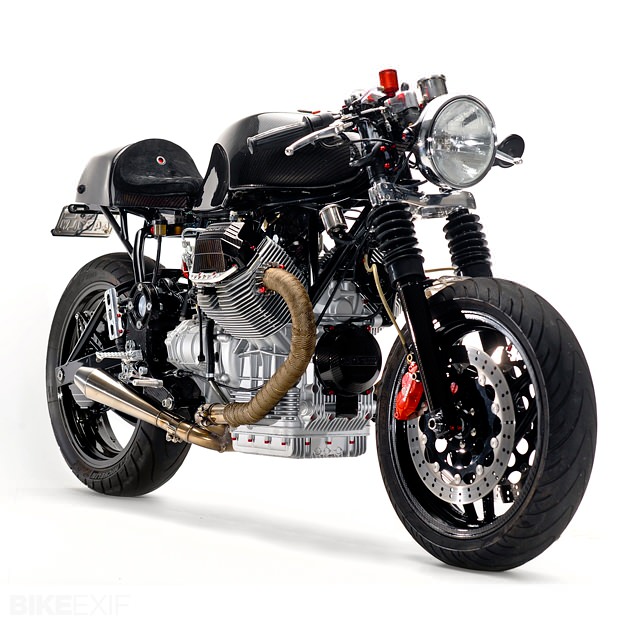
Back to Moto Guzzi specials

 
A while ago I posted a couple of articles about these great Italian bikes that somehow manage to combine a feel of mechanical brutality with a good degree of refinement and mechanical efficiency. Ok, so put more simply, I should perhaps say that I like the looks of these machines, and still regret having sold my Le Mans Mk 1 years ago.
 
Several custom builders, in Italy, Australia, the USA and Germany (and probably other places too) work on ways of making this apparent paradox both more aesthetically convincing and more potent by lightening the machine up all around and tweaking the mechanical parts. In fact, from the mechanical and dynamic side, it mostly comes down to the old Colin Chapman (of Lotus fame) adage of just "adding lightness".
 
Here are a few pictures to show what I mean. They include quite a few of the machines produced by the excellent Axel Budde, who works in Germany and specializes in Guzzis. In case you were wondering what to offer me for Christmas, this should give you some ideas....
 
This is a special from a Daytona base. Remove the silly pipe-wrap and you have a pretty nice machine.
 
 
A rather more elaborate and futuristic effort from a more recent Guzzi model, the Griso


 Now we get down to a series of pictures of machines based on the earlier Le Mans model. The above version is quite close to the machine I owned back in the late 70's/early 80's
 
And the ones below are all by Axel Budde. See what I mean?


5 Oct 2012

The beauty of old motorcycles and some examples


When we talk about age, and indeed about beauty, relativity must be our companion. What is considered to be "old", "very old" or whatever is often related to the age of the person talking. As for beauty, well, we know just how subjective that one is.
If we enter the field of mechanics, and particulary that form that evolves around the internal combustion engine, then our time frame narrows down to less than 150 years. The frst motorcycle with a petrol-fuelled engine is credited to the German engineer Gottfried Daimler (of future Daimler-Benz fame), associated with Maybach. Here is a picture of the beast, which dates from 1885:

 
1885 Daimler-Maybach

Moving on in time, and given the growing application of electronics, not to mention the fickle finger of fashion and its often heavy hand in design, many motorcycles from the 1980's may now seem to be "old" to a younger rider. But, for the purpose of this article, I want to talk about bikes from, or which clearly refer to, the period between WWI and WW2.
The beauty of old Harleys, modified, reinvented, or whatever
I have occasionally made disparaging remarks on this blog about Harley Davidsons, despite the fact that I did, a number of years ago, own a couple of Harleys myself, one of which dated from 1943. My problem with this brand is that I feel is has gotten fatter and fatter over the years (very literally for most of its machines, and see for yourself below!). With the result that their machines usually appear soft and unfocused these days. I am not convinced either by its way of playing on a kind of phony nostalgia without really reinventing itself. Just noise is not enough to make a good motorcycle, even if it may be enough to get non-bikers buy the things for a while.
 
A bike, or a car on 2 wheels? Harley Electra-Glide in full dress

There was, not so long ago, a very good attempt made to produce a modern Harley that would actually turn corners, brake and accelerate. This was the Buell episode, to which I will perhaps return in a future article. The people at Harley were so smart that they put an end to it last year!
When one looks into the many modified versions of these machines that practically invented the rapidly expanding category of “specials” with the advent of choppers back in the 1960’s, many of these seem so repetitive, and often garish as well, that they do not turn me on either.

 
But there are exceptions to any form of generalization, and I would like to show you a couple of them. The Harley in the pictures above and below was built by a German called Bernhard Elflein and who went on a mechanics course to be able to realize his dream bike. I found him thanks to the almost daily specialist site Bike Exif, which is based in New Zealand (bravo to the All Blacks for their convincing win in the southern hemisphere championship). I also note that my colleague, Von Sontag, posted images of this machine on his excellent blog (in French), Le Dépassionné.  Elflein was clearly inspired by the Harley racers of various descriptions from the 1920’s and 1930’s. This was perhaps the golden age for this brand. And, believe it or not, he used as a base for this bike an Electra-Glide (ie something that started out looking like the ugly fat thing in the previous picture).
 
 
Elflein has, for me, managed to capture something quintessential about motorcyles in this machine, which I will not hesitate to call a work of art. The bike is both sleek, functional-looking and somewhat brutal it its brazen bareness. Naked power, some degree of engineering complexity, and a bit of fantasy all seem to exude from each of its pores. Take a look at some detail pictures...
 
View of the tank, taken from a pre-war NSU, and the cockpit, clearly hand-made
 
Seat and oil tank detail
 
 
primary chain-guard: do NOT wear laced shoes while riding this bike!
 
Elflein has started a workshop, called Herzbube Motrocycles, where he does things to US bikes. I took a look at it and must say that I didn't like most of the machines I saw: ape-bar Harleys (who can ride those things further than the end of the high street anyway?). But one bike really caught my eye, a pre-war Indian that is so pure and pared down that it really captures the "board-track" spirit with a perfectionist touch, not to mention lovely and subtle use of colour. The bike doesn't look quite finished, but she is so beautiful that I couldn't resist.


Here are the links to the sites I have mentioned in this article
And, naturally, Bernhard Elflein's own site


19 Aug 2012

Bikes and stuff on the road in California and Oregon

Having just spent a couple of weeks on the road (in a car, admittedly) in Northern California and Oregon, here are a few observations and images related to my favourite mode of transport: the motorcycle.


1). I dearly wish that I had done these roads, and this trip, on a bike. Most of the roads I drove on, up and down the coast and through the redwood forests, between San Francisco and Portland, would have been even more enjoyable on a motorcycle. For the most part these roads are well signaled, sometimes with superb surfaces (although variable) and with great scenery. I would add that the vast majority of car drivers here are attentive, and that bikers seem welcome in most places.


2). With roads like this (I mean the twisty ones along which I have been driving for most of the time), I am surprised that about 80% of the bikes that I have seen on the road have been Harleys, and usually big ones with lots of heavy baggage added on, and sometimes even trailers. I am not a great fan of HD's, as they seem like noisy 2-wheeled tractors to me, although naturally any bike is better than none. But here I am just thinking about suitability to the roads. They just seem far too heavy and unwieldy for the job of riding roads like the superb Highway 1 and many sections of 101, as well as the crossroads that link them. I think that the American fascination with the Harley goes hand-in-hand with addiction to other big heavy things like SUV's and monstrous 4-wheel drive pick-ups.


3). Most of the other bikes seen along the highways have been BMWs of various descriptions, mostly recent GS's, well laden too. But also the occasional classic and modified variety, like this 750, seen parked in Healdsburg.


BMW's are far better for these roads for sure, but I saw very few sports bikes (where are the Ducatis?). I did see the occasional KTM, like this one, parked outside a cinema in a place called Point Arena.


4). Talking about Point Arena, which is on the coastline along Highway 1, just south of the much smarter Mendocino, I woke up there one morning, wondering where were all the motorcycle shops, and stumbled upon this sign:


And, a couple of doors down the street, I found this place:


Which opened a little later to reval this lovely Ducati SS, amongst others nice things (a beautiful touring Ducati S3, a Triumph Tiger 500, and other goodies).


The Zen House, which naturally practices the art of motorcycle maintenance on all 2-wheelers but with a preference for older European machines, belongs to David Harris, a former architect and also Ducati dealer in San Diego. Not only does he practise what Robert Pirsig preached (oh dear, I can see God creeping in here and I didn't mean that!), he clearly also epitomises what Robert Crawford laid out in his excellent and more recent book that I once enthusiastically reviewed here.

Harris has his own website, which is: www.TheZenHouse.net


Because of places like this, I would liked to have spent more time in and around Point Arena, which appears somewhat run-down, is totally unpretentious, and yet has facilities that many much larger places do not have, such is the cinema below that shows current release movies and using, for the moment, an old-style projector


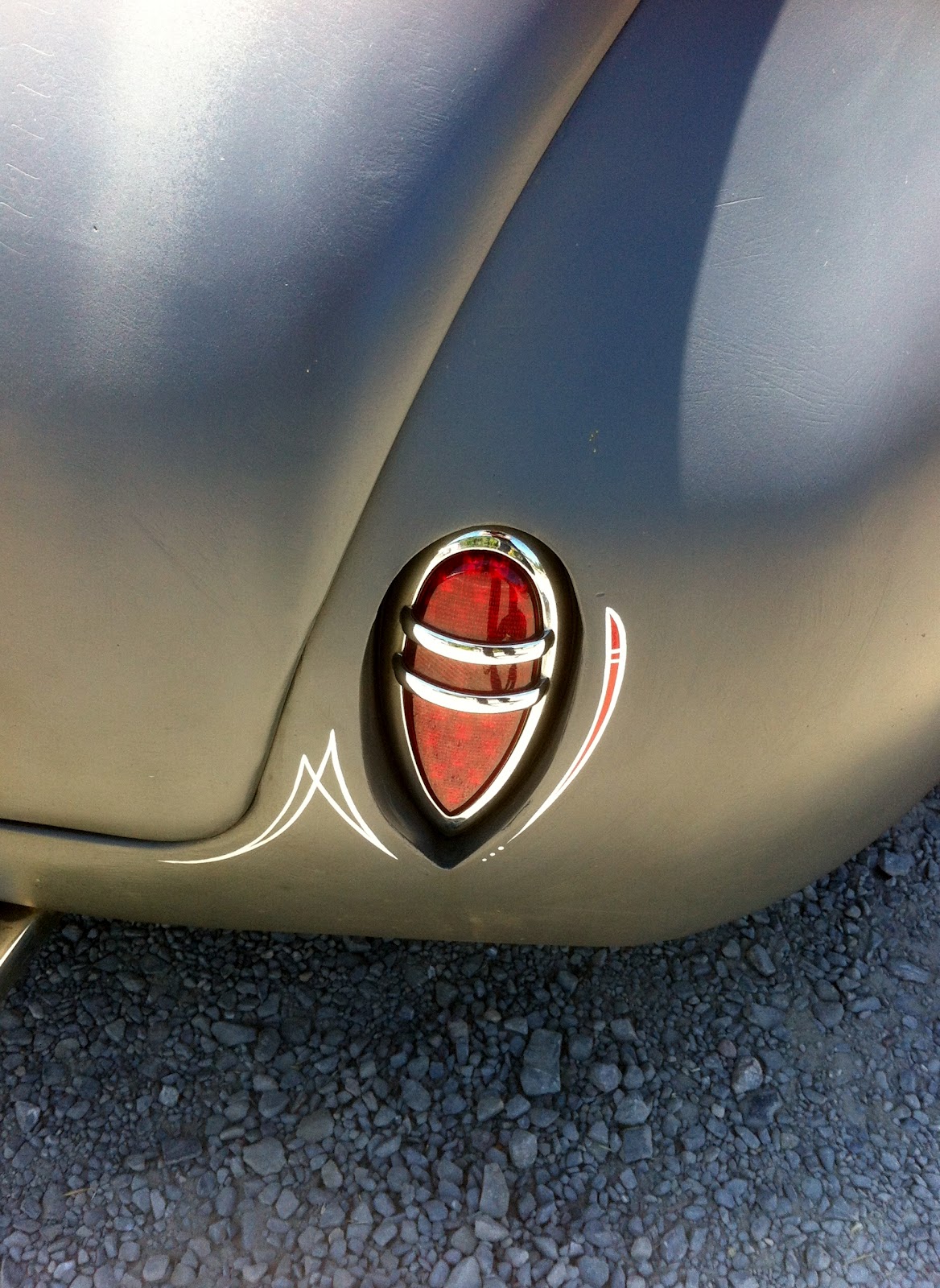
5).In a country with a fairly recent history, anything over about 30 years old tends to get dubbed "historical". If it has survived that long, it often gets carefully restored, and sometimes creatively modified, like this beautiful low-rider car on what must be a 1940's coupé base (don't know enough about cars to identify it further). It looks like something out of a strip-cartoon. The detail work is equally impressive and, on the whole, sober.


6). And bikers? Well, I didn't really get the opportunity to talk to many, apart from this very friendly guy who stayed in the next-door room in a motel in Grants Pass. He said that he liked his big 6-cylinder Triumph and had been running it for 6 years. His lady friend was on a Can-Am 3-wheeler, of which I saw a few.