10 Mar 2012

Women in Wine

I guess it is appropriate to slot this one in here soon after (March 8th) what is known as International Women's day took place.

In a western world that tends get a little over-obsessed with equality (can everybody really be "equal"?), but coming from a much longer period during which men seem to have dominated almost all professions to a totally absurd extent, the slow acceptance of women as being men’s equals in many fields is clearly on the way. The world of wine is no exception to this tendency, even if we are yet some way off achieving full equality here!


look closely...yes, Schwarzy is holding a glass of wine!


A statistic caught my eye the other day. It would appear that 27% of wine estates in France are now managed by women. This figure may seem quite low to some, but one has to remember where we are coming from. About 20 years ago, the figure was half of that. If the trends continues, another 20 years will see equality and more!

If one goes back another generation or two, in many wine-growing areas of France it was considered to be dangerous for the wine to allow a woman into the cellar during her menstrual period, as the wine might “turn”! Such stupid superstitions are thankfully disappearing fast. They did not obtain in every traditional region however. For example, I can remember Claude Papin, of Château Pierre Bise (who makes superb wines from the Anjou, Savennières and Layon appellations) telling me that it was his grandmother who used to carry out many of the key wine-making activities back in his grandparents time, simply because his father, who was a part-time boatman ferrying goods on the river Loire, was not at home for long periods and so there was no other solution: when the wine needed to be de-vatted, his grandmother handled the process. The first world war also boosted the arrival of women in various aspects of wine production, in France for example, simply because the majority of able-bodied men had been killed in the trenches.


And women certainly found their way into cellars as well


But what has placed women firmly into the management and scientific echelons of wine production and selling has been higher education. An increasing proportion of graduates from agricultural and oenological university programmes are now women, and quite often they are majors in their particular graduate years. I was speaking to a student at the Faculty of Oenology in Bordeaux this week and he told me that there were currently more female than male students in the current promotion.

Whilst the profession of sommelier remains very much male dominated, probably on account of its working hours that make things very difficult for married women, that of journalism, for example, welcomes more and more women.  Based in Great Britain, but applicable anywhere in the world, the very arduous Masters of Wine examination, which includes a written thesis as well as examinations and tasting tests, has a rising proportion of women amongst its elite members: they are currently 87 out of a total to date of 299.


Jayne Boyce MW


In order to boost the proportion of women holding jobs and credibility in the world of wine, various “positive action” initiatives have been created in recent years. Amongst these, the international Wine Women Awards, held every two years in France, or a couple of wine competitions for which all the tasters must be women are examples. In as far as this encourages more women to come to the fore and acquire self-confidence in tasting, talking and writing about wine these are good things.

On the other hand, those worn-out theories that are regularly bandied about in various magazines about “feminine” wines or “ a woman’s taste in wine” are of no help whatsoever in improving women’s’ place in the world of wine! In fact just the opposite, since they apparently consider taste to be sexually determined in some way, which it is not. For a specialist wine magazine for which I write regularly, we recently tried an experiment, giving identical sets of wines to male and female juries who were isolated from each other. There was no specifically “male” or “female” style of wine that emerged from this. Tannic wines are usually considered to be "masculine", yet the most tannic wine in one of the series was the one preferred by the female group, whilst the male group did not rate it highly!

So we can cut the crap about "feminine " wines, or "feminine" taste, and just let the ladies who want to get into all aspects of wine on their own merits.

6 Mar 2012

Musée Granet, Aix-en-Provence

I used to go regularly to Aix-en-Provence and its surrounding area, back in the 1960's and 1970's. At that time I found Aix to be a beautiful and even inspiring city, sometimes a bit frayed around the edges, but full of light and joy. Going back there now is bit of a let-down, with one notable exception which is the main subject of this article. Of course Aix, as a city linked to art, is strongly linked to one of its natives and former residents, Paul Cézanne. Also, in a way, to Picasso, one of whose many houses was on the more gently sloping side of the Mont St. Victoire (see below: the painting being by Cézanne).


Aix comes over to me today as a bit of a let-down on account of its horribly encroaching urban sprawl, which has totally swamped the old town, turning it into a walkabout zone for thousands of people whose sole interest seems to be clothing shops. A huge surge in local population is behind this, but also, I supect, some poor local political management. Of course the old buildings are still there and have their charm. The light has not changed. But it is now surrounded by motorways and thousands of nasty suburban "villas", even nastier "commercial zones" and all the visual crap that goes with this. But let's not get bogged-down in stupid nosatlgia however because there is at least one very good thing about comtemporary Aix-en-Provence: the Granet museum (musée Granet).


This, believe it or not, I remember as harbouring a dingy and dark little collection up a dingy and dark little back street. After what must have been considerable work the Musée Granet is now a delightful, airy place, with not too many people in it (and least on the day I went there, which was a Saturday in February) and a fantastic collection of work to admire. For the next 15 years it will be harbouring the Planque collection from Switzerland, whose range of impressionist and post-impressionist work includes paintings by Picasso, Klee, de Staël, Bissière, Dubuffet, Braque, Dufy and many others.


It also has a few Cézannes (Aix was his home town) although many of these are often away on loan to various places around the world, and a very good set of work loaned by the French National collections, many of them from a donation made by the Meyer family. These include a wonderful series of both sculptures and paintings by Giacometti.


a Cézanne that you may or may not see at Granet

One of the joys of this museum is that its rooms are not too big, yet big enough to hang a good group of paintings that make sense together.


François-Marius Granet, who gave his name to the museum, was a local 18/19th century painter of modest but honest talent, as this landscape below shows.


He was, as many, portrayed by Ingres, which I guess shows that he had some fame in his day (see below). He certaonly manged to acquire a large house in the 18th century part of Aix.


Another work by Ingres is the one below, of Jupiter and Thetis, in which I find that Thetis looks like she is made of marshmallow and Jupiter is, well, very jupitorial (just tickle my beard).


If you think that you might just not go out of your way to see a couple of paintings by Ingres, rest assured, there is much more, including a wonderful small self-portrait by Rembrandt from about 1659 (see below) and other interesting stuff including some rather strange pictures of goats by another local painter called Loubet.


The Planque collection alone makes a visit to Aix worthwhile, but there are things in the Musée Granet for all tastes. I left the scupture and archaeological section for another time, and found the temporary exhibition  by an illustrator named Philippe Favier uninterestingly obsessional. 2 hours is about all I can usually take in any museum, and these were well filled here.


4 Mar 2012

A clear run for Wales in the 6 nations?

The captains of the six nations teams for 2012

Now that the stupidly delayed game between France and Ireland has been finally played in Paris and resulted in a draw (17-17), the final result, whilst still uncertain, looks much clearer now.

Wales have won all three of their games so far, although their victory againt England last week was perhaps a tad lucky. They now have to play Italy, the weakest team, and then France, their closest rivals. But this last game they will be playing at home, and with the added incentive of taking their revenge on a world cup semi-final that they should not have lost. So they must be clear favourites, and have looked the best team in the tournament in all their games so far.


Strettle the English winger, just prevented from scoring against Wales

Of course rugby is an unpredictable game and no team is less predictable than France, who could just upset the Welsh plans by winning aginst the odds 2 weeks from now. But I wouldn't bet on that!

England and Ireland have both lost a game and are not really in the running for victory in this tournament, especially Ireland who have lost one game and drawn another. England's only chance is to beat what must now be a doubting French team in Paris next weekend. They have a young team that has shown guts and some promise, but they will probably lack the experience for this one.

Ireland played well in their game against France, with Bowe scoring 2 tries, but their scrum and line-out did not look like world-beaters, apart from the back row who were excellent.


Tommy Bowe, the Irish winger and scorer of 2 tries against France today

3 Mar 2012

Fashion is plain stupid

I suppose that, at some point of my life, I have been a "victim" of fashion. In other words, that I have been persuaded to adopt clothing or whatever that happened to be a "trend" at that moment.

I feel less and less inclined in this direction. In fact I find myself increasingly appalled by and disgusted with the whole world that gravitates around what is now a major business that occupies a lot of written press and huge spaces in our towns.

 How many clothes do we really need? And who could possibly require or even use the increasing numbers of shops selling them. Walking around city centres almost anywhere in the world tody, it seems as if people have given up eating, or reading, or indulging in any other activities apart from looking at cloths, maybe trying them on oaccasionally, and, presumably, buying more and more. Otherwise I simply cannot figure out the proliferation of these shops, most of which sell look-alike garments anyway. It all seems totally futile and vacuous.

I felt this once again on a recent visit to what used to be a pleasant old Provençal city, Aix-en-Provence. And today I picked up a so-called serious French daily newspaper (Le Monde) only to read, on the front page, this lead to a full page article on the inside (my translation from French):

"Ladies, vinyl and sequins are the fashion of 2013 
.......Creators have chosen elegant, striking and sexy materials for this year's autumn/winter ladies fashion: vinyl, Lurex, sequins and gilded embroidery."

I hate the ubiquitous use of the term "creator" for almost anyone able to cut and paste. I also find it pretty hard to imagine who, apart from a few weird fetishists, could possibly find that either vinyl or Lurex or sequins are elegant or "sexy". They are more trashy than anything else to me. Whenever I see eminent people in the fashion world, I tend to think that they are, on the whole, a pretty strange lot and usually living in a world of their own that has little or nothing to do with everyday life for most of us. Maybe I am wrong, but take a look at Galliano and Lagerfeld, just for a start. Unfair? Maybe. One could possible call some of them "amusers", or "court jesters" (not Galliano, I agree, the guy is a nutcase). But "creators" ?

What is certain is the economic drive behind all this twaddle. That a major and usually serious daily like Le Monde should treat this rubbish in a sycophantic way just shows how dependant they are these days on advertising from the fashion world. Their weekly magazine, which used to be readable, has turned into a sort of fashion catalogue recently.

I decided to take a look at what Ambose Bierce the excellent author of the cynic's bible, The Devil's Dictionary (1911) had to say under his entry for Fashion. As usual, his definition is subtle and just a tad ambiguous:

FASHION, n. A despot whom the wise ridicule and obey.


A king there was who lost an eye
In some excess of passion;
And straight his courtiers all did try
To follow the new fashion.

Each dropped one eyelid when before
The throne he ventured, thinking
'Twould please the king. That monarch swore
He'd slay them all for winking.


What should they do? They were not hot
To hazard such disaster;
They dared not close an eye — dared not
See better than their master.


Seeing them lacrymose and glum,
A leech consoled the weepers:
He spread small rags with liquid gum
And covered half their peepers.


The court all wore the stuff, the flame
Of royal anger dying.
That's how court-plaster got its name
Unless I'm greatly lying.


—Naramy Oof

22 Feb 2012

Discovering Koshu wine from Japan


Koshu: a Japanese grape variety sometimes used for winemaking

I had not tried many wines made with the koshu variety until earlier this week, when a tasting organised in Paris by the association called Koshu of Japan gave me the opportunity to try about a dozen of them in an hour or so.

These pictures show the colour of the Koshu grape, its long bunches, and the little paper hats used to protect these from storms as harvest approaches. The trellising is the pergola system.

Koshu is an unusual variety in that its skin is a pinkish-gray colour, but its juice is very pale, almost white. It has apparently been known in Japan since the 12th century (some say earlier), where it may have been introduced by Buddhist monks coming from China. For most of the time since then it has been used as a table grape, but quite recently it has been vinified, at first as a sweet or semi-sweet wine, but now increasingly as a dry and rather lively (ie acid) wine with a relatively low alcohol level (between 10,5% and 12% in the case of the samples I tried). Some sources say that it travelled to Japan via China from the Caucasus region, following Marco Polo. Others say it is in fact a hybrid between vitis vinifera and some indigenous grape species. If anyone can enlighten me further, I would be grateful.


There are not a lot of wine grapes planted in Japan, although it is a considerable and sophisticated wine market. This is due essentially to fairly unsuitable climate conditions, with rainfall at the wrong time of year and risks from typhoons and so on. There are, I understand, about 500 hectares of koshu grapes planted and about 90% of these are in the region of Yamanashi, which lies around the lower slopes of Mount Fiji, about 100 kilometres west of Tokyo. Whilst the use of Koshu as a table grape has declined over recent years, experiments in altering traditional cultivation techniques to adapt it better to wine making have gone forward. The old way can be seen in the photograph below, using the pergola system where the vine ends up as thick as a tree and with very long stems. This is not the best way to control yields from the vine, so various vertical shoot systems, such as the Scott Henry trellising method, have been introduced. Several consultants, from Australiea New Zealand and even France have been helping the producers with some ideas recently.

The traditional pergola training system and the paper hats to protect young bunches


Koshu is a robust grape with thick skins, which helps it resist during the wet periods that can hit the vineyard. The dry wines I tasted were very pale in clour, mostly bone dry, with low alcohol and high acidity. The vast majority of them had been fermented in tanks and bottled young, from the latest 2011 vintage. The occasional one had received some barrel ageing and was thus rounder and softer. On the whole I preferred the tanks ones, but I would not say that these wines would be to everyone’s taste. An idea? Well, a kind of mix between a Trebbiano and a dry Riesling would be near the mark. In other words quite acidic, with delicate aromas, not a huge amount of character, but a lightness of touch that I found attractive.


The wines I liked best from this tasting were the following :

Alps Wine, Japanese style Koshu 2011
Seems a bit weightier than the announced 11,5% alcohol and I also felt there was a bit more residual sugar than the announced 1,1 grams. Still was fine and vibrant. Good and relatively intense for the series. 

Grace Wine, Koshu Kayagatake 2011
Delicat and floral, very lively. Pure and dynamic


Grace Wine, Koshu Private Reserve 2011
Just as perfumed as the previous wine, but more austere in its structure and with greater power


Yamanashi Wine, Sol Locet Koshu 2011
Fine, delicate and precise.


Yamanashi Wine, Sol Locet Koshu 2010
One of the few “older” wines available at this tasting, I thought it showed more complexity and length than the others.

Suntory Tomi No Oka Winery, Tomi No Oka Koshu 2010
This has been aged in oak and so was rounder and seemed riper than the others. It has much lower acidity than most and would probably be easier for international markets to appreciate. Very silky texture.

16 Feb 2012

The champagne bath: ridiculous, shameful or just decadent?

If you want to know my answer to the rhetorical question posed in the title, it is emphatically "all 3".

The idea of bathing in champagne an old fantasy that has been lugged around for ages, but it came to my attention recently, thanks to the UK trade web site called Drinks Business, that a London hotel has revived the stupidly decadent practise of filling baths with champagne for customers who have more money than good sense.

I should also mention that I have already published a version of this story here in another blog for which I write, in French. This blog is called Les 5 du Vin, and I write an article for it every Monday, whilst my colleagues deal with the other days of the week. I should also add that we recently won a prize for this blog (The Wine Blog Trophy see here) at a wine trade fair in the Loire Valley (Le Salon des Vins de Loire), partly thanks to an article that I had written a few months ago on a wine bar situated in this region and called Café de la promenade.

The Cadogan Hotel, in London's Knightsbridge district, has a bit of a history in the field of decadence (if one wants to call it that). It was here that Oscar Wilde was arrested for sexual practices that were, at the time, considered as reprehensible. It was also here that the future English King Edward VII held trysts with the actress Lily Langtree. Given that the then Crown Prince, son of Queen Victoria, was known by some of his contemporaries as "Dirty Bertie", I can leave you to fill in the gaps.

According to Drinks Business, the Cadogan Hotel is offering its weathier clients to fill their baths with champagne, as from the 14th of February (Saint Valentine's day in case you missed it) and for the rest of this year.

For the modest sum of £4,000, someone will pour 122 bottles of a champagne celled Louis de Custine, vintage 1998, into the bath of your hotel room and even heat it to the desired temperature. I do not know whether you are allowed to add lemons and spices before drinking the stuff. If you like cold baths, probably not. What is certain is that you will need a good shower afterwards to avoid stinking like an empty wine vat, and probably feeling a little sticky from the added sugar that is part and parcel of most champagnes.


To add insult to possible injury you can even request a "bath butler" to come and serve you one of the six "gift" bottles of the same brand of champagne in which you are wallowing, accompanied by strawberries coated in chocolate (yuck!). We do not know if the bath butler is blindfolded to protect your intimacy on this wonderful occasion. Maybe he'd fall over and send the tray crashing into the bath, turning the great event into a blood bath!


I have never heard of Louis de Custine Champagne but I see that it retails for around £25 per bottle in the UK. Looks like thay may have a bit of stock on their hands. If bathing in an unknown brand of champers doesn't tickle your fancy, then the thoughtful people at the Cadogan Hotel have other solutions on hand. For £6,000 you could opt for vintage Perrier Jouet. For £8,000 you have the choice between vintage Veuve Clicquot and vintage Perrier Jouet Rosé (bathing in the pink!). But the ultimate has to be a bath of Dom Perignon 2002, for the incredibly modest sum of £25,000. If you can find nothing better to do with your pots of money than this, I have several suggestions for you, so please get in touch!


Not sure that the bath in this photo is big enough for 2. Or that I would want to take a both outdoors at this time of the year.

 
According to the hotel, at least one client has paid the requisite deposit for the top option with Dom Perignon in this contest of indecent stupidity in the show-off stakes.

After considerable research, I have manged to procure images of the projects sent in by agencies invited to compete to produce a poster campaign to advertise this great idea. Some of them seem to need a little education as to the geographical origins of champagne, as indeed as to the types of cork necessary to keep its bubbles in the bottle. Here they are.....


It is perhaps to be noted that the last image of these three shows that the Champagne bath fantasy was probably at the origin of the product known as bubble bath.

Enjoy your next bath!


13 Feb 2012

6 nations rugby, or is it 4 nations?


The annual 6 nations international rugby tournament is back again in Europe, as is a snap of very cold weather that seems to have caught some with their pants down.

The last 2 weekends should have seen the first two matches completed between all teams from the six competing nations: England, France, Ireland, Italy, Scotland and Wales. It didn't quite happen this way because the match that was to have been held in Paris on Saturday evening was cancelled at the last minute when the refereee deemed the pitch at the supposedly modern Stade de France to be unplayable because it was frozen in patches. The game was between France and Ireland.

Since then, the French have been playing their usual game of passing the ball very fast, as if it were a hot potato, to determine who is reponsible for this fiasco. One should bear in mind that the event involved aboit 79,000 spectators having paid good money to see a game (many coming from far away) which was cancelled at the last second despite the pitch having been covered all week under, apparently, heated covers.


A derisory last minute attempt to thaw the pitch in Paris. Seems to me like using an iron on a Christo wrap of Central Park!

Everybody knew that the weather was cold, and indeed had been for almost 2 weeks. Other games took place during the weekend, and the Stade de France is supposedly a modern stadium. Yet it is clearly ill-equipped, and one might add that the decision to play a key game at 9pm in Febuary in a stadium with no roof was not perhaps the most sensible choice initially.


Philippe Saint André, or PSA for short, the new French trainer

Now what about the games that have actually been played? It is interesting to note that 3 of the 6 teams involved have new trainers who have just taken over: England, France and Italy. Four teams have now played 2 matches (out of 5) each so far, so let's look at them first.


Leigh Halfpenny, the Welsh fullback, scoring one of his two tries against Scotland on Sunday. He also kicked a lot of goals.

England and Wales have won both their games. Wales just beat Ireland in Dublin and more convincingly beat Scotland at home. Both games were superb and have confirmed the considerable talents and promise of the current Welsh team, as revealed during the recent World Cup. 

England were lucky to win both their games, each played away. Curiously they won each game due to a charge-down try made by their fly-half, Charly Hodgson, and in each case against the course of the game. Italy scored 2 tries against them and only lost this weekend's game in Rome because they do not have a goal-kicker. They lack a bit of depth in terms of replacement players but they have never been closer to winning against the other European nations as the narrowing score sheets show. Remember that they just beat France in Rome last year.


Charly Hodgson congratulated by Owen Farrell

a battle in the snow in Rome: the English team spent more time defending than attacking 


the Italian winger, Venditti, breaks through for the first try


Sergio Parisse, the Italian captain and the best player on the field, tackled


Scotland were unlucky to lose to England at home, but were more clearly dominated by Wales. They are good to watch as their game is one of constant movement, but I have to say that their huge numbers of passes sometimes lack direction and they rarely manage to break through defenses.

We shall now have to wait for another couple of games to see who looks likely to win this year's tournament. I would pick Wales as my favourite, with France second. The game between these two should be a key match and a kind of revenge for the Welsh after the closely fought semi-final they lost to France during the World Cup. England lack experience, with a lot of young and promising players. If they win, it will be a considerable surprise, but at least they are building for the future and are not giving away masses of silly penalities all the time like they did during the World Cup.

Goodness knows when the France vs Ireland game will be rescheduled!

10 Feb 2012

When someone dies

People are dying all the time. Ones sees so many horrors when looking at what is known as "the news" that to mention the death of a single person seems derisory, maybe even indecent. When death takes someone close to you, one enters the realm of the intimate, be the event dramatically untimely or simply in the natural order of things, like for someone who has lived a long time. In any case, if the death is of that intimate nature, I usually do not feel inclined to talk about it in public. But what about someone that you barely know, just an acquaintance?

I heard just this morning that a guy I knew slightly because we frequented the same gym had been killed a couple of months ago, in a motorcycle accident. It shocked me. I had not seen him for a while, but then such things happen all the time: people move, or decide to go to another gym, or whatever. But I did find it strange that he had said nothing. This morning I happened to be in the changing room with another regular and asked him what had happened to Guillaume. He told me. I had to sit down.

I did not even know Guillaume's second name. He was a regular at the gym, very friendly and with the kind of light sense of humour that I enjoy. A really nice guy and the kind of person that, when you see him and exchange a smile and a couple of words, makes you glad that you have gotten up early to go and suffer for an hour or so. He was in good shape and used to running 10 kilometre races. We discovered that we were both bikers and talked a bit about this, amongst other things. From what I heard this morning he touched the edge of a secondary road on one of his weekend outings and lost it, going off the road. I know no more details and do not want to. He rode a Honda Fireblade. I never rode with Guillaume although we had discussed doing this sometime this spring.

Death has the definitive edge to it that nothing else can have. I don't believe in any form of life after death. I read, also this morning and in an excellent book that I have just finished, the following line, spoken by one of the characters right at the end of the book and after the death of one of them: "you are alive, so don't complain, for you anything is possible". For Guillaume this is not the case. Will I take more care when riding? Very probably. Will I stop riding bikes? No.

4 Feb 2012

Champagne Jacquesson: care at all stages makes fine wine

Champagne vineyards in winter. Smoke comes from shoots being burnt during the pruning operations. Here in the upper Marne valley, vineyards are limited by woods at the top end and by the river below. The limestone sub-soil often shows through (photo DC).


Champagne is a marvellous drink. It refreshes you in the summer, feels as cristal-clear as the air can be in the winter, and it improves your frame of mind at all seasons. But just saying "Champagne" is insufficient. Which Champagne? How is it made, and by whom? What results and impact does the whole approach of the producer and their process have on the wine's flavours, and so on, are just as important questions as with any other wine. Because, of course, Champagne is to be regarded just as any other wine, and definitely not simply as a sparkling substance that derives from a vaguely understood technical process having perhaps something to do with grapes at the outset!

There are considerable differences between the sizes of Champagne's many producers. Some are huge, like Moët and Chandon or Veuve Clicquot, and often very respectable too in terms of the average quality of their wines, even with annual production figures counted in 10's of millions of bottles. Some are of medium size and with perhaps a more focused style that may or may not be to the tastes of all drinkers. In this bracket I would spontaneously name Charles Heidsieck, Pol Roger, Deutz and Bollinger for instance. These lists being far from exhaustive, naturally.

The river Marne and vineyards bordering it, just downstream from Epernay (photo DC).

Quite a bit smaller, with an annual production of under a million bottles, is the family-owned house of Jacquesson, whose base is in the small village of Dizy, just across the river Marne from the town of Epernay. The scale of operations at Jacquesson is closely linked to their will to control each and every part of the process and to craft wines that are true to the raw materials they have in the vineyards and from purchased grapes. This is a fairly banal statement that you can read in many wine producer's brochures or hand-outs. But in this case it happens to be true, although means, or the lack of them, inevitably have a bearing as well, given the cost of acquiring vineyards in Champagne. Although the name of Jacquesson is long-standing in Chamapagne, this house has been under current ownership for about a generation. Despite the fact that Champagne seems to lie in a world of permanenant expansion, the Chiquet brothers, Jean-Hervé and Laurent, have actually scaled back the size of their operation over the past few years in order to be able to ensure a full control on the quality level of the bottles they produce, and to produce only the wines they themselves like, and with a singular approach to the range they produce. This is a craftsman-like operation where evry detail counts in the process.

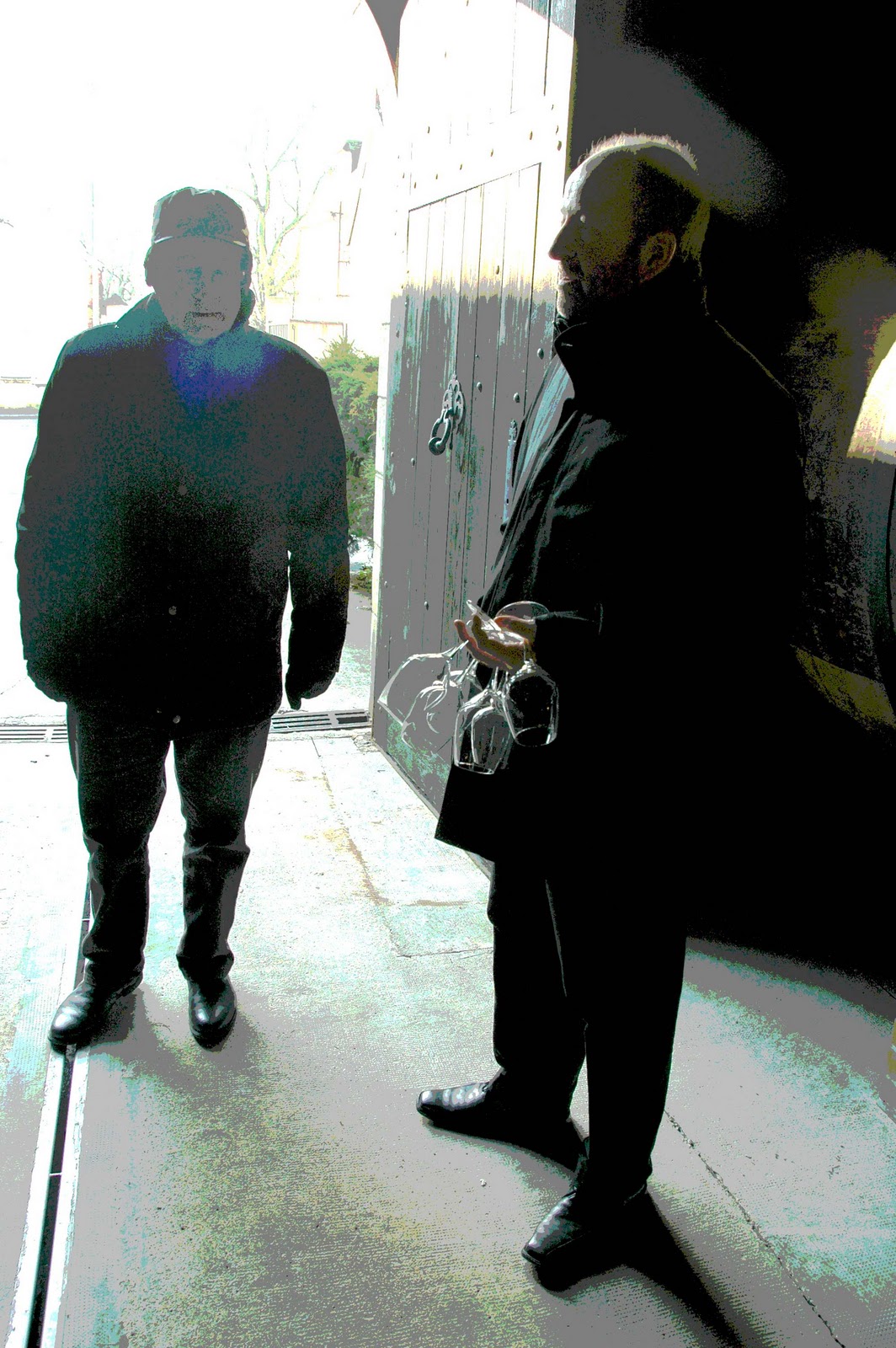
The Chiquet brothers getting ready for a tasting in their cellars. Yes, it was frigging cold that day! (photo DC)

Most Champagne is sold without a vintage being shown on the label. This is necessary in such a marginal climate for growing grapes, since the quality of these grapes can vary so much from year to year. Wines from good years are held in reserve and then blended with a larger quantity of the latest harvest to ensure a certain constance in both quality and style. This blend acquires, over time, the seal of a "house" style, helping it to be recognised taste-wise and form a part of that producers's identity. Jacquesson has a slightly different approach to this matter. Considering that each harvest has its particular character, even when blended with about 30% of older wines, they allot a number to each blend, and that number changes each time the blend is made. Thus the current non-vintage blend from Jacquesson bears the number 735 (this numbering system has its origin in the house's archives), the next cuvée will bear the number 736, and so on. So, without bearing a vintage number, each cuvée has its own identity.

In the tasting room, the Chiquet brothers show, once again, their attention to detail by placing this glorious poster of the Willi's Wine Bar collection smack in front of where the journalist sits. This can only have a positive effect on one's thoughts about the wines being tasted! (photo DC)

We tasted 5 of these non-vintage wines, from the future 736, which will only be released at the end of 2012, back to the 732. The main part (67%) of the cuvée 736 comes from the 2008 harvest, and contains just over 50% chardonnay, with about 30% pinot noir and 20% pinot meunier. It is a splendid wine, very aromatic, finely textured, delicate and with incredible length on the palate. For me it looks like it will be the finest of the series that I tasted. The 735 (based on the 2007 harvest) is currently in markets. It is more powerfully expressif than its future successor, more generous but less tightly-knit. The flavours are broadly spread and yet precise. The 734 (based on the 2006 harvest) seems more chalky in its texture, as if it contained more chardonnay in the blend. It also shows a slight touch of bitterness and is less generously expressive than the 735. The 733 (based on the 2005 harvest) has lovely aromas, is taught and very fruity on the palate, with a creamy feel to it. Its seems simpler that the 735. Finally the 732 (based on the 2004 harvest) is firmly structured and a little austere, as was the nature of this vintage. Its flavours are restrained but pure and it shows no sign of ageing.


The other part of the range, which is only released in the best vintages, is a series of three single vineyard vintage Champagnes, each from different villages and separate vineyards owned by the firm. There is also, in some years, a very fine rosé with real colour to it.
We first tasted the three single vineyard Champagnes from the 2002 vintage.
Corne Bautray (the name of the plot), is from the village of Dizy. We visited the 1 hectare plot, which is right at the top of the hill with woods at the top end. It faces south-west and is entirely planted to chardonnay. The nose is airy and very fine. It is rich and broad in its flavours, starting well-spread on the palate, then becoming finer and more delicate on the finish. A savoury and very satisfying Champagne. I would have said that it contained some meunier, but it doesn't. (18/20). 
Champ Caïn is from the village of Avize, the other side of the Marne river in the Côtes des Blancs. The plot, which I didn't visit, is a the foot of the slope, facing south and entirely planted to chardonnay. The nose is initially quite discreet then opens up showing floral and fruity aromas, with a marked hint of lemon. Very beautiful. The palate shows the precision, light and joy of a Vermeer. The feel is exceptionally fine, etched and harmonious. The flavours build gradually, always with finesse, and are very lingering. A truly magnificent wine. (19/20).
Vauzelle Terme is from the village of Aÿ, which borders on Dizy to the east. The nose seems much broader and perhaps less refined than those of the previous two wines. It has a smoky edge to it. The flavours are also broader, softer and less precise. Very ripe fruit that seems almost sweet on the palate. A very good wine but I was rather less enamoured of it than with of other two (maybe I took my eye off the poster?). (16/20)
Finally we tasted the rosé. Called Terres Rouges, it comes from the village of Dizy and is much younger, from the 2007 vintage.
I confess to a clear preference for rosés that assume their colour difference. In other words, I am less attracted to those pale, wishy-washy rosés that seem to be imitating a white wine, in fact as if they were apologetic for NOT being white. I feel that the whole point of a rosé is to be different from both red and white wines. More colour also equals more flavour in general, and this wine was no exception. Its beautiful deep pink colour leads to deliciously clear and fruity flavours. This did not seem hugely complex, and perhaps lacks a bit of ageing, but it is still very good. (15/20) 


In the Jacquesson vineyard above Dizy (the Corne Bautray plot) looking south and west towards Epernay (photo DC)

Of course before getting the reward of tasting such a beautiful series of wines, one has to do the basics. That implies trying to understand what is the approach behind (or rather before) the wines. This clearly begins in the vineyards. We visited three different plots, two in Dizy and one in Aÿ. All are grassed over and cultivated under the vines, except for one, much flatter, which is ploughed almost entirely. The slopes in this part of Champagne are not huge, but given that the rock base is chalky limestone and the top soil is clay, it doesn't take much to encourage this top soil to head downhill. If one wants the soil to breathe and live, with some micro-fauna in it and so on, it is best to refrain from the all-too generalised practise of putting weed-killer everywhere and transforming the surface appearance to something close to concrete. But tilling the soil and leaving it uncovered exposes one to landslip. So grassing between the rows of vines is a good answer. Naturally one has to cut the grass, which means more work. What comes first in terms of your priorities?

Vines in Aÿ using the Cordon de Royat training system (photo DC).

Vines in Champagne can use one of two different training systems: Chablis or Cordon de Royat. The picture above shows the Cordon de Royat system, favoured by Jacquesson as it allows the bunches to be spread out wider on the vine, and makes it easier to remove leaves in the summer, thereby allowing air in and preventing rot from setting in during bad weather. All these details can count in reducing the need to spray anti-rot substances like sulphur and copper, or synthetic sprays. Jacquesson have a basically organic approach to their farming, without being dogmatic about it. And their holistic approach, which favours prevention over curing, has clearly created some emulation amongst neighbouring plots. Every detail counts, obviously, when one follows the process through.

From Russia, with love. Jean-Hervé Chiquet in the tank room


In the world of wine, a lot of bullshit is talked involving the hold-all term "tradition". What exactly people mean by "tradition" or "traditional" is never quite clear, but it usually implies an strong inference that "things were better before, and so we stick to old-fashioned ways". This is mostly rubbish, and often dishonest rubbish at that, but in some instances, tried and true old methods can be the best solutions for certain situations. In the case of pressing grapes to make wine in champagne, the old vertical presses which hold 2000 or 4000 kilos of grapes can be an excellent way of controlling the quality of pressing if the volumes are not too big. So Jacquesson use these traditional presses, and insist on the grapes they purchase to complement those from their 30 hectares of vineyards being crushed on their own presses. 
In the wine-making process, Jacquesson uses a mixture of stainless steeel tanks, large oak vats and small oak barrels to ferment and hold their wines. The choice of which vessel to use will be determined by the type and the volume of the wine batch involved. Each batch will have its home, allowing precision in the final blending, not to mention traceability.


The fact that a former owner of the firm Jacquesson, and who gave it its name, invented the wire and cap system of holding Champagne corks in their bottles may or may not be of interest to lovers of Champagne. What seems more important to me is that the painstainking process of producing their wines has gradually, and quite recently, raised the name Jacquesson, as run by the Chiquet brothers, firmly amongst the very top quality rank in Champagne today. Their grapes come from Grand Cru and Premier Cru vineyards, either tended by their own teams or known to them as neighbours. These vineyards are farmed ecologically and thoughtfully. They press all the grapes, eliminating first and last pressings to retain the purest and most delicate juices. Then they take their time about making and ageing the wines: the current non-vintage has had four years ageing, and the vintages have had 11 years. All this, and many other details, add up in the end. You can see the results when you taste the wines. As always, the proof the the pudding is in the eating, not just the wrapping, even if the wrapping is most elegant in the case of the Jacquesson bottles. Attention to detail again....


 all photographs by David Cobbold