11 Mar 2011

Ron Rash and Serena: the pioneering myth

Several people have recently encouraged me to read something by the American author (of poetry, short stories and novels) Ron Rash. I have just finished his novel entitled Serena and I can now pass on the encouragements with bells added.


Serena (which is the first name of the main female character in Rash's book) has something of the inexorably tragic and epic form that one finds in Cormac McCarthy, or in Ken Kesey's early novel, Sometimes a Great Notion, published in 1964, and made into a film by Paul Newman in 1970, in which Newman himself played the hero, Hank Stamper. Indeed the motto of the Stamper family in Kesey's book, which was "Never give an inch", could well be that of the Pemberton couple who are at the ruthless, tragic centre of Rash's novel published in 2008. And both families are involved in the logging business, albeit at different periods, in different places (Kesey's book was situated in Oregon, whereas Rash's lies in the Appalachians, on the North Carolina/Tennessee border) and at very different levels in financial terms. And they, or their characters, share something of the same blind, head-first "pioneering" spirit that has been raised to mythological status in the USA, usually to the detriment of any human sentiment or respect for the world around. I also found myself thinking of Cimino's magnificent film, Heaven's Gate.

I will not reveal any other aspects of the story, which holds you in its claws as firmly as the eagle that Serena uses to hunt rattlesnakes. I found it a strange irony that, during the time when I was reading this book, there was one of these events called "Woman's day" occuring (at least here in France). And here I was reading about a woman who behaves much like a man and who is far stronger and more redoutable than her male partner. I do hope that this is not the future for women, even if we obviously hope that they have equal rights, wages and everything else in all countries!


Ron Rash


Apart from the story and its Greek tragedy-like unfurling, the most impressive thing about Rash's writing, as shown in Serena, is his descriptive ability, including his feel for nature and the rythm of words. He mixes the terse and the eloquent with a fine sense of balance. His writing can be physical, very much rooted in the Appalachians where he lives, but with a universal scope.

"Soon the trees fell away and the men entered an old pasture. Locust fence posts still stood, draping brown tendrils of barbed wire. Milking traces were faint but visible, indenting the slantland like the wide steps of some Aztec ruin. Though wisps of fog held fast to the coves and valleys, sunlight leaned into the pasture. The air was bracing, more reminiscent of fall than spring."

But Serena is a hard story, and one that does not lose itself in descriptions of nature which is, at least here, sacrificed to the ambition of men. I will read more of Ron Rash's work.

Please read on...

10 Mar 2011

Time for a rosé; and what is rosé wine ?


This rather curious photograph (I took it so I can say what I like about it) shows a bottle of Château de Sours, Bordeaux Rosé, in suspension in front of an lithograph of an rugby match in late 19th century England. The reason for this backdrop, apart from the fact that I like both the wine and rugby? Well, the owner of this winery is English, and that's about all. Let's talk about the wine.

Probably the first wines in the world were pink (or rosé) in colour, since people used to (and still do in some places) press red and white grapes together, thus producing a wine whose colour varied according to the proportions of each colour of grape. Nowadays most rosés (but not all) are made using only red grapes, which may be lightly pressed to produce a very pale pink juice, which is then fermented as a white wine. Or the grapes may be crushed and put into tanks where they macerate for a day or less, before the juice is run off and fermented without the skins. This juice will usually have rather more colour than that produced by pressing with no skin maceration. Most rosé Champagnes, which are the most expensive of all rosés, are made by blending a little red wine with white wine, all of it being from the Champagne area of course.

All the lobbying propaganda produced (mainly) by French winemakers from Provence a year or so ago about how a "real" rosé should only be made from red grapes is total bullshit, both historically, currently, and in terms of quality potential. If they were so sure of the superiority of their (multiple) techniques in terms of the quality of the wines they produced, they would have left the subject well alone. Their sadly successful lobbying was solely aimed at protecting their own short-term interests. Curiously enough, one look at many of the appellation rules that govern the production of rosé wines in France will show anyone that white grapes co-exist with red ones within the authorised lists of grapes. So you can mix grapes of two different colours but not wines of those colours? Can someone please explain to me why one practice is "superior" to the other? And most French wine journalists just swallowed all this claptrap without blinking!

Back to the wine of the week
Here we have a Bordeaux Rosé from Château de Sours, a producer which has been for years a very successful specialist of this type of wine. It is presented in a modern way with a screwcap closure, and quite rightly so as this is the best way to preserve the freshness of its fruit aromas. I would describe the label as modern-traditonal. It is elegant and clear. But the back label is much too full of guff for my taste. And silly guff at that! Who wants to drink a wine that contains "hints of bubblegum" for god's sake? And who can believe, even when shown under quotes, a statement such as "Probably the best rosé in the world"?, even if it is signed by Auberon Waugh, one of Britain's finest polemicists of recent years, about whom I wrote an article on this blog, on January 2nd this year: http://morethanjustwine.blogspot.com/2011/01/world-of-auberon-waugh.html

Never mind, the proof of the pudding is in the eating (surely to be amended to "drinking" in this case), and this test is most conclusive. The colour is medium deep compared to other rosés. The nose is fresh and fine, not very expressive but quite pleasant. The flavours on the palate are reminiscent of crisp fresh fruit, sharp but not agressive, with a feel that seems almost rounded, quite delicious and yet vibrant and refreshing. This is a very good rosé that does its job perfectly: that of reminding you of a real flavoursome wine whilst lifting your palate and making you ready for some food.

Château de Sours rosé sells for around 7 euros a bottle, which, although not cheap, actually represents quite good value when compared to some of the over-priced rosés from Provence that tend to flood the top end of the growing market for this type of wine.

9 Mar 2011

Patrick Pagès, RIP

I do not much like obituaries, and this is not one since I am not competent for such an exercise as I did not know this man well. In fact we only met a couple of times. But few people have ever impressed me with their enthusiasm and their generosity as much as Patrick Pagès did, so here goes for a few words, which may only mean something to those who knew him, but which, I can only hope, may also strike a few more hearts here and there. 


Patrick obtained, and held for ten years, a Michelin star in his family auberge in one of France's most remote rural areas, in that austere and unspoilt Cevennes region which has been a refuge for persecuted Protestants way back during France's bloody religious wars of the 17th century. Patrick Pagès also presided the region's sommelier association for some time, as he was, as well as being a fine chef, a true wine lover and connoisseur. His auberge, called Chanteloiseau, was known to any who ventured past its doors as one of the most fantastic places in the world for an ideal fusion of wine with food, all in a true spirit of sharing and warmth, because he loved all these ingredients equally.

Yet, being situated far away from any major town (it took a couple of hours to get to his place from Montpellier, and along windy roads which made getting back quite hasardous given the quality of his wine list!), this wonderfully warm and welcoming auberge was never, sadly, a viable economic proposition. So Patrick had to attempt all kinds of other enterprises in order to survive. Paris and Moscow were amongst them. I do not know all of the details, and it doesn't really matter now. He has just lost his final battle, against the dreaded crab. 

What I will remember, and for all my life, is his extraordinary generosity and will to share the treasures of his region, his heritage, his knowledge, and all that he had to give. And that was a lot! I was once party to the organisation of a press trip, about 20 years ago, to the auberge called Chanteloiseau (what a beautiful name: it signifies "the song of a bird"). Not content with offering us the most fabulous aperitif and lunch that I think I have ever seen, he also confided me with the key to his (spectacular) cellar for that meal. I will never forget that day, and his spirit of sharing and confidence that, in all likelihood, brought on him many financial difficulties.

His passing is a loss for all who knew him, and we can only hope that many more will take up the baton of that level of generosity and joy in life.

Sing bird, sing....


8 Mar 2011

Madeleine Peyroux does it sometimes


A short while ago I wrote a short piece on this blog about Billie Holiday: 
http://morethanjustwine.blogspot.com/search/label/Sounds%20good 

She just has to be the most moving jazz singer ever. I dislike making direct comparisons, and this does not purport to be one. But, if asked whose voice and phrasing (amongst contemporary women singers) most reminds me, at times, of Lady Day, I would have to say Madeleine Peyroux. She does not have that tragic story to add weight and her dresses are perhaps not the greatest things ever seen on stage, but there is something in her voice that is so sad and so beautiful.

Just try listening to this: 


Madeleine Peyroux - Dance Me to the End
envoyé par hoel6128. - Regardez plus de clips, en HD !


I suppose it helps that Leonard Cohen wrote the song, but then Holiday had some pretty good song writers too, including herself.

7 Mar 2011

Win or lose, it's just a game, isn't it?

Recent results in the two team sports that I follow (rugby and, to a lesser extent, cricket) have rubbed this message in, once again, with all due pertinence. In an age of increasing professionalisation of sport, with all that may or may not imply, it is sometimes hard to remind oneself that it is only a game, and to refrain from either over-celebration in the case of victory, of over-despondency on the case of defeat. I tend not to overdue celebrations, but defeat can be hard to manage at times, especially when you feel that you, or your team, have not given of your best.

Following a team you support (or an individual, in the case of that kind of sport) can be full of joys and also hold its share of frustrations, but neither should be allowed to get out of hand. Living something intensely does not signify that it should take over everything and distort one's judgement. I also believe that one should continuously strive to see and bring out the best in any game or sport. This naturally involves a true spirit of fair-play (ie playing by the rules and respecting those who are there to arbitrate them), which includes respect for the day's adversaries and their supporters.

There can be, especially with team sports, a thin line between ardent support and excessive language or behaviour, even if the language may often used in a spirit of derision and within the framework of participation in a kind of ritual. In other words, people get a bit carried away in the heat of the moment.

When your team wins, its can feel like this:

Firework display at Stade de France after a recent victory of Paris over Toulouse


But when it loses, one can feel like its a bad rainy day and you just hope things will brighten up tomorrow, or you become a little cynical to put the pain at a distance. Yet the difference between the two situations may be very minor, unless your team was totally underperforming (as happened on Saturday when watching the Paris rugby team in their defeat on their home ground against Perpignan).

The recent victory of England over France in international rugby, on the other hand, gave me no particular will to rejoice. This was partly on account of the fairly tight margin by which the game was won by England, at least when compared with what might have occurred. It is also because I live in France and so rightly have to moderate any possible enthusiasm in such moments out of elementary politeness towards my host country. And, to be fair to all my French friends, they were most elegant in defeat, freely admitting that the best team won on that day.  

Turning to cricket, the current World Cup series for the short, one day-long version of the game that is being played in India and Sri Lanka has held its fair share of surprises and cliff-hangers, and, with them, alternating bouts of heartbreak, relief and joy for supporters of the English team. An unbelievably spectacular tied game with India (possibly the favourites for the tournament), a shock loss to Ireland (good team, but hardly top notch), and then a very narrow victory over South Africa, who must have been favourites for that game. And we are still in the preliminary pools part of the tournament !

So, let's take our (whoever "our" may be) victories with modest joy, and a our losses with stoicism and the will to come back and do better.

6 Mar 2011

Dangerous grandparents

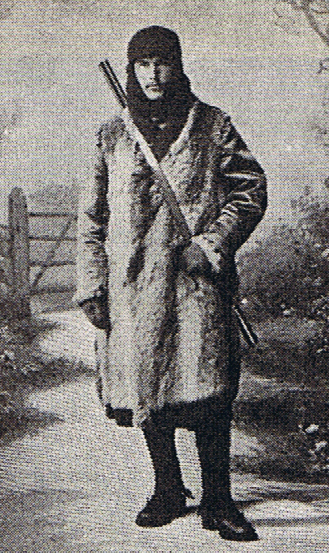
Corsican bandit? Dangerous terrorist? No, but probably an English spy.


This is a photograph of my paternal grandfather, Ralph Patteson Cobbold, who, in 1897/1888, spent a year wandering around Central Asia in the area of the Hindou Kush and Pamir mountains, roughly speaking where Afghanistan, the then Indian part of the British Empire (now Pakistan), China and Russia come together. His declared objective was hunting mountain sheep (ovis poli), ibex, bears and tigers, and he looks more or less equipped for that in the picture above. But most contemporaries were firmly convinced that he was actually sent by the British government to spy on the Russians and their plans in the area.

Here is a satellite picture of the area. They didn't have satellites in those days. Or aeroplanes.


He was actually captured by the Russians at one point but escaped and walked back to Kashmir. As he put it in his book Innermost Asia, published in 1899, "I feel it is time to return as none of my boots have any leather left on their soles, I have lost all of my pack animals and have no money beyond that which I may borrow."

A little big man, he lived to be 94. Here he is dressed for the mountain conditions, which involved sleeping in yurts at minus 27 degrees.


5 Mar 2011

My eleventh bike was a Norton Commando

My 1974 Norton Commando MkIIA

The most attentive and/or bike-crazy readers of this blog may be saying: "hey I've seen this one before, this guy is cheating!". And they would be right for the first part, as I did show it before on this blog, concerning my vows for the year of 2011, which focused on getting this bike, which I used to own and have recently re-purchased, modified a bit.

Here is some information on this project:


The 750 Norton Atlas engine, gradually increased in capacity to 828 cc, is one of the most beautiful of  British bike engines

Although I have recently bought this bike back from the friend to whom I sold it some years ago and who refrained from using it much, I initially owned this machine for a number of years back in the late 1980's and early 1990's.

At that time I had it totally rebuilt (the machine I purchased was in a sorry state and I am no mechanic) by a specialist near Paris called Jean Souper. And he did a fanastic job on it, meticulously rebuilding the engine and matching all the parts so that, unlike most Commandos that came from the factory, this one never leaked any oil! Not being a purist, I had the frame done in grey epoxy and the mudguards painted black. I also had a big tank fitted (from the Interstate model), as this bike was originally the Roadster version with a small tank. I did this because I wanted to ride some distances on the bike, and indeed I took it to Spain (two up) and quite a bit around France. The bike as you see it in these recent photographs is exactly as it was rebuilt back then, just a little worn, but well cared-for as my friend hardly ever rode it. I took pity on the poor thing (the bike, not the friend) and liberated it from his garage, as bikes are made to be ridden, right?


Now, as I explained before, it is currently with Frank Chatokhine, the excellent Norton doctor, to bring it up to date (as far as one can for an almost 40 year-old veteran) with brakes that will actually stop the thing, and one or two other mods. It will reappear in this column in a couple of months  time (hopefully) in its new glory.


4 Mar 2011

A Champagne bar and restaurant in Paris: Point Bulles

The name of this place could be roughly translated as "Check-Point Bubbles", which is a pretty good name. I have tried it twice recently and I must say that it has given me one of the most interesting and convincing Champagne and food matching experiences that I have ever had.

Point Bulles is a small and rather discreet bar/restaurant (the decor is functional rather than inspiring) well situated in one of Paris's best-known shopping areas, on the left bank in the Saint Germain district. In fact it is within the Marché Saint Germain, which is the covered market that lies between the Boulevard Saint Germain and Saint Sulpice church (which must be one of Paris' most ugly monuments, although readers of Dan Brown apparently flock to it: don't ask me why as I have never read any of his books).


The owners of this place form an interesting blend: the sister of a brother-and-sister team who run a family Champagne business called Philippe Gonet; an enterprising Lebanese restaurant owner named Karim Haïdar; and an Italian as a third party. This fusion of different cultural backgrounds has produced a fascinating menu which, Champagne oblige, gives the lion's share to sea-food of various kinds, although there are other things for those who want them, plus a very decent still-wine list for those who do not want to drink Champagne. And, most unusually, all the wines and most of the Champagnes are available by the glass! Of course Chantal Gonet has her own Champagne well to the fore, but not exclusively as the full range of another producer (which changes every month) is always featured by the glass and there are more Champagnes on the bottle list. The Lebanese influence is to be felt in the use of citrus fruit, herbs and spices in several of the dishes. For example, in the photograph below, apart from the superbly fresh no:2 oysters and the sea-urchins (all the sea-food is of top quality), there is a tartare of John Dory prepared with dill, chives and a citrus fruit whose name I cannot remember although it looks suspiciously like lime.


The idea of this meal was to try different matches between the Gonet range of Champagnes and some of the dishes, which are served in small, tapas-style portions most suited to this kind of exercise. I decided to concentrate on sea-food, but all the dishes have been designed to go well with Champagne, which has to be the most accomodating of all wines at table. Gonet is based in the Côte de Blancs sub-region of Champagne, and so their wines are dominated by the Chardonnay grape, even though some wines include Pinot Noir or Pinot Meunier from vineyards in the Marne Valley. All have well-defined flavours and are beautifully dosed to feel light and crisp on the palate. I find it quite boring (or simply frustrating) to read long descriptions of how each combination between a specific wine and a particular dish tasted to somebody during a meal, so I won't go there. Suffice it to say that this is a restaurant to which you can go feeling confident in the quality of the wines and in the fact that the owners have really thought about this question of the suitablity of the food to go with them. In fact it is a main theme here.

I should add that Point Bulles is open 7 days a week from 10am to 2am (most unusual in France), that their busiest days are Saturday and Sunday, when they do a brunch and have a jazz group playing on Sunday, and that their terrace doubles the capacity in the evenings and when the weather is suitable. There is also an adjacent mini-boutique where you can buy bottles to take away. Definitely a place to go if you are in Paris.

Point Bulles
7 Rue Clément
75006 Paris
tel : 33 (0)1 46 33 00 47
contact@pointbulles.com

3 Mar 2011

"Natural" is not necessarily good (2)

You my remember a recent rant I had here about how "natural" wines is a silly term, and a misleading one as well. Here is the link:
http://morethanjustwine.blogspot.com/2011/02/why-term-natural-wine-is-absurd.html

In case you haven't the time to read it, the gist of the article is that since all things in nature are not necessarily "good" (nature is amoral), therefore the assumption that a so-called "natural" wine is going to be better for your health, or the planet, than a less "natural" wine is probably erroneous. And that this kind of simplistic thinking is just another fad to stop people from thinking and that it is high time to use more complex thought processes about our relationship to nature. 

I am increasingly uneasy with regard to the "organic" or "bio" wave that is unfurling throughout developed countries. Of course one has to protect natural ressources and take care that dangerous substances (often hard to define by the way) are not put into food or drink. But what the French call "biological" (ie. organic) agriculture does not seem to me to be necessarily the best solution in every case. In the field of vineyard management, for exemple, most honest farmers involved in this approach freely admit that the carbon footprint left by their activities may well be more negative when going organic than under "conventional" agriculture, simply because they have to treat their vines more frequently (with products authorised under their various organic charters) and thus use much more diesel fuel for their tractors.

But this is just one aspect, as I noticed when reading a recent report published in the American journal called Environmental Health Perspectives, by researchrs from the NIH. This spoke about increased risks of Parkinson's Disease occurring among people who have been expose to two products used on all kinds of crops. One of these is paraquat, a synthetic herbicide; the other one is rotenone, a "natural" pesticide. Rotenone is an extract from various tropical plants and has been in use in organic farming for many years. In France, it was officially withdrawn from the market in 2008, but farmers, including vinegrowers, may continue to use it until April 2011. There seems to be no substitute for rotenone at the moment.

Now I lack the technical expertise to go into any more detail, but it seems to me that this proves my point that one should strongly resist making a necessary connection between organic farming and good health. And I have not yet mentioned the sometimes heavy use of copper sulfate on vines (authorised under organic farming rules) and its bad effects on soil life.

No, what is "natural" is NOT always "good". Step carefully through that jungle!

2 Mar 2011

Work while you sleep


My attention was recently attracted by a short article in a French daily newspaper (Le Monde, edition 27 & 28 February 2011), that spoke of the fact that one's brain continues to work whilst one sleeps. In other words the brain never rests, or at least not completely. Of course we know this from the world of dreams, but this article spoke of the sifting of information from everyday life, allowing the brain to abandon unwanted information, whilst retaining the more important stuff. Now how does the brain know what is "important" and what is not? Maybe its a matter of which brain we are talking about (good excuse to show this beautiful image of 8 brains).


I looked around for more information on this subject, and saw various articles, including some talking about "screen-saver" mode for the brain. I am not too convinced by this particular analogy, but then I do not know any more about computers than I do about the brain (and that ain't a lot folks!). Neuroscientists have found that a resting brain (see at top of page for a picture of a resting brain), awake or not, continues to perform meaningful functions (not quite sure what a "meaningful" function is, but still). In the process of research using 16 participants, Lila Davachi, of New York University, scanned the brains of her subjects using magnetic resonance imaging. Then she showed them images containing pairs of objects and asked them to imagine interactions between them. After a few minutes another scan was made.The test was repeated, with new faces and objects being shown each time. Finally, the participants were given a quiz designed to measure their recollection of the pictures. Comparing the results of the scans before and after the experiment, researchers found a higher level of correlation of brain activity after looking at the images than before. And the more brain activity going on during "rest" after looking at the images, the better a participant performed on the quiz. It would seem that other researchers have found similar results.


The piece of reserach related in the article that I read in Le Monde involved sleep phases for the subjects. The idea, I suppose, was to test that old saying "take a good night's sleep and all will be clear in the morning." Researchers took 26 volonterres, aged between 23 and 27, and showed them a series of words to read, each word being followed either by "to remember" or "to forget". Half the test group slept the night following this, whereas the other half was deprived of sleep. Three days later their memories of the full exercise were tested. The subjects who had slept performed much better that those who had not. The scan performed during the test also revealed that the hippocampus area of the brain (see above) was more active when a word was marked "to remember" than when one was marked "to forget". And this information, it seems, is consolidated by the brain when one is asleep, whereas the person who stays awake tends not to consolidate it.

So one's brains is functioning when one sleeps. In some respects it may even be functioning better when you are asleep than when you are awake. This probably doesn't mean that you should go to sleep at work, but it does mean that you need to sleep in order to be able to work well and retain stuff that you have recently taken in. Does this explain the use of short naps, or siestas? I do not know. It does give me an excuse to show this image (entitled Android at rest) which I also find very beautiful.

This particular piece of research does not tell us either whether men's brains are different from women's, but one can perhaps make assumptions on that issue from personal experience...